Looking for Plagiarism-Free Answers for Your US, UK, Singapore, New Zealand, and Ireland College/University Assignments?
Talk to an Expert| Category | Assignment | Subject | Education |
|---|---|---|---|
| University | Massey University | Module Title | 218.323 Measurement II |
Question 1
The client for Project GONDOR has decided to use a Lump Sum pricing method for the contract. Your company has been selected as one of the bidders for this project. The client requires a detailed SOQ developed (without rates) to the highest industry standards, adhering to ANZSMM 2022, with take-off references for post-contract validation of quantities before agreeing to the rates.
Tasks to be Measured by Your Team
Your manager has instructed your team to measure the following items for Levels 1 and 2 of the IC building and include all Notices for Tenderers (NTT):
Notices for Tenderers (NTT) – 1
The client requires the following:
Question 2
The main contractor of Project Pinnacle has decided to subcontract the Structural steel and use a lump-sum pricing method. Your company is going to BID for this project. Your manager has instructed your team to build BOQ for the following items:
The following are excluded:
– Foundation elements (including holding-down bolts unless specified)
– Temporary works
– Stairs, handrails, and non-structural elements
– Canopies, soffits, and parapets
– Detailed fabrication items such as welds, and hole drilling
Notes:
The client requires the following:
Do you Need Help With 218.323 Measurement II Assessment Portfolio Two?
Chat With Experts NowQuestion 3
The client wants to understand how the contractor calculates their rate so that any further variations can be easily processed, transparently. Each rate should include a detailed breakdown of all resources with a clear rationale for rates and productivity constants, sources of data, and be priced according to ANZSMM 2022, suitable for New Zealand. Therefore, the client wants contractors to provide unit rates as self-performed work for all items related to the following sections
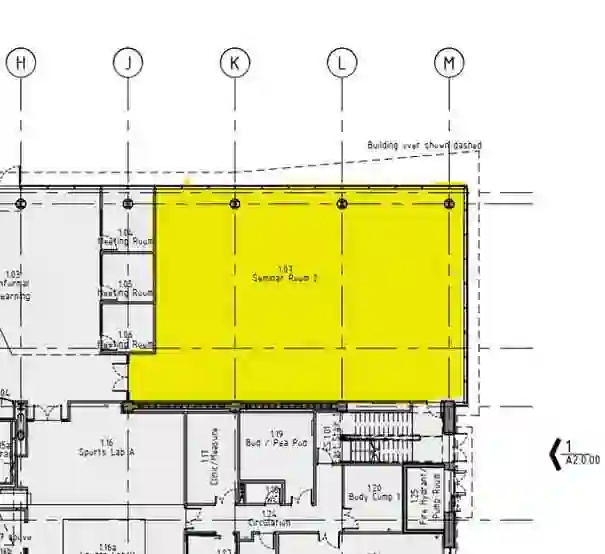
1. IC building – seminar room 2 (1.07) (level 1, grid 1 – 2/, J-M) (refer to the highlighted area) related to the following areas
a. Carpet and Resilient Finishes – Floor finishes
b. Suspended Ceilings
Notices for Tenderers (NTT) – 1 related to (Carpet and Resilient Finishes – Floor finishes and Suspended Ceilings)
2. Installation of a typical structural steel beam (such as beam 1034) between Grid C–D at Level 2, under repetitive working conditions across Zone A (Grid A–M, Grid 1–4), including lifting, positioning, alignment, and bolting for beam-to-column connections
Part 1
Part 2
Part 3
For the whole submission
| Assignment & Marking criteria | Marks |
| ASSIGNMENT 1 | |
| Part 1
Question 1 a. Preparation of BOQ with supportive documentation suitable for industry practice with clear documentation. i. Presentation of each section (3) ii. Coverage of all documentation, including required content (7) b. Correct descriptions and appropriate headings / sub-headings for the measured items including generic & specific preamble notes i. Carpet and Resilient Finishes – Floor finishes – IC building ii. Suspended Ceilings – IC building c. Correct quantities for the measured items, including side-casting, entry of measures, and quantity referencing. The schedule of quantities for the trades is presented in the correct SoQ format. i. Carpet and Resilient Finishes – Floor finishes – IC building ii. Suspended Ceilings – IC building Question 2 d. Correct descriptions and appropriate headings / sub-headings for the measured items including generic & specific preamble notes i. Structural Steel e. Correct quantities for the measured items, including side-casting, entry of measures, and quantity referencing. The schedule of quantities for the trades is presented in the correct SoQ format. i. Structural Steel Part 2 Question 3 1. Resource Breakdown 2. Productivity & Waste Logic 3. Calculation & Logic Part 3 Peer review report · Peer review report with Student name, ID, Work section completed by each student Generative AI use statement. |
15
6 6
9 9 15
25
6
5
4
4
1 |
| GRAND TOTAL | 100 |
Question 1 and 2
| Criteria | Excellent (80-100%) | Good (60-79%) | Satisfactory (40-59%) | Poor (<40%) |
| A. Preparation & Documentation | Professional presentation. All sections present. Supportive docs (query sheets, take-off lists) are perfectly organized. Queries are clear, most assumptions sound. | Logical presentation. Most sections present. Supportive documentation is organized but may have minor omissions. Queries and assumptions are mostly clear. | Basic presentation. Some sections or required documentation are missing. Organization is loose. Queries or assumptions are vague. | Disorganized or incomplete presentation. Missing major sections or supportive documentation. Assumptions are unclear or missing. |
| B. Descriptions & Headings | Precise technical terminology. Headings follow SMM exactly. Descriptions are comprehensive, following SMM and leave no room for ambiguity. All items are properly covered. | Good use of technical terminology. Headings follow SMM with only minor errors. Descriptions are clear with minimal ambiguity. Most items are well covered. | Some technical terms used incorrectly. Headings are inconsistent. Descriptions are vague or missing key details. Some items omitted. | Non-technical or incorrect terminology. Headings do not follow SMM. Descriptions are ambiguous, incomplete, or missing. |
| C. Quantities & Accuracy | Quantities are accurate. Taking-off methods are mostly accurate when applied properly. Calculations are good. All items are properly covered. | Quantities are largely accurate with very minor errors. Taking-off methods are sound. Calculations contain only minor mathematical slips. | Quantities show several inaccuracies. Taking-off methods are inconsistent. Calculations have multiple mathematical errors. | Significant quantity inaccuracies. Taking-off methods are fundamentally flawed. Calculations are mathematically unreliable. |
Question 3
| Criteria | Excellent (80–100%) | Good (60–79%) | Satisfactory (40–59%) | Poor (<40%) |
| Resource Breakdown (LMPO) | Comprehensive breakdown of resources. Clear distinction between each resource. Flawless application of measurement rules from ANZSMM 2018. Includes all items deemed to be included. | Clear distinction between resources. Application of ANZSMM rules is mostly accurate, with only minor omissions of items deemed to be included. | Resources are included, but the coverage is poor and poorly defined. Follows general measurement principles but misses several specific ANZSMM 2022 requirements. | Fails to provide a clear resource split. Significant items are missing. Does not follow ANZSMM measurement units. |
| Productivity & Waste Logic | Realistic NZ productivity constants (man-hours), data sources, waste factors, and calculation logic. Clearly mentions and justifies the rationale for each choice. | Uses realistic NZ constants and waste factors. Provides a rationale for choices, though it may lack specific depth regarding site constraints. | Uses generic constants and waste. Rationale is present but lacks professional justification or specific connection to the context. | Productivity constants are unrealistic or missing. No justification for waste factors. Fails to cite data sources or uses a non-NZ context. |
| Calculation & Logic | Mathematical accuracy throughout. Clear Logical link from the resource build-up to the final unit rate. | Strong logical link from resources to the final rate. Contains 1–2 minor mathematical slips. | Calculations are generally correct, but the logical link between the breakdown and the final unit rate is cluttered or difficult to audit. | Significant mathematical errors. No clear logical link between the resource costs and the final bill rate provided. |
a. Plagiarism: Plagiarism is a very serious offence. DO NOT PLAGIARISE. Read the rules here: https://owll.massey.ac.nz/referencing/plagiarism.php.
b. Late submission: A penalty of 3 marks will be deducted for each calendar day (including weekends and public holidays) or a part of a day an assignment is submitted late after the Stream deadline. Assignments submitted more than seven calendar days after the Stream deadline will not be marked and will get a mark of 0.
c. Extension of time: An extension may only be granted by the course coordinator based on the circumstance.
Get Answer of 218.323 Measurement II Assessment Portfolio Two
Pay & Buy Non Plagiarized AssignmentStruggling with your 218.323 Measurement II Assessment Portfolio Two at Massey University? Get reliable and professional Assignment Help in New Zealand tailored specially for NZ students. We provide complete assignment answers samples and detailed solutions written by subject experts, ensuring they are 100% AI-free and plagiarism-free according to your academy requirements. Our content is carefully researched, properly structured, and delivered on time to help you achieve excellent grades. Trust our expert academic support to submit high-quality work with confidence and meet your assessment standards successfully.

Get Your Free Academic Quote
No hidden fees · Instant response · 100% confidential

Let's Book Your Work with Our Expert and Get High-Quality Content