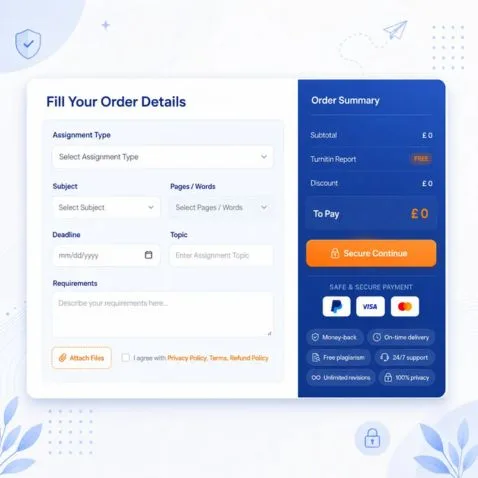
Science assignment help at Workingment connects UK students with subject-qualified writers across Biology, Chemistry, Physics, and Environmental Science. Every assignment is written to your module requirements, with accurate referencing.



Get Your Free Academic Quote
No hidden fees · Instant response · 100% confidential
There are several other platforms are available who provide Science Assignment but when it comes to trust Workingment is a renowned brand. Here are some of the reasons:

Workingment is home to some of the best science assignment writers in the UK Most of the academic writers on our team have completed their master’s degrees and PhDs.

The days of missing deadlines are over. Get Science homework help online so you can submit all your papers on time - every time.

Get A+ solutions delivered by top postgraduates. Our experts have the capability to complete all science assignments, no matter how difficult.

Our primary aim is to ensure 100% satisfaction with our science assignment help services. If we fail to do so, you can request a free revision.

Our unwavering focus is on YOU. Whether it's providing instant responses, sharing work details, or offering continuous support – we are dedicated to delivering excellence every time.

For better understanding, you can ask our writers to provide well-written science assignment for free reference.
Qualified science assignment writers ready to help you

Life Sciences & Biology Expert
Dr. Olivia Bennett earned her PhD in Biomedical Sciences from the University of Bristol and an MSc in Biotechnology from the University of Glasgow. Dr. Bennett also supports healthcare dissertations and is well-versed in scientific report writing, literature reviews, and research methodology.
Hire Writer
Work with the UK's best science problem solvers at the lowest rates ever.
Order Now Physics
Space science
Computer science
Earth science
Chemistry
Physics
Space science
Computer science
Earth science
Chemistry
Workingment's science assignment help covers four core subjects, each explained below with its main sub-topics. A number of narrower specialisms sit alongside these for more advanced or applied briefs.
Biology assignment help covers cell biology, genetics, human biology and ecology, from A-level coursework to undergraduate dissertations. Writers work directly from your module brief and reading list, whether that's a cell biology lab report, an ecology field study or a human biology case study.
Chemistry assignment help covers organic, inorganic, physical and analytical chemistry, from practical lab reports to reaction mechanism and titration problem sets. Writers show full working for every calculation, with correct significant figures, units and balanced equations throughout.
Physics assignment help covers mechanics, thermodynamics, electromagnetism and quantum physics, across problem sets, practical write-ups and theory-based essays. Writers show full working for every calculation, not just the final answer, since UK marking schemes award method marks for the working shown.
Environmental science assignment help covers ecology, climate science, sustainability and conservation, including fieldwork reports, case studies and data-based assignments. Writers interpret datasets, reference current research and apply UK and international environmental frameworks and legislation where your module requires it.
For more specialised or postgraduate-level briefs, Workingment also covers biochemistry, microbiology, biotechnology, genetics, physiology and zoology assignment help. If your topic sits outside these six areas, contact the team directly to confirm writer availability before you order.
Dr Olivia Bennett holds a PhD in Biomedical Sciences from the University of Bristol, reviews the science content on this page and confirms it reflects current UK marking conventions across biology, chemistry, physics and environmental science.
The five areas below set out exactly how that accuracy is checked and maintained before an assignment reaches you.
Every science assignment is matched to a writer with a background in that subject, not a single generalist pool covering all four sciences.
Writers hold a master's or PhD degree in the relevant subject, checked before they take on assignment work, so the writer assigned to your brief has genuine subject knowledge, not just general academic writing experience.
Referencing style depends on your specific department, not a single house style applied everywhere. Harvard referencing covers most life and environmental science modules, Vancouver is standard for medically adjacent topics, and physics or engineering-linked assignments often require IEEE or APA instead.
Writers apply the system your module handbook specifies, with in-text citations matched exactly to the reference list.
Every assignment is written from scratch against your specific brief, not recycled from a template or a previous student's work. Before delivery, each piece is checked with Turnitin.
This matters beyond the plagiarism-free promise itself: universities increasingly run their own AI-detection checks on submitted work, so a check on this end reduces that risk before you ever submit.
Assignments are structured around what UK marking criteria actually reward: clear argument structure, correctly applied method, and referencing accuracy, not just word count or general fluency.
Where you can share your specific module's assessment rubric or marking grid, writers work directly from it, so the final structure matches the categories your marker is actually scoring against.
Before delivery, the second reviewer checks the assignment against your original brief for factual accuracy, correct units, consistent referencing and adherence to your word count.
This exists because errors are easier to catch on a second, focused read than during the writing process itself, when a writer's attention is on getting the content down rather than checking it.
Workingment covers seven assignment formats across all four science subjects. Each format has its own structural convention, and markers notice immediately when a student has used the wrong one.
A lab report follows a fixed structure: Introduction, Method, Results, Discussion, known as IMRaD. Markers check each section separately, so a strong results section with a weak discussion still loses marks.
The discussion is where you explain what your results mean, not repeat them, and where you compare findings against expected theoretical values, not just state whether the experiment "worked."
A well-structured numerical answer states the given information and any assumptions, names the formula or method being used, shows each step of the calculation, and finishes with a final answer in the correct units and significant figures.
Skipping straight to a final number, even a correct one, forfeits the method marks that most UK marking schemes allocate for demonstrated working.
A case study assignment gives you a real or simulated dataset, clinical scenario or environmental reading and asks you to draw evidence-based conclusions from it, not simply describe it.
Strong answers state clearly what the data does and doesn't support, name any confounding variables or limitations in how it was collected, and avoid claiming certainty the evidence doesn't actually warrant.
A literature review is not a list of source summaries strung together. It groups sources by theme or by chronology, and shows clearly where studies agree, disagree, or leave a genuine gap your assignment can address.
If your module asks for a systematic review, the search strategy needs documenting, and many departments now expect it to follow PRISMA reporting standards.
Science coursework essays are argument-led, not descriptive. A workable structure states a clear position in the introduction, builds each paragraph around a point supported by evidence and an explanation of what that evidence shows, known as PEEL, and closes by weighing the strongest opposing evidence rather than ignoring it. This differs from a lab report, where the format is fixed and argument plays no part.
A research proposal sets out a research question, a justified method, a sampling approach and, for most primary research, a section on ethical considerations.
Before you can collect data from people, animals or protected sites, your university's ethics committee usually has to approve the proposal first, often weeks before fieldwork or testing can begin. A dissertation is a much longer, chaptered version of the same requirements.
A scientific poster is read from a distance before anyone reads a word of it. Titles need to be legible from across a room, results are shown as a graph or diagram rather than a paragraph of text, and the main finding has to register within the few seconds someone spends glancing at it. Presentation slides follow the same principle: minimal text, with the spoken explanation carrying the detail.
Science assignments call for technical precision and formal academic writing at the same time, yet most undergraduate courses prepare students for one without addressing the other. Students who seek help with science assignments tend to face the same barriers, all of which are specific and avoidable.
The IMRAD format (Introduction, Methods, Results, Discussion) is standard across UK science programmes, but universities do not mark it as a single piece of work. Each section is assessed against distinct criteria.
Results sections must present processed data with correct SI units and appropriate significant figures. Discussion sections must critically evaluate findings, not simply restate them.
Students who describe what they observed rather than interpret what it means routinely lose marks across multiple sections at once.
Running a t-test or calculating standard deviation is one thing. Writing those results up in formal scientific language, interpreting what the numbers show, and noting their limitations is a skill most students are never formally taught. That gap compounds every assessed practical.
UK module handbooks routinely separate "describe," "analyse," and "critically evaluate" as distinct performance bands, aligned to the national Framework for Higher Education Qualifications.
A report that presents data accurately but does not evaluate its limitations or implications will rarely reach a 2:1, regardless of whether the science itself is correct.
Students seeking help with science assignment submissions often discover only through feedback that they were addressing the wrong intellectual question entirely.
If you're searching for academic help , here are some top-quality academic services available to you:
What Do Our Writing Experts Offer?
Get access to our premium assignment solutions to get academic success whether it's a report, dissertation, report, ppt, case study, and essay. Our Writers are always ready to help you.
Book qualified writers to guarantee an A+ in academic papers.

Hey everyone! It's Charlie Here, I just wanted to share useful information about the assignment help service of Workingment. Indeed, I adopted it for my final year subject and it was a game-changer. Because of the great details that they provided, I achieved 70 marks out of 100 in my final year assignment project. It was great to have their support, they were very experienced and provided quality work.
Hey folks, Raheem here! I completed my Environment and Health course, all thanks to Workingment who is doing an exemplary job in the assignment section. As time went by, I was having a really tough time but their assistance was excellent. I must say that I didn’t have much expectations for this exam, but I was able to score 60 marks and I can only imagine how much better I could have done if I had paid more attention. I would like to suggest Workingment for assignment help.
Hey everyone, it's Mia! ended my course recently with an A+ Grade, and I can’t fail to give a shoutout for this magnanimous service from Workingment. I was really struggling a lot with my course however, with their assistance I was able to keep up and get a 80 percent score. They were incredibly friendly, and they made everything very clear and understandable, even when I had numerous questions.
Hey folks, it's Amelia! Hi, I hope everyone had a great week. I have just completed my Contemporary Marketing course and had a good experience today using Workingment’s assignment help service. It was really annoying that I felt ill but with their help, I passed by somehow with a 65% score. They always made me understand everything that was tough and did not mind helping whenever I asked. I would highly recommend their service.
I wish I could have contact with such an excellent team then I could have passed in my last assignment without fail. However, I feel it is not too late to connect with such a team who provide this type of excellent academic support. I received the result today of the last assignment that I submitted. I got 76 out of 100 which was beyond my expectation. Your service is really recommended to other students.
It was a great achievement for me to complete my research work on time and it was only possible for your excellent support. I would like to thank all the experts who contributed to producing excellent research work. I have received excellent guidance from your team and the insightful feedback that I have received helped me in improving. I really appreciate your service.
I am writing this to highlight before the readers that this organization really provides excellent dissertation help with the knowledgeable experts. I took services for the dissertation help which was highly beneficial for me. I am very happy to declare that I am fully satisfied with your dissertation help. Just try it and find excellent results.
I was anxious about doing my coursework, however excellent support that I received from your team is highly appreciable. You guys are extremely knowledgeable, and I really appreciate your all-encompassing support. I appreciate your help.
Hello, I received my results today and I'm delighted to share with you all that I received 71 out of 100 on my failing file, which was completed by you guys. I really appreciate it. Thanks again for your excellent support. This is the second time I am using your services. I already recommended your excellent services. I will definitely recommend others again.
My friend recommended their help and I am very happy to say I never expected a higher grade in the very first assignment where I took help from them. I would recommend others who are struggling to tackle challenging topics and looking for higher grades.
Hello guys. The topic that I assigned them seemed to be highly complicated however I got exceptional guidance from their exports and did my assignment excellently. They have knowledgeable exports and their application of knowledge in doing the course work is excellent.
I can say that the assignment help services which are delivered by you guys are really amazing. Highly appreciable. I really found my lacking when I compared my previous coursework that I personally did with your work. It was a good learning experience for me. Thanks.
You guys are really knowledgeable and your comprehensive support is really appreciable. Thanks for your support. Yesterday I got the results of my final assignment. I got 81 out of 100 in the HRM assignment. Thank you.
It was an invaluable service and I am glad to reveal that the assignment help that I received made a big difference. There is no doubt that your experts really work hard to deliver excellent service. I especially want to thank the experts who did my economics assignment. It really helped me in improving my grades.

We cover biology, chemistry, physics, biochemistry, microbiology, environmental science, neuroscience, geology, and related interdisciplinary subjects. If you are unsure whether your module falls within scope, submit your brief and we will confirm before you place an order.
Yes. Lab reports are one of the most commonly requested assignment types we receive. We write to the IMRAD format and address each section against the marking criteria in your brief, covering Introduction, Methods, Results, and Discussion in full.
Writers use the referencing style specified in your brief. Chemistry work typically follows RSC format; some UK departments also accept ACS. Biology and medicine require Harvard or Vancouver. Share your module handbook if your department uses a local variant and the writer will follow it exactly.
Yes, depending on availability and word count. We accept orders with 24-hour deadlines, though shorter turnarounds reduce the pool of available writers. Submit your brief as early as possible and we will confirm whether we can meet your date.
Every piece is written from scratch and checked for plagiarism before delivery. We also run AI detection checks prior to sending your work. No content is recycled or generated from templates.
Price is determined by your academic level, word count, deadline, and subject complexity. There is no fixed rate that applies to every order, but the starting price is €9/ page. Use our order form to enter your details and receive a confirmed quote before committing.
Request a revision and we will update the work at no extra charge. Revisions must relate to the original brief. If the scope changes significantly, that will be treated as a new order.
Let's Book Your Work with Our Expert and Get High-Quality Content