Looking for Plagiarism-Free Answers for Your US, UK, Singapore, New Zealand, and Ireland College/University Assignments?
Talk to an Expert| Category | Assignment | Subject | Education |
|---|---|---|---|
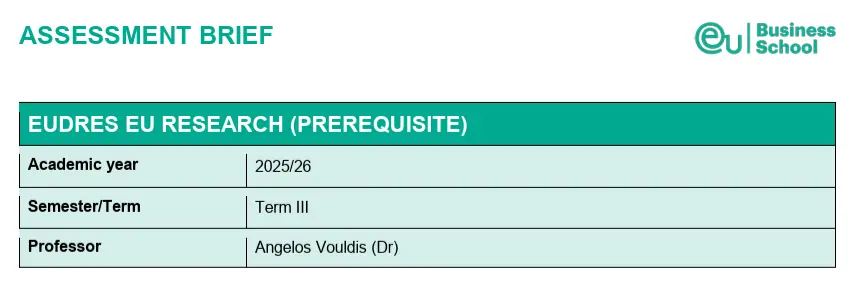
| University | EU Business School | Module Title | EUDRES EU Research (Prerequisite) |
|
MINOR ASSESSMENTS |
|
|
Task 1.1: Proposed Dissertation Title and Preliminary Research Question Assessment type: Forum Due: 8 May 14:00 CEST |
Description: Propose a potential dissertation title and articulate a preliminary research question. Consider your research interests, academic discipline, and gaps in the existing literature. This task should demonstrate clarity of focus and the potential scope of your research. |
|
Weight: 5% |
≈100 words |
|
Task 1.2: Draft Research Aim and Objectives Assessment type: Forum Due: 22 May 14:00 CEST Weight: 5% |
Description: Develop a draft research aim and five objectives for your potential dissertation. Ensure that your aim clearly states the purpose of your research, and that each objective is specific, measurable, achievable, relevant, and time-bound (SMART). |
|
|
≈200 words |
|
Task 1.3: Draft Literature Review Structure and Key Themes Assessment type: Forum Due: 5 Jun. 14:00 CEST Weight: 5% |
Description: Create a draft table of contents for the literature review section of your potential dissertation. Include the main themes, subtopics, and key authors or theories you plan to cover. The structure should reflect a coherent, critical approach to synthesizing existing scholarship. |
|
|
≈250 words |
|
Task 1.4: Draft Research Proposal Outline Assessment type: Forum Due: 19 Jun. 14:00 CEST Weight: 5% |
Description: Develop a draft table of contents for your research proposal, outlining the main sections and key points to be addressed. Include elements such as research question, methodology, literature review, ethical considerations, and expected outcomes. This should demonstrate a clear, structured plan for your proposed study. |
|
|
≈300 words |
|
FINAL ASSESSMENT |
|
|
Task 1.5: Research Proposal for Dissertation Development Assessment type: Written assignment |
Description: Develop a comprehensive research proposal that demonstrates critical engagement with the literature, formulates a research question or hypothesis, and outlines a robust methodology for your dissertation study. |
You are required to design a research proposal that demonstrates critical understanding, originality, and scholarly rigor. While this is a prerequisite course, the assignment is intended to prepare you for postgraduate research by developing skills in critical analysis, synthesis of literature, and research planning.
Your submission must meet the following formatting requirements:
All refencing and citations require Harvard referencing style. Students must avoid plagiarism and use the Harvard Referencing Guide and Turnitin to ensure that their sources are correctly cited. Plagiarism includes the use of artificial intelligence tools, such as ChatGPT and Grammarly, when output is copied and pasted from these sites. Students should also note that submitting the same work for multiple assessments is considered an academic offence and may result in disciplinary action. For further guidance, please refer to the Academic Policies and Procedures
Manual and the Student Good Practice Manual in AI Literacy available on the Student Services page for further details.
|
Forum |
Fail 0-59% |
Borderline fail 60-69% |
Fair 70-79% |
Good 80-89% |
Exceptional 90-100% |
|
Posts demonstrate inadequate understanding of content and research, with frequent inaccuracies and poor use of concepts. Connections to course material or peers’ contributions are absent or irrelevant. Engagement is negligible. Posts are late or missing, undermining discussion. Professional conventions, including tone, clarity, and respect, are frequently disregarded. |
Posts reflect partial understanding, with limited or inconsistent application of advanced concepts and research. Connections to course materials or peers’ posts are weak and superficial. Engagement is minimal, often limited to brief agreement or repetition. Posts are mostly on time but rarely stimulate discussion. Professional conventions are inconsistently applied, with occasional lapses in clarity, tone, or academic style. |
Posts show competent understanding of advanced content, generally applying concepts and research appropriately, though with occasional inaccuracies or limited critical insight. Connections to course materials and peers’ posts are clear and contribute meaningfully to discussion, though not consistently. Engagement with peers is constructive, usually through elaboration or clarification. Posts are timely and support peer interaction. Professional conventions are observed, with clear, respectful, and appropriate academic tone. |
Posts demonstrate strong, well-developed understanding of advanced content and research, using concepts and terminology accurately and effectively. Ideas connect clearly to course materials, research, and professional practice, providing relevant examples and some critical insight. Engagement with peers is meaningful, often prompting reflection, questions, or elaboration that extend discussion. Posts are consistently timely, contributing to an active, collaborative forum. Professional conventions are consistently observed, with clear, polished, and respectful communication. |
Posts demonstrate exceptional mastery, critical insight, and originality, with precise, sophisticated, and nuanced use of concepts, research, and terminology. Contributions make strong, insightful links to course materials, scholarly literature, and professional practice. Engagement with peers is proactive and influential, prompting substantial discussion, critical reflection, and new perspectives. Posts are timely and sustain a rich, high-level forum dialogue. Professional conventions are exemplary, with polished, articulate, and highly professional communication throughout. |
|
Written Assignment |
Fail 0-59% |
Borderline fail 60-69% |
Fair 70-79% |
Good 80-89% |
Exceptional 90-100% |
|
Purpose, Understanding & Content
25% |
Work lacks a clear or appropriate focus. Demonstrates minimal understanding of key concepts or frameworks. Content is largely irrelevant, incoherent, or inaccurate. No evidence of higher-level analysis or synthesis. |
There is an attempt to address the topic, but the purpose is unclear, inconsistent, or weakly aligned with task expectations. Understanding is superficial, with gaps in logic or accuracy. Analytical engagement is limited. |
Demonstrates appropriate understanding of complex material. The purpose is mostly clear, and content is relevant, though arguments may be underdeveloped or overly descriptive in places. Some engagement with theoretical or contextual complexity is evident. |
Purpose is well-defined and consistently maintained. Content reflects a solid grasp of advanced concepts and issues. Demonstrates independent engagement with complex material, supported by well-structured arguments and relevant evidence. |
Purpose is sharply defined and pursued with intellectual clarity. Content shows mastery of complex and/or abstract concepts. Integrates theory and practice with confidence, offering original insight and critical evaluation throughout. |
|
Organisation & Coherence |
The work lacks organisation, coherence, and structure. Arguments are fragmented or |
Basic structure is attempted, but coherence and flow are weak. Transitions are unclear or mechanical. The organisation |
Structure is generally logical and supports comprehension. Some sections may lack clarity or |
Well-structured and logically organised. Each section contributes meaningfully to the overall purpose. Transitions |
Structure is sophisticated and enhances argument and clarity. Logical progression is seamless, supporting a complex, nuanced |
|
20% |
absent. Paragraphs do not support a logical flow of ideas. |
does not fully support the argument or line of reasoning. |
depth. Transitions are functional, though occasionally awkward. |
guide the reader clearly through the work. |
argument. Demonstrates excellent control of pacing and signposting. |
|
Communication & Expression 15% |
Language is unclear or ungrammatical. Communication is ineffective, with little attention to academic tone or appropriate structure. Oral or written presentation is disjointed or confusing. |
Communication is inconsistent or lacks fluency. Tone may be uneven or inappropriate for a postgraduate audience. Errors in style, grammar, or referencing detract from clarity. |
Language is generally accurate and appropriate for an academic context. Communication is mostly clear, with some minor lapses. Academic tone is evident but not fully consistent. |
Clear, precise, and appropriate academic expression. Demonstrates fluency and control. Grammar and style are well-managed. Oral or written communication is confident and authoritative. |
Articulate, fluent, and sophisticated communication. Demonstrates complete command of academic language and tone. Expression is precise, polished, and compelling throughout. |
|
Authenticity, Critical Thinking & Integration 20% |
No meaningful critical engagement. Work is descriptive, derivative, or incoherent. No original perspective or analytical development is evident. |
Limited attempt at analysis or evaluation. Arguments are shallow or repetitive. Critical insight is minimal and lacks independence. |
Shows emerging critical awareness. Some original thought is present, and basic evaluation is attempted. Integration of perspectives may lack depth or balance. |
Work is analytical and reflective, with critical perspectives applied effectively. Demonstrates independent judgement and integration of ideas from a range of sources or frameworks. |
Demonstrates exceptional critical engagement, originality, and intellectual autonomy. Synthesises ideas with sophistication across theoretical and practical contexts. Insightful, persuasive, and innovative in argumentation. |
|
Use of Sources & Referencing 20% |
Sources are insufficient, inappropriate, or incorrectly cited. Plagiarism or significant issues with academic integrity may be present. |
Some use of sources, but they may be weak, outdated, or poorly integrated. Referencing is inconsistent or error prone. Academic conventions are not well followed. |
Adequate use of academic sources. Citation style is mostly accurate, with minor inconsistencies. Some engagement with source material is evident but may be under-analysed. |
Well-chosen, high-quality academic sources. Referencing is accurate and consistent. Shows analytical use of literature and appropriate integration into arguments. |
Outstanding use of diverse, authoritative sources. Demonstrates deep engagement with literature through critical evaluation and synthesis. Referencing is flawless, with exemplary academic integrity. |
Struggling With Your EUDRES EU Research (Prerequisite) Assessment? Deadlines Are Near?
Hire Assignment Helper Now!Struggling with EUDRES EU Research (Prerequisite) Assessment at EU Business School? Get expert Assignment Help Australia tailored to boost your grades and understanding. Our Assignment Help provides well-researched, plagiarism-free solutions designed as per university guidelines. Access a Free List of Assignment Samples Answers to see high-quality work before you order. Whether it’s essays, case studies, or reports, our professionals ensure timely delivery and top-notch content that helps your assignment rank higher and stand out. Join thousands of students who trust our services to excel academically and achieve success in their studies with confidence and ease.

Get Your Free Academic Quote
No hidden fees · Instant response · 100% confidential

Let's Book Your Work with Our Expert and Get High-Quality Content