Looking for Plagiarism-Free Answers for Your US, UK, Singapore, New Zealand, and Ireland College/University Assignments?
Talk to an Expert| Category | Assignment | Subject | Business |
|---|---|---|---|
| University | York St John University (YSJU) | Module Title | YBR7004M Contemporary Theories and Philosophies in Business |
| Module code: | YBR7004M-SEM2 | Level of Study: | 7 |
| Assessment format: | Online Portfolio (PebblePad) | Method of submission: | PebblePad (ATLAS) |
| Deadline or Assessment Period: | 8 June 2026, 12:00 noon BST | Feedback date and place: | 30 June 2026 |
| Assessment limits: length, load, word count, etc. | Equivalent to 5,000 words | Component number: | 1 of 1 |
| Is this exempt from anonymous marking under the policy? | Yes | Component weighting: | 100% |
|
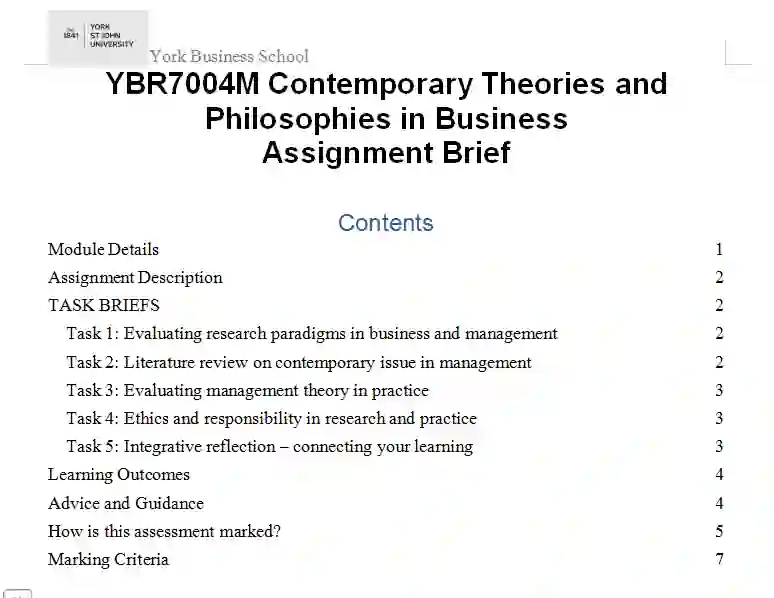
This is an individual assignment; you must develop a PebblePad portfolio of evidence and materials corresponding to the tasks listed below. This module focuses on developing your understanding of research, with an emphasis on qualitative research approaches in business and management. The portfolio is made up of five tasks, each linked to key learning outcomes. Please read through these task briefings and the Advice and Guidance section later in this Assignment Brief document. Please note: Tasks 1 to 4 are written pieces, around 1,000 words each, while Task 5 is a is a video presentation. TASK BRIEFSBelow is an overview of each task, including Learning Outcome mapping to show how each task supports your learning and development. Task 1: Evaluating research paradigms in business and management(around 1,000 words) 1. Select two good quality academic papers from different research paradigms (e.g., positivist vs. interpretivist) discussed in workshops. 2. Produce a comparative evaluation of the papers’ research paradigm and philosophical underpinnings, specifically how the authors articulate the implications for their research. 3. Evidence your understanding how different paradigms shape inquiry and interpretation. Supports the following learning outcomes through: LO 7.1: Demonstrating understanding of how qualitative research philosophies influence design and analysis. LO 7.6: Developing academic writing and critical thinking skills through structured reflection. Task 2: Literature review on contemporary issue in management(around 1,000 words) 1. Choose 3 to 4 good quality academic papers relating to one contemporary business issue (e.g., sustainability, digitalisation, diversity). 2. Produce your own thematic reflection that synthesises key arguments, identifies tensions or contradictions, and considers implications for practice. 3. Evidence critical engagement with current debates and societal relevance. Supports the following learning outcomes through: LO 7.1: Deepening your understanding of how qualitative methods are used to explore real-world challenges. LO 7.4: Considering how academic research connects to wider societal and professional contexts. LO 7.6: Practising synthesising ideas and presenting arguments clearly. Task 3: Evaluating management theory in practice(around 1,000 words) 1. Select one management theory (e.g., stakeholder theory, institutional theory) and evaluate how it is applied in two case studies or empirical papers. 2. Produce a critical analysis of how theory informs practice, including strengths, limitations, and contextual factors. 3. Evidence your ability to bridge theory and real-world application. Supports the following learning outcomes through: LO 7.1: Evaluating how theory informs qualitative research and practice. LO 7.4: Reflecting on how theory contributes to knowledge and can be applied outside academia. LO 7.6: Building skills in critical analysis and academic writing. Task 4: Ethics and responsibility in research and practice(around 1,000 words) 1. Engage with two readings, papers or case studies, on ethical dilemmas or responsible business practices. 2. Produce a reflective commentary on ethical considerations, including how values, cultural attitudes, and societal expectations shape ethical decision-making. 3. Evidence your ethical awareness and critical judgement. Supports the following learning outcomes through: LO 7.1: Examining how ethical considerations shape qualitative research and practice. LO 7.4: Reflecting on the societal impact of ethical decision-making. LO 7.6: Developing your ability to present thoughtful, well-structured reflections. Task 5: Integrative reflection – connecting your learning(6-minute video presentation, equivalent of 1,000 words) Reflect on what you’ve learned across the module and how your understanding of qualitative research, theory, and ethics has developed. Share through a short video presentation, using slides with text and images to support your reflections. 1. Revisit your previous tasks and readings. 2. Produce a final integrative audio-visual reflection that draws connections across paradigms, theories, and ethical debates, and considers how their understanding of business and management has evolved – this must be embedded in your portfolio in video format with audio narrative throughout. 3. Evidence synthesis of learning and personal academic development. Supports the following learning outcomes through: LO 7.1: Demonstrating a holistic understanding of qualitative approaches and their implications. LO 7.2: Beginning the process of articulating how you might apply qualitative enquiry in future research. LO 7.3: Reflecting on how methodologies and methods relate to your academic interests. LO 7.4: Considering how your learning can be applied in academic and professional contexts. LO 7.6: Showcasing your ability to reflect critically and communicate effectively. |
GENERAL GUIDANCE
GENERATIVE AI: TIER 1 - GENERATIVE AI USE PROHIBITEDThe use of Generative AI tools is not permitted in this assessment. You must complete all parts of the work independently. This includes:
This assessment assesses your individual understanding, critical thinking, and ability to express your knowledge in your own words. AI use would compromise these learning outcomes. Academic IntegrityUse of AI tools for any part of this assessment may constitute academic misconduct. This includes using AI to paraphrase or generate content. Any unauthorised use may be subject to investigation under the University’s Code of Practice for Assessment Policy. RESEARCH ETHICSYou are not expected or permitted to collect any data for this module. Students must not conduct any primary research without formal ethical approval from the University. If you need further clarification, please speak to your module leader, Dr Steven Hirschler s.hirschler@yorksj.ac.uk. |
|
Your work will be marked according to the assessment instructions provided within this document and the selected Learning Outcomes’ (LOs) (see above). Furthermore, this assessment is marked using the assessment marking criteria or a similar rubric that aligns with the University’s Generic Assessment Descriptors (see below). This is to ensure all assessment decisions are comparable regardless of the discipline or mode of assessment. Please note that you must meet the required baseline standards (50 – 59%) which will include the LOs and minimum expectations of the assessment. Further still, you must ensure you meet the requirements of each grade boundary to progress to the next, i.e., you should demonstrate your learning through the standards of the Pass, Merit and Distinction to reach a Distinction (70 – 84%). These standards are designed to scaffold and build your learning to achieve your fullest potential in each criterion being assessed. |
Pass Grade Bands (100 – 50) (Learning Outcomes must be met)
Fail Grade Bands (49 – 0) (Learning Outcomes are not met)
|
General Characteristics |
Pass (50, 52, 55, 58) |
Merit (62, 65, 68) |
Distinction (72,75, 78, 82) |
Distinction (85, 88, 92, 95, 98, 100) |
Borderline Fail (45, 48) (Credits may be compensated) |
Fail (32, 35, 38, 42) (Credits may not be compensated) |
Fail (0, 2, 5, 8, 12, 15, 18, 22, 25, 28) (Credits may not be compensated) |
|
Adjectives |
Satisfactory |
Good |
Excellent |
Exemplary |
Not Successful |
Unsuccessful |
Fail |
|
Thinking skills |
The work has attempted to apply advanced thinking skills methodically to material from the taught content (core and additional) and to present an evidence-led understanding of the topic. |
The work has systematically applied advanced critical thinking skills to the (taught and independently researched) material. It has identified problems with, or asked questions about, the source material and proposed appropriate approaches to resolve these. |
The work has successfully offered and evidenced new insights into problems or areas of development which are central to research in this discipline. |
The work has created new insights or proposed new hypotheses (where appropriate) in response to problems or areas of development which are at the forefront of research in this discipline. It shows a professional awareness and application of the thinking skills used to process this knowledge. |
The work may have applied some thinking skills to part of the existing knowledge from the taught content but not enough of these are advanced thinking skills. More of the core content needs to be addressed or applied in this work. |
The work has applied a few thinking skills to the materials from the core content but none of these are advanced thinking skills. Most of the core content has not been addressed or applied. The work is limited by some misunderstandings, misapplications, or gaps in key areas of knowledge from the taught content. |
The work |
|
Research skills |
The work has attempted to apply appropriate research methods from the taught content correctly. It has attempted to solve problems and answer research questions which have been encountered in directed and independent studies. |
The work has successfully utilised research methods from the taught content and independent studies. It has carefully selected and applied these research methods to generate data and / or insights to solve complex problems or answer bespoke research questions. |
The work is supported by an appropriate / systematic / thoughtful methodological approach and design. The work demonstrates a strong competency and in-depth understanding of the purpose and function of its research methods. |
The work has successfully developed new knowledge by using research tools, research design and methodology effectively. It clearly articulates the researcher’s position. The design and rigour of the planning and implementation of the research adheres to the professional standards of the field / discipline / industry. |
The work may have partially applied some of the research methods from the taught content to existing knowledge. It does not yet use these skills and methods to solve problems and / or answer research questions. The work needs to include a more coherent account of how these skills and methods are relevant or applicable to the research topic. |
The work does not apply the required research methods to existing knowledge. These skills and methods are not used to solve problems and / or answer research questions. The work does not articulate how these skills and methods are relevant or applicable to the research topic. There may be some misunderstandings and misapplications. |
The work does not address the required research methods |
|
Practical skills |
The work has attempted to apply the taught techniques in a way which adheres to relevant professional, ethical and / or legal frameworks (including health and safety). It has explained, critiqued and / or adapted established disciplinary practices and / or practical skills where this is relevant. It has demonstrated proactivity in tackling and / or solving problems, planning, and implementing tasks at a professional (or equivalent) level. |
The work has successfully applied a range of taught and self-taught techniques in a way which adheres to relevant professional, ethical and / or legal frameworks (including health and safety). These have been integrated to form a system of professional practice. |
The work has effectively selected and synergised a range of appropriate skills into a system of practice in a way which adheres to disciplinary / professional / industry / commercial standards. It has applied these techniques in |
The work has systematically, consistently and / or creatively applied professional / disciplinary skills, in a way which adheres to relevant professional, ethical and / or legal frameworks (including health and safety). It applies these skills as part of a system of practice which would be considered exemplary by disciplinary / professional / industry / commercial colleagues. |
The work may have applied some of the core taught techniques but does not fully explain, critique and / or adapt established disciplinary practices / practical skills in a way which adheres to relevant frameworks / guidelines. There is some evidence of proactivity in problem-solving and / or planning and implementing tasks at a professional or equivalent level but more is needed |
The work applies few of the core taught techniques. It does not clearly explain, critique and /or adapt established disciplinary practices / practical skills in a way which adheres to relevant frameworks / guidelines. There is no clear evidence of proactivity in problem-solving and / or planning and implementing tasks at a professional or equivalent level. |
The work does not reference or apply any taught techniques. It does not explain, critique, or adapt established disciplinary practices / practical skills. There is little or no evidence of proactivity in problem-solving and / or planning and implementing tasks at a professional or equivalent level. There is little or no evidence of practising in a way which adheres to relevant frameworks / guidelines. |
|
Communication |
The work is largely clear, coherent and communicates appropriately to an audience. It is aware of relevant technologies and uses an appropriate writing or presentation style |
The work communicates using technically proficient language appropriate to the medium and its intended audience. It shows an appreciation of relevant technologies. |
The work communicates persuasively. It engages with relevant technologies and communicates complex ideas in ways that are accessible to specialist and non-specialist audiences. |
The work communicates with a structure which flows logically. It successfully communicates complex ideas in ways that would be understandable to a range of specialist and non-specialist audiences. The work engages ethically with relevant technologies and uses them in a socially responsible way. |
The mode of communication in this work is comprehensible to some extent and there may be some areas of focus (topic / conclusions / intended audience). The work’s language may show some technical proficiency and partially apply an appropriate writing or presentation style but there are gaps, mistakes, or inconsistencies. |
The work’s clarity and focus are limited. The language used is not consistent in its coherence or technical proficiency and the work |
The work has little or no clarity or focus and does not attempt to communicate to an audience. The language used is not clear or technically proficient. Little or no attempt has been made to apply an appropriate writing or presentation style. |
|
Creativity |
The work attempts to adapt / combine / transform existing knowledge /concepts to a sufficient extent that it is distinct from these inspirations. |
The work is new and valuable by being functional, thought-provoking, and /or informative to an intended audience. |
The work and its creative idea / approach is new, surprising, and valuable to a clearly identified audience. It operates at a level of creativity comparable to industry / professional expectations. |
The creative idea and style inform (and are integrated consistently into) the work. It is new, valuable, and surprising to an identifiable and well-defined audience and it exceeds this audience’s expectations. It operates as a leading example in the field / discipline / industry. |
The work may demonstrate some originality (being new, valuable, or surprising) by adapting / combining / transforming some existing knowledge/ concepts. It partially explains its value or engages an audience, but it needs to distinguish itself from existing knowledge / concepts more clearly. |
The work has evidences limited originality (newness, value, surprisingness). It shows few adaptations / combinations / transformations of existing knowledge / concepts to explain its purpose or function or to engage an identified audience. It has mostly replicated existing knowledge / concepts. |
This work evidences little or no originality (newness, value, surpris |
Working on YBR7004M Contemporary Theories and Philosophies in Business (Component 1, equivalent to 5,000 words) at York St John University (YSJU)? Get expert academic support designed to help you tackle complex business theories, critical analysis, and philosophical perspectives with confidence. Our experienced writers provide well-structured, thoroughly researched, and properly referenced assistance aligned with university expectations. Whether you need guidance with planning, research, or academic writing, our Assignment Help UK and Business Management Assignment Help services can support your success and help you achieve stronger academic outcomes.

Get Your Free Academic Quote
No hidden fees · Instant response · 100% confidential

Let's Book Your Work with Our Expert and Get High-Quality Content