Our SPSS dissertation help service covers statistical analysis, output interpretation, and reporting formatted to APA 7 and Harvard standards. Undergraduate, master's, and PhD students receive a completed results chapter alongside an SPSS output file.



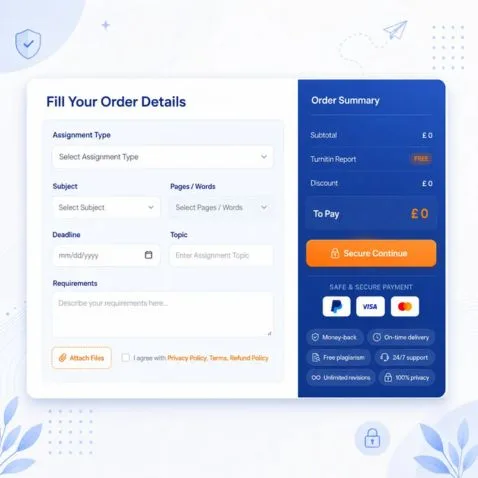
Get Your Free Academic Quote
No hidden fees · Instant response · 100% confidential
Unlock the Perks of Getting SPSS Dissertation Help in the UK.

We'll also connect you with industry experts and qualified writers to help you understand complex topics and provide top-level guidance.

We provide customized solutions for each SPSS Dissertation to ensure that all your specific requirements are met in the best possible ways.

If you are dissatisfied with our spss dissertation writing service, feel free to contact us for an immediate free revision.

Our efficient team ensures that you get your work on time, giving you peace of mind and allowing you to focus on other tasks.

When you book our spss dissertation help service, rest assured that we will not share your personal information with anyone.

Our commitment to your success extends beyond office hours. Get 24/7 support and stay connected with your dedicated tutor.
Get Experts for SPSS Dissertation Writing Help in the UK

Economics & Finance Expert
PhD Economics | MSc Finance | CFA Level II | 10 Years Experience PhD Economics University of Edinburgh Dr. Priya Sharma has received her PhD in Economics at the University of Edinburgh and an MSc in Finance at Heriot-Watt University. Dr. Sharma is extremely well versed in statistical software like STATA, SAS, and R. Dr. Sharma has mentored more than 1,500 postgraduates through complicated quantitative exercises and research projects.
Hire Writer
Trust our SPSS dissertation helpers to achieve academic excellence.
Order NowSPSS Dissertation help is an important component for PhD students, and for those who are engaged in academics, this deep process of data analysis within their research provides them with in-depth knowledge, particularly about dissertations and theses.
These writing components provide you with expert assistance with handling tough and complex data, which ensures the dependability of statistical findings.
When you search for the best SPSS dissertation writing help, you must think about the best helper who can help you with everything from the topic to the final proofreading. So, you are at the right place.
We at Workingment, with our experienced writers and a well-equipped team, will assist with all your problems and can provide you with the best SPSS dissertation writing.
Our team is familiar with the SPSS Statistical Package for the Social Sciences, a strong statistical software, which discloses valuable insights from the data. So just browse Workingment, and get all the help with just one click.
The most common error in SPSS hypothesis testing is selecting a statistical test for your dissertation by name recognition alone rather than by what your research is designed to find out. The right starting point is always your research objective.
If you are comparing a score between two separate, independent groups, use an independent samples t-test; if the same participants are measured at two different time points, use a paired samples t-test.
When you have three or more groups, one-way ANOVA is the standard choice for ANOVA dissertation help; if a continuous covariate must be controlled across those groups, use ANCOVA instead.
Where your research design involves multiple dependent variables measured simultaneously across groups, MANOVA is the correct approach, not a series of separate ANOVAs, which inflates the probability of a Type I error.
When both variables are continuous and normally distributed, Pearson correlation measures the strength and direction of the linear relationship between them. If either variable is ordinal, or if normality assumptions are not met, Spearman's rank correlation is the appropriate alternative.
Where both variables are categorical, chi-square tests whether an association exists between them. For regression analysis in your dissertation, the decision turns on your outcome variable: linear regression applies when the dependent variable is continuous, and logistic regression applies when it is binary or categorical, such as a yes/no or pass/fail outcome.
If your study uses a multi-item survey scale, Cronbach's alpha assesses its internal consistency, and exploratory factor analysis identifies whether items group into distinct underlying dimensions.
Non-parametric tests apply when your data violates the assumptions that parametric tests require, most commonly normality or homogeneity of variance.
Mann-Whitney U replaces the independent samples t-test, Kruskal-Wallis replaces one-way ANOVA, and Wilcoxon signed-rank replaces the paired samples t-test.
When choosing a statistical test in SPSS for a distribution that fails normality checks, using a non-parametric alternative is the methodologically correct decision, not a fallback.
Generating SPSS output is only half the task. The written SPSS results chapter requires APA 7 reporting conventions that differ meaningfully from the sixth edition, and many students are applying outdated guidance.
For every significance test, APA 7 requires the test statistic (t, F, r, or chi-square), degrees of freedom, and the exact p-value to three decimal places without a leading zero: p = .032, not p < .05. Effect size reporting in your dissertation is mandatory under APA 7, not a recommendation.
For a t-test, that means Cohen's d; for ANOVA, eta-squared or partial eta-squared; for chi-square, Cramer's V or phi; for correlation, r-squared; for regression, R-squared and adjusted R-squared. APA 7 recommends reporting 95% confidence intervals alongside significance tests, and Workingment includes these in every written results section.
A common source of confusion for UK students: Harvard referencing governs how sources are cited in the text, not how statistics are formatted. Statistical reporting conventions apply regardless of which referencing style your programme requires. Workingment confirms your referencing style at order stage and applies it to source citations throughout the dissertation results chapter.
Below is what correctly written results look like in academic prose:
SPSS is used across disciplines, but the data type and required analysis differ by field. Below are the subjects Workingment most commonly supports.
If your subject is not listed, contact Workingment directly. Most quantitative dissertation subjects that use SPSS fall within our service scope.
Dissertation data analysis using SPSS, done correctly, produces more than just a results section. Below is exactly what you receive with every order.
Parametric tests including t-tests, ANOVAs, and regression models depend on specific statistical conditions being met. Assumption testing in SPSS establishes whether those conditions hold before the main analysis runs; skipping it risks producing invalid results that supervisors and examiners will identify during review.
Normality is the first condition checked. For samples under 50, the Shapiro-Wilk test in SPSS is the standard normality test for dissertation work; for larger samples, the Kolmogorov-Smirnov test is applied. Significance values and Q-Q plots are assessed together, because the p-value alone can be misleading at very small or very large sample sizes. Where normality is violated, the analysis switches to the appropriate non-parametric alternative.
Homogeneity of variance is assessed using Levene's test before any t-test or ANOVA is run. When Levene's test returns a significant result, Welch's correction adjusts the degrees of freedom to account for unequal variances, preserving the parametric analysis where the remaining assumptions hold.
In regression models, multicollinearity is examined using the Variance Inflation Factor (VIF). A VIF above 10 signals that predictor variables are too strongly correlated for stable coefficient estimates, and the model is revised through variable removal or transformation before reporting. Linearity is checked through scatterplots before any Pearson correlation or regression is run.
Every assumption test Workingment runs is documented and reported alongside the main analysis. You receive a written record of which conditions were met, which were violated, and how each violation was handled, so your methodology is defensible when a supervisor or examiner asks.
Marking criteria for dissertation results chapters are tied to UK FHEQ levels. What a supervisor expects from an undergraduate is not what a master's examiner expects, and doctoral-level work operates by a different standard entirely. Getting the level wrong affects your mark.
At FHEQ level 6, results chapters require descriptive statistics and basic inferential tests. Chi-square, t-tests, and Pearson correlations are standard. Results chapters typically run 1,500 to 3,000 words within a 10,000 to 15,000 word dissertation.
Assumption testing is required but brief reporting is acceptable at this level. Referencing follows APA 7 or Harvard. Workingment's SPSS dissertation help for undergraduates covers output interpretation and correct statistical write-up.
At FHEQ level 7, the analytical requirement is more demanding. Regression, ANOVA, and factor analysis are typical. Effect sizes must be reported alongside significance values, and full assumption testing must be documented explicitly.
Results chapters run 3,000 to 5,000 words within a 15,000 to 20,000 word dissertation. SPSS help for master's dissertations must include interpretation that connects findings to the literature.
PhD SPSS data analysis requires advanced methods: structural equation modelling, multilevel modelling, ANCOVA, and longitudinal analysis. Multiple datasets are common. Assumption testing must be fully documented, and ethics records must align with approved protocols.
Results may extend across more than one chapter. Workingment's PhD SPSS data analysis support covers the full process from data preparation to written-up chapters.
If you're searching for academic help , here are some top-quality academic services available to you:
What Do Our Writing Experts Offer?
Get access to our premium assignment solutions to get academic success whether it's a report, dissertation, report, ppt, case study, and essay. Our Writers are always ready to help you.
Book qualified writers to guarantee an A+ in academic papers.

Hey everyone! It's Charlie Here, I just wanted to share useful information about the assignment help service of Workingment. Indeed, I adopted it for my final year subject and it was a game-changer. Because of the great details that they provided, I achieved 70 marks out of 100 in my final year assignment project. It was great to have their support, they were very experienced and provided quality work.
Hey folks, Raheem here! I completed my Environment and Health course, all thanks to Workingment who is doing an exemplary job in the assignment section. As time went by, I was having a really tough time but their assistance was excellent. I must say that I didn’t have much expectations for this exam, but I was able to score 60 marks and I can only imagine how much better I could have done if I had paid more attention. I would like to suggest Workingment for assignment help.
Hey everyone, it's Mia! ended my course recently with an A+ Grade, and I can’t fail to give a shoutout for this magnanimous service from Workingment. I was really struggling a lot with my course however, with their assistance I was able to keep up and get a 80 percent score. They were incredibly friendly, and they made everything very clear and understandable, even when I had numerous questions.
Hey folks, it's Amelia! Hi, I hope everyone had a great week. I have just completed my Contemporary Marketing course and had a good experience today using Workingment’s assignment help service. It was really annoying that I felt ill but with their help, I passed by somehow with a 65% score. They always made me understand everything that was tough and did not mind helping whenever I asked. I would highly recommend their service.
I wish I could have contact with such an excellent team then I could have passed in my last assignment without fail. However, I feel it is not too late to connect with such a team who provide this type of excellent academic support. I received the result today of the last assignment that I submitted. I got 76 out of 100 which was beyond my expectation. Your service is really recommended to other students.
It was a great achievement for me to complete my research work on time and it was only possible for your excellent support. I would like to thank all the experts who contributed to producing excellent research work. I have received excellent guidance from your team and the insightful feedback that I have received helped me in improving. I really appreciate your service.
I am writing this to highlight before the readers that this organization really provides excellent dissertation help with the knowledgeable experts. I took services for the dissertation help which was highly beneficial for me. I am very happy to declare that I am fully satisfied with your dissertation help. Just try it and find excellent results.
I was anxious about doing my coursework, however excellent support that I received from your team is highly appreciable. You guys are extremely knowledgeable, and I really appreciate your all-encompassing support. I appreciate your help.
Hello, I received my results today and I'm delighted to share with you all that I received 71 out of 100 on my failing file, which was completed by you guys. I really appreciate it. Thanks again for your excellent support. This is the second time I am using your services. I already recommended your excellent services. I will definitely recommend others again.
My friend recommended their help and I am very happy to say I never expected a higher grade in the very first assignment where I took help from them. I would recommend others who are struggling to tackle challenging topics and looking for higher grades.
Hello guys. The topic that I assigned them seemed to be highly complicated however I got exceptional guidance from their exports and did my assignment excellently. They have knowledgeable exports and their application of knowledge in doing the course work is excellent.
I can say that the assignment help services which are delivered by you guys are really amazing. Highly appreciable. I really found my lacking when I compared my previous coursework that I personally did with your work. It was a good learning experience for me. Thanks.
You guys are really knowledgeable and your comprehensive support is really appreciable. Thanks for your support. Yesterday I got the results of my final assignment. I got 81 out of 100 in the HRM assignment. Thank you.
It was an invaluable service and I am glad to reveal that the assignment help that I received made a big difference. There is no doubt that your experts really work hard to deliver excellent service. I especially want to thank the experts who did my economics assignment. It really helped me in improving my grades.

You can send your dataset as an SPSS .sav file, a Microsoft Excel (.xlsx) file, or a comma-separated (.csv) file. If you collected survey responses via Google Forms, Qualtrics, or SurveyMonkey, export as CSV and send that directly.
No. Assumption testing is included in every analysis. Before running any parametric test, we check the relevant conditions (normality, homogeneity of variance, linearity, and multicollinearity where applicable) and document the results in your output file.
We work to whichever style your university specifies. Most UK programmes require APA 7th edition or Harvard referencing. Statistical results are formatted consistently regardless of bibliography style, and we confirm your requirement at order stage.
Yes. Alongside the written results chapter, you receive a plain-English explanation of what each test found and why it was selected. This means you can discuss your analysis confidently in a viva or supervision meeting.
Yes. The results chapter is our core service. If you need the methodology section covered too, including your research design, justification of chosen statistical methods, and sampling strategy, this can be added at order stage.
Yes. If your supervisor requests different tests, additional assumption checks, or revised reporting, we can re-run and rewrite the affected sections. Our revision policy covers amendments within the original scope of work.
Let's Book Your Work with Our Expert and Get High-Quality Content




 Dissertation Methodology Help


