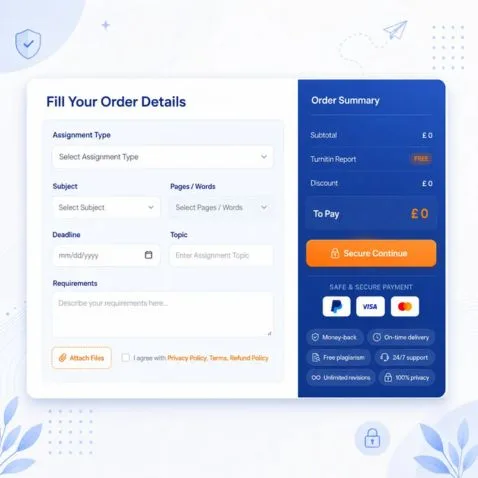
Workingment's data analysis assignment help matches you to a subject-qualified expert who handles every stage: organising your raw data, selecting the correct method, running the analysis, and writing a report formatted to your university's standards.



Get Your Free Academic Quote
No hidden fees · Instant response · 100% confidential
There are several data analysis assignment writing services are available but students choose us over then because of the numerous reasons. Here are some of them:

Psychology briefs go to psychology-trained experts. Econometrics assignments go to economics specialists working in Stata. You are not reassigned to whoever is free when you submit.

SPSS, R, Python, and Stata for statistical work. NVivo thematic coding and mixed-methods chapters for qualitative work. No need to use separate providers for each.

You receive a full document: introduction, methodology, analysis, discussion, and conclusion. Results are interpreted and connected to your research question, not dropped as raw tables.

All statistical results are formatted to the standard your university requires, APA, Harvard, or discipline-specific. Tables and charts are submission-ready and need no reformatting from you.
Our experts understand what separates a 2:1 from a First in British quantitative work. That is not the same as meeting a generic quality benchmark, and it is reflected in how work is written.
If any part of the analysis or write-up does not match the requirements you submitted at the start, it is revised until it does. The benchmark is your original brief, not our judgement of done.
Hire Our Data Analysis Assignment Writer

Mathematics & Data Science Specialist
Liam Thompson holds an MSc in Data Science from the University of Bath and a BSc in Mathematics from the University of Exeter. He has a strong track record supporting students with final year projects, dissertations, and advanced statistical modelling requirements.
Hire Writer
Achieve higher grades in your Academic life with our Data Analysis Assignment writing service
Order Now Text Analysis
Statistical Analysis
Descriptive Analysis
Diagnostic Analysis
Text Analysis
Statistical Analysis
Descriptive Analysis
Diagnostic Analysis
What we cover is the complete analytical process, from your research question down to a formatted, submission-ready report. For many students, data analysis help means someone runs a test in SPSS and sends back a screenshot. That is not what happens here.
The work starts at the hypothesis stage. Your assigned expert organises and cleans the raw data, identifies missing values and outliers, and selects the statistical or analytical method suited to your research design. Before any test runs, the assumptions for that method are checked and recorded, because UK markers regularly deduct marks when students skip this step.
Once the analysis is complete, the results are interpreted and written up accurately, including commentary that connects the output to your research question. The discussion section, which carries the heaviest weight in most UK marking rubrics, is part of what we produce.
The same applies to qualitative data analysis assignments. Thematic coding, discourse analysis, and NVivo projects follow the same pipeline: organise the data, apply the correct method, and write findings that demonstrate clear analytical thinking.
Work types covered include standalone assignments, dissertation data chapters, coursework reports, and research methods sections.
Parametric tests covered include all three t-test variants (one-sample, independent samples, and paired), one-way and two-way Analysis of Variance (ANOVA), Multivariate Analysis of Variance (MANOVA), Analysis of Covariance (ANCOVA), Pearson correlation, and both linear and multiple regression.
For data that do not meet normality requirements or use ordinal measurement scales, the non-parametric equivalents are used: Mann-Whitney U, Wilcoxon signed-rank, Kruskal-Wallis, Spearman correlation, and chi-square tests for both goodness of fit and independence.
Hypothesis testing covers the full process: formulating null and alternative hypotheses, setting the significance threshold, and interpreting results with a clear account of Type I and Type II error risk.
Where UK university marking has shifted most noticeably in recent years is in effect size reporting. A p-value tells your assessor the result is unlikely to be due to chance. It does not tell them how meaningful the finding is.
Our experts include Cohen's d, eta-squared, and Omega-squared where appropriate, alongside confidence intervals that give your assessor a precise, contextualised account of the result's practical significance. Many students lose marks at the 2:1 to First boundary precisely because they omit this step.
Qualitative work is data analysis. If your assignment involves coding interview transcripts, analysing responses thematically, or building a project in NVivo, it belongs here.
The software your assignment requires depends on your course and university. Here is how it typically maps across UK programmes:
When placing your order, state the software your brief specifies. If it does not name one, your expert selects the most appropriate tool for the method the research design requires.
If you are searching for data analysis assignment help UK, you are almost certainly dealing with one of the following problems, not a vague sense that "data analysis is hard."
Many UK universities require specific SPSS versions. Licences expire mid-semester without notice. R packages that work on university computers conflict on personal laptops, and tutors rarely troubleshoot home setups. Hours disappear before the analysis has even started.
"Use appropriate statistical methods" does not tell you whether a parametric or non-parametric test fits your data, or whether correlation or regression better addresses the research question. Choosing the wrong method costs marks even when the execution is correct.
Most students run the main test without checking normality, homogeneity of variance, or independence first. UK markers specifically look for this, and its absence is consistently penalised.
Producing SPSS or Python results is achievable. Translating those numbers into academic discussion is a different skill entirely. Reporting a "significant" result without addressing effect size or practical meaning is one of the most common data analysis homework help searches UK students make before submission.
The correct statistical reporting format is required. Most courses assume students know it without demonstrating it.
Time that runs out. Data collection, cleaning, and analysis are three separate stages. Students who underestimate this start writing too late.
These are the specific errors that UK markers flag most consistently in data analysis submissions. Every point below represents a real mark loss in a real UK academic context.
Most students cannot immediately identify which method their assignment actually requires. The sections below are organised by analytical stage, so you can find your specific need without wading through an unsorted list of techniques.
Descriptive statistics assignment help covering the starting point of any dataset.
Quantitative analysis assignment help for concluding sample data.
For assignments involving multiple inter-related variables and structural complexity.
Predictive modelling and data mining assignment help for algorithm-driven analytical tasks.
Non-numerical analysis is handled with the same precision as quantitative approaches.
Before any analysis runs, your dataset must be clean and correctly structured.
Data visualisation assignment help from chart selection through to full academic report formatting.
Understanding what markers actually assess is more valuable than any last-minute revision. This is the kind of information a good personal tutor would share before you submit, and it is specific to UK academic standards for quantitative work.
Data analysis methods are not interchangeable across disciplines. The statistical tests used in a psychology dissertation differ fundamentally from those expected in an econometrics module, and the software standard in nursing research is not the same as what a business analytics student submits for their MBA dashboard assessment.
Workingment matches each student to an expert with direct experience in their subject area, not simply someone with general statistical knowledge.
Assignments in these disciplines commonly require SPSS for inferential testing, including t-tests, ANOVA, and chi-square analysis, alongside NVivo for systematic qualitative data coding. Dissertation work increasingly uses mixed-methods designs that combine survey data from Qualtrics or SurveyMonkey exports with thematic analysis of interview material.
Our experts understand the ethical reporting requirements specific to research involving human participants, including informed consent documentation and anonymisation protocols. For psychology students specifically, we work to BPS-aligned standards, which require APA formatting for all empirical work, including accurate notation for effect sizes, degrees of freedom, and p-values throughout results sections.
Business analytics coursework at UK universities increasingly expects proficiency beyond Excel. Python and R are used for market basket analysis, demand forecasting, and regression models examining consumer behaviour and pricing. Tableau and Power BI feature heavily in dashboard coursework assessed at both undergraduate and postgraduate levels.
For financial modelling tasks, Excel pivot-table analysis and scenario modelling remain standard. Our experts understand the Harvard referencing conventions used consistently across UK business schools, and we structure all quantitative reports to reflect the analytical rigour expected at MSc and MBA level, where methodology justification carries as much weight as the output itself.
Quantitative work in these fields involves statistical methods that social science students rarely encounter. Logistic regression for binary health outcomes, survival analysis using Kaplan-Meier curves, and SPSS for clinical trial data are routine requirements in nursing and public health dissertations.
Systematic review assignments frequently require structured data synthesis from primary studies. Where qualitative methods are used, NVivo is the standard tool for coding patient interview transcripts.
Our experts are familiar with NHS datasets, the NICE evidence quality framework, and the GDPR requirements that govern the handling of any patient-linked data in UK academic research. These are not generic considerations. They are specific to the regulatory environment UK healthcare students operate.
Social science data analysis and econometrics assignment help are distinct services that require entirely different expertise. Economics students at UK research universities work in Stata for panel data analysis, applying fixed effects and random effects models, specifying instrumental variable regressions to address endogeneity, and conducting cointegration testing for time-series work.
R is used for economic modelling and reproducible workflows. Data typically comes from ONS, the World Bank, or the UK Data Service. Our experts write up results using standard econometric notation, reporting robust standard errors, Hausman test outcomes, and model specification decisions in the format expected by UK economics departments, not in the simplified language appropriate for other quantitative disciplines.
If you're searching for academic help , here are some top-quality academic services available to you:
What Do Our Writing Experts Offer?
Get access to our premium assignment solutions to get academic success whether it's a report, dissertation, report, ppt, case study, and essay. Our Writers are always ready to help you.
Book qualified writers to guarantee an A+ in academic papers.

Hey everyone! It's Charlie Here, I just wanted to share useful information about the assignment help service of Workingment. Indeed, I adopted it for my final year subject and it was a game-changer. Because of the great details that they provided, I achieved 70 marks out of 100 in my final year assignment project. It was great to have their support, they were very experienced and provided quality work.
Hey folks, Raheem here! I completed my Environment and Health course, all thanks to Workingment who is doing an exemplary job in the assignment section. As time went by, I was having a really tough time but their assistance was excellent. I must say that I didn’t have much expectations for this exam, but I was able to score 60 marks and I can only imagine how much better I could have done if I had paid more attention. I would like to suggest Workingment for assignment help.
Hey everyone, it's Mia! ended my course recently with an A+ Grade, and I can’t fail to give a shoutout for this magnanimous service from Workingment. I was really struggling a lot with my course however, with their assistance I was able to keep up and get a 80 percent score. They were incredibly friendly, and they made everything very clear and understandable, even when I had numerous questions.
Hey folks, it's Amelia! Hi, I hope everyone had a great week. I have just completed my Contemporary Marketing course and had a good experience today using Workingment’s assignment help service. It was really annoying that I felt ill but with their help, I passed by somehow with a 65% score. They always made me understand everything that was tough and did not mind helping whenever I asked. I would highly recommend their service.
I wish I could have contact with such an excellent team then I could have passed in my last assignment without fail. However, I feel it is not too late to connect with such a team who provide this type of excellent academic support. I received the result today of the last assignment that I submitted. I got 76 out of 100 which was beyond my expectation. Your service is really recommended to other students.
It was a great achievement for me to complete my research work on time and it was only possible for your excellent support. I would like to thank all the experts who contributed to producing excellent research work. I have received excellent guidance from your team and the insightful feedback that I have received helped me in improving. I really appreciate your service.
I am writing this to highlight before the readers that this organization really provides excellent dissertation help with the knowledgeable experts. I took services for the dissertation help which was highly beneficial for me. I am very happy to declare that I am fully satisfied with your dissertation help. Just try it and find excellent results.
I was anxious about doing my coursework, however excellent support that I received from your team is highly appreciable. You guys are extremely knowledgeable, and I really appreciate your all-encompassing support. I appreciate your help.
Hello, I received my results today and I'm delighted to share with you all that I received 71 out of 100 on my failing file, which was completed by you guys. I really appreciate it. Thanks again for your excellent support. This is the second time I am using your services. I already recommended your excellent services. I will definitely recommend others again.
My friend recommended their help and I am very happy to say I never expected a higher grade in the very first assignment where I took help from them. I would recommend others who are struggling to tackle challenging topics and looking for higher grades.
Hello guys. The topic that I assigned them seemed to be highly complicated however I got exceptional guidance from their exports and did my assignment excellently. They have knowledgeable exports and their application of knowledge in doing the course work is excellent.
I can say that the assignment help services which are delivered by you guys are really amazing. Highly appreciable. I really found my lacking when I compared my previous coursework that I personally did with your work. It was a good learning experience for me. Thanks.
You guys are really knowledgeable and your comprehensive support is really appreciable. Thanks for your support. Yesterday I got the results of my final assignment. I got 81 out of 100 in the HRM assignment. Thank you.
It was an invaluable service and I am glad to reveal that the assignment help that I received made a big difference. There is no doubt that your experts really work hard to deliver excellent service. I especially want to thank the experts who did my economics assignment. It really helped me in improving my grades.

Workingment covers undergraduate coursework (Level 4 to Level 6), postgraduate dissertations (Level 7), stand-alone analysis reports, data chapters within theses, and group project analysis sections. Both quantitative and qualitative data analysis assignments are supported across all UK academic levels.
Our experts use SPSS, R, Python (Pandas, NumPy, Matplotlib, Scikit-learn), Stata, Excel, NVivo, MATLAB, Tableau, and Power BI. When ordering, always specify the software your university requires so your assignment is completed in the correct tool.
Yes. Many students seeking help with data analysis assignments already have a dataset but need support with cleaning, method selection, running tests, and writing the results section. Send your dataset file, assignment brief, and marking rubric when you enquire.
Your expert reviews the research design, data type, number of groups, and assignment brief before selecting any test. Assumption testing is always included. If your brief specifies a method, it is used. If not, the chosen method is justified in your methodology section.
Yes. Workingment covers thematic analysis, content analysis, discourse analysis, and NVivo-based coding projects, including code creation, coding queries, and theme development. Findings are written to the standard expected by UK social science, education, nursing, and health programmes.
Yes, and this is standard, not an add-on. All submissions include relevant effect sizes, Cohen's d, eta-squared, or odds ratios, alongside confidence intervals where applicable. UK markers at the 2:1 and First boundary specifically check for these alongside significance values.
Yes, depending on complexity. A basic SPSS or Python assignment with a pre-cleaned dataset can be completed within 24 hours. Complex mixed-methods work requires longer. Share your brief and dataset when enquiring so availability for urgent data analysis homework help can be confirmed accurately.
We follow whichever style your brief specifies. APA is standard for psychology and social science; Harvard for business and management. Statistical notation follows APA 7th edition conventions by default. Always state your institution's required style when placing your online data analysis assignment help order.
Let's Book Your Work with Our Expert and Get High-Quality Content