Our Programming Assignment Help coding experts handle Python, Java, C++, and every language your degree throws at you. Submit your brief, get working code with full explanations, and meet the deadline. Over 5,000 students have been helped since 2018.



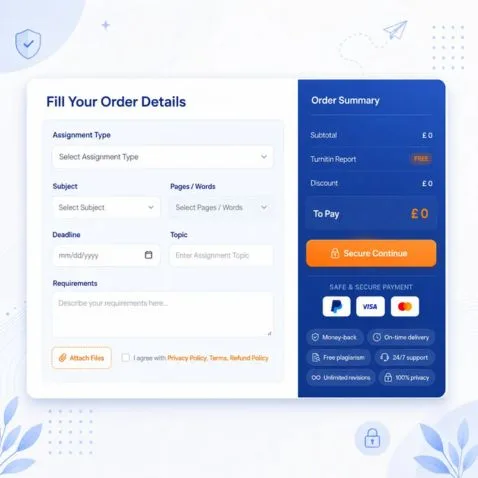
Get Your Free Academic Quote
No hidden fees · Instant response · 100% confidential
Work with verified UK coding specialists who understand your module requirements, marking criteria, and submission standards, so every assignment you receive is built to perform academically.

Every programmer on our team holds an MSc or PhD in Computer Science. They have handled hundreds of UK university assignments and know exactly what your assessor expects to see in your code and documentation.

Before your assignment reaches you, our programmers and testers run it through a full review. Every function is checked, every edge case tested. You receive code that compiles and runs correctly, first time.

Tight deadline? We work to your submission date, not ours. Whether you need your Python script in 24 hours or your final-year project in two weeks, your assignment arrives with time to review it properly.

Your order details, personal information, and university are never shared with any third party. Our systems are routinely updated to keep your data secure, and your name is never attached to any submitted work.

Our pricing reflects the UK student budget without cutting corners on quality. Get a fixed quote before you commit. No hidden fees, no surprise charges, just transparent pricing from the moment you make contact.

Not satisfied with the delivered assignment? Request a revision at no extra cost. Whether it is a logic adjustment, a formatting change, or a full section rewrite, we rework it until the assignment meets your requirements.

Our support team is available around the clock, every day of the week. Whether you have a question about your order at midnight or need an urgent update on your deadline, someone is always available to help.

Before you place an order, browse our library of completed programming assignments across Python, Java, C++, and more. Each sample shows the standard of work and documentation you can expect from our team.

Need to discuss your brief with the person actually writing your code? We connect you directly with your assigned programmer so nothing gets lost in translation and your requirements are understood from the start.
Every specialist on our team holds a postgraduate degree in Computer Science or a related field and has direct experience with UK university marking criteria, from BTEC and HND through to Russell Group final-year projects.

Computer Science & AI Expert
Dr. Emily Chen holds a PhD in Computer Science from Imperial College London and an MSc in Artificial Intelligence from the University of Southampton. She covers a wide range of programming languages and emerging technologies. Dr. Chen is also experienced in database management, computer networks, and technical report writing.
Hire Writer
Send us your brief and get a fixed-price quote within the hour
Order NowProgramming assignments are not marked like essays. There are no argument structures or citation lists. A marker runs your code, reads your comments, and assesses the submission against a rubric tied to your FHEQ level, not the same criteria used for written coursework.
At Level 6, the final year of an undergraduate programme at a UK university, that rubric covers five areas.
Every programmer at Workingment provide computer programming assignment help is briefed on these criteria before starting your work. They are not applying essay-marking logic to code. Every submission is written to the FHEQ level you specify.
Many UK computer science modules assess group projects with an individual component alongside the shared output. This might be a personal contribution log, a specific module you are solely responsible for, or an individual reflection piece submitted separately. These components exist precisely because your university wants to assess your understanding, not just the group's.
If you are struggling with the technical concepts behind your assigned part, Workingment provides programming assignment help in the form of one-to-one explanation and guidance. We help you understand the logic, the structure, and the decisions involved in your specific contribution so that you can write and submit your own work with confidence.
This is not about producing someone else's output for you to pass off as your own. It is a computer programming assignment help focused on building your understanding of the material you are individually responsible for.
Programming assignment help UK is not something only Computer Science students need. Across most STEM and computing-adjacent degrees, at least one module will require you to submit working code.
Here is where Workingment regularly provides computer programming assignment help:
Whatever your degree, if your module brief contains a code submission, Workingment's programming assignment help covers it.
Whether you need programming language assignment help for a foundation module or an advanced final-year project, Workingment covers the full range of languages taught across UK universities.
From compiled systems code to web applications and data pipelines, every solution is written to match your module's marking criteria, submission format, and technical environment.
If you need online programming assignment help for a specific tool, version, or coursework structure, you will find it covered below.
Python is one of the most commonly taught languages at UK universities, used across data science, AI, and web development modules.
We handle Python assignment help UK tasks including data analysis with Pandas and NumPy, machine learning models built with scikit-learn or TensorFlow, Flask and Django web applications, automation scripts, and bioinformatics coursework.
All solutions are written in Python 3.x and are compatible with PyCharm and Jupyter Notebook environments.
Java remains a core language in UK computer science programmes, particularly for object-oriented design and application development.
Our Java assignment help UK covers OOP design patterns, inheritance and polymorphism, data structures and algorithms, Android component development, and GUI applications built with JavaFX or Swing. We work across multiple JDK versions and support both Eclipse and IntelliJ IDEA development environments.
C and C++ assignments are standard in first and second-year CS modules, and often the most technically demanding for students new to low-level programming.
We provide C++ programming help UK and C programming assignment help covering memory management, pointers, data structures built from scratch, systems programming tasks, and embedded systems work. Solutions are compiled and tested using GCC and Clang.
SQL assignment help UK from Workingment covers schema design, normalisation, complex join queries, stored procedures, and triggers across MySQL and PostgreSQL.
One area most services overlook: UK university database assignments frequently require a combined submission of working SQL code alongside a written report explaining your design decisions and query logic. We produce both, formatted to your module's submission guidelines.
Beyond the main languages above, we provide computer programming assignment help across a wide range of additional languages. This includes: JavaScript for front-end and Node.js tasks; R and MATLAB for statistical and mathematical coursework; C# for .NET applications; PHP for server-side web modules; HTML and CSS for interface assignments; Haskell and Prologue for functional and logic programming modules; Swift for iOS development; Assembly for low-level architecture tasks; and Rust for systems programming coursework. If your programming assignment help requirement involves any of these, send us the brief.
Not every student comes to us with the same problem. If you need help with programming assignments at any stage, from blank page to near-finished code, here is what Workingment covers.
If you need someone to do my programming assignment for me and then help you understand it before a viva, this is the option.
When Workingment's programming assignment experts complete your task, here is exactly what arrives in your delivery.
From debugging support to full project builds, every programming service at Workingment is handled by verified UK coding specialists who understand your module, your language, and your deadline.
Programming Languages We Covered
Whether it's beginner level or advanced, our experts offering programming UK can offer assistance with different languages.
Book qualified writers to guarantee an A+ in academic papers.

I am so happy to get the solution for my Python structure assignment from the workingment because I scored the top marks. The final document and code were perfectly written and answered all my queries and doubts.
I was unable to write the detailed and researched OOPS Concept of Java assignment so I decided to take help from Workingment. It was totally worth it. Very helpful and reliable service.
I was really struggling with my Web Development with PHP and MySQL assignment and a complex topic in which I needed professional support. So I hired the assignment writing service of Workingment. I am impressed with their service and highly recommended.
Hello everyone! Today I got the result of my Machine Learning with Python assignment and it was so good. And without the help of Workingment it could not be possible. Because of its professional writers, I got perfectly written assignments with clear code and I am so satisfied.
I got an error-free and accurate final draft of the C++ data structure and algorithm assignment that was made in the structure and explained each topic very well. I got positive feedback. Highly recommended.
I was confused with my ‘JavaScript Frontend Development’ assignment. Workingment gave me step-by-step solutions. The final assignment was written in a structure with clear and error-free code. very good experience it was.
I needed support from workingment for the ‘Database Management with SQL’ assignment. Their professional team described each step and all my doubts and queries were solved and the code was executed as it should be. It was a great experience!
My 'Mobile App Development with Flutter' assignment was looking so complex and difficult. With the help of Workingment, I got clean code and properly structured documentation. The delivery was also on time so it enabled me to submit my assignment before the last date.
My experience with workingment was very good while cyber security and programming assignment writing. And their team provided me solution with well-organised and clean code. I would like to recommend it to all UK students.
My coding errors were causing me troubled in my Game Development with Unity assignment. But with the help of Workingment, my work has been done smoothly in the structure of my university guidelines within the time. I am so happy with their service.
I needed professional support to complete my ‘AI and Neural Networks in Python’ assignment. The Workingment team gave me practical solutions and easy-to-understand code that made the final draft high-quality. Thank you team for your guidance and support.
The ‘R Programming for Data Science’ assignment was very confusing. The Workingment team gave me step-by-step solutions and made my assignment quite well-structured that satisfied me with my requirements. It was a good experience I will trust them again.
I was having problems writing the ‘Cloud Computing with AWS’ assignment because it was a complex task to understand all the topics for me. With the professional guidance of Workingment, my assignment was completed and submitted before the deadline.
The ‘Blockchain Development in Solidity’ assignment was looking technical. Workingment helped me to write easy-to-understand and clean code with its theory explanations. The assignment was made in a high standard and structure. Highly recommend!

Yes. Workingment connects UK students with expert programmers who complete assignments to your exact specification. Submit your brief, receive a quote, approve and pay, then receive a tested and documented solution before your deadline. The service covers individual tasks, full projects, and debugging requests across UK universities.
Pricing depends on the language, complexity, scope, and turnaround time required. Prices start from €15. A quote is confirmed before any payment is taken, so you know the cost upfront. Urgent requests carry a higher rate to reflect the priority placed on your task.
The core languages include Python, Java, C, C++, C#, JavaScript, SQL, R, MATLAB, and PHP. Less common languages including Haskell, Prolog, Swift, Rust, and Assembly are handled on request. If you are unsure which language your brief requires, this can be clarified when you submit your assignment details.
Short debugging tasks and simple scripts can be delivered in 6 to 12 hours, subject to expert availability and a complete brief being submitted at the point of contact. Standard assignments take 24 to 48 hours. Complex projects require longer. Incomplete briefs delay the scoping process and push back delivery.
Yes. Every solution is compiled and run in your specified environment before delivery. If an error appears during testing, it is corrected before the file is sent. You receive working code, not code that has only been written. Inline comments are included throughout so the logic of every function is clear.
Revisions are available within 7 days of delivery if any element does not match the original brief submitted at the point of order. Amendments needed to bring the solution in line with your original requirements are covered. Changes to the brief made after delivery are treated as new requests.
Let's Book Your Work with Our Expert and Get High-Quality Content




 AJAX
AJAX