Workingment provides nuclear engineering assignment help to undergraduate and postgraduate-level UK students. Your nuclear assignment help is completed by a writer with a postgraduate qualification in nuclear engineering or a closely related discipline.



Get Your Free Academic Quote
No hidden fees · Instant response · 100% confidential
Here we are introducing our nuclear engineering assignment helpers who hold master's and PhD degrees from reputed UK institutions.
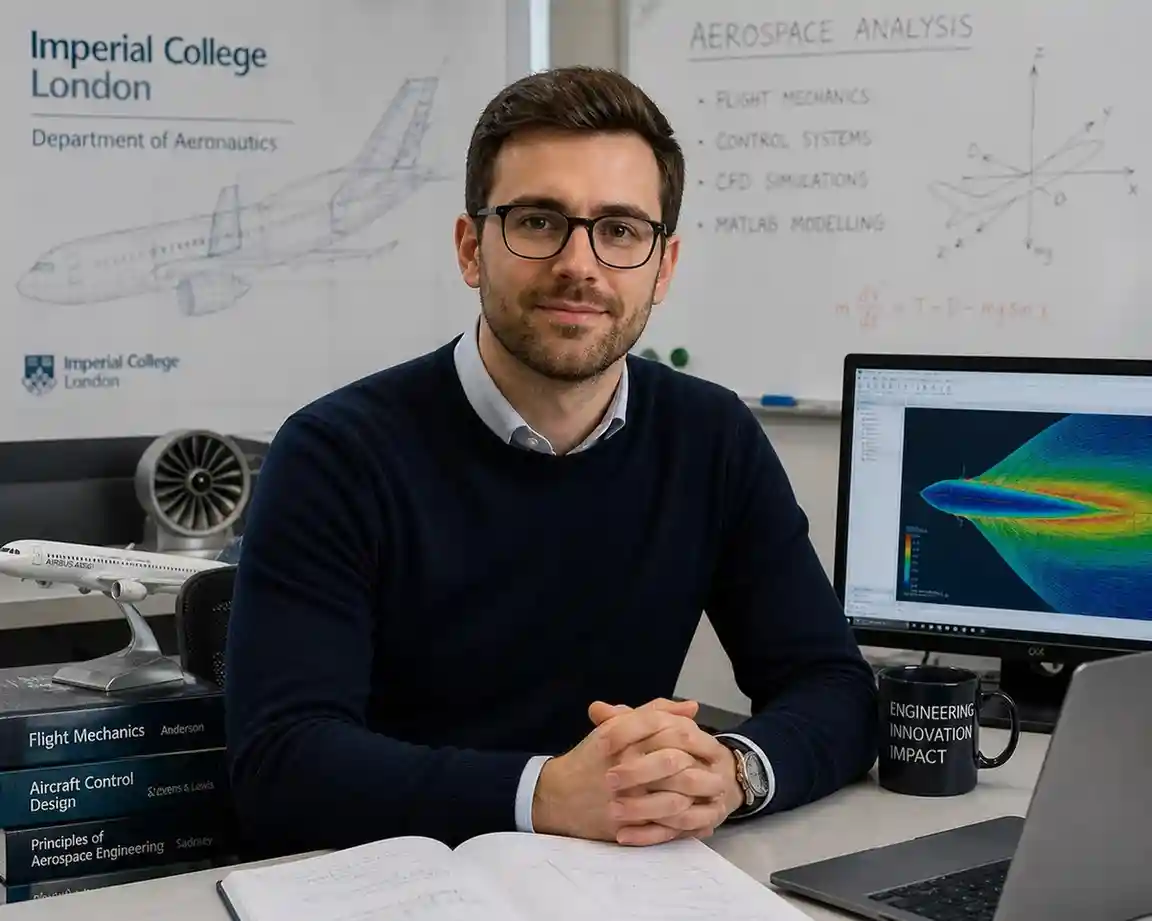
flight mechanics and control systems
Danny Smith is an expert in flight mechanics and control systems. Previously worked on the Airbus A350 development team. Handles complex CFD and MATLAB simulation assignments.
Hire Writer
Workingment is well-known for providing personal guidance to nuclear engineering students to achieve higher grades.
Order NowReactor physics forms the foundation of nuclear engineering, but your assignment brief can span far wider territory. Nuclear reactor design, fuel cycle management, radiation protection, nuclear safety, nuclear decommissioning, and nuclear fusion each appear as standalone modules in UK programmes. Your work is matched to a writer who specialises in your specific topic area.
Your reactor physics assignment requires neutron flux calculations, criticality analysis, and direct application of the neutron diffusion equation. Assignment briefs ask you to calculate the multiplication factor (k-eff), apply the four-factor formula, or determine criticality conditions for a specified reactor geometry.
Neutronics submissions at UK universities increasingly specify MCNP or SCALE as the required computational tool. Your work goes to a writer with nuclear reactor analysis experience, not a generalist.
Your thermal hydraulics assignment covers heat generation in reactor cores, coolant flow behaviour, and departure from nucleate boiling (DNB). You are asked to model heat exchanger performance, calculate pressure drop across reactor coolant circuits, or analyse thermal margin under fault conditions. UK MEng programmes introduce thermal hydraulics as a standalone module at Year 3 or Year 4.
RELAP5 and TRACE are the simulation codes most commonly specified for computational submissions in this area.
Your nuclear fuel cycle assignment covers uranium enrichment, fuel fabrication, in-reactor fuel behaviour, and final disposal. Reprocessing work requires knowledge of the PUREX process. UK assignment briefs regularly reference Sellafield’s Thermal Oxide Reprocessing Plant and the Capenhurst enrichment facility as domestic case study context.
Your materials questions address radiation damage in zircaloy cladding and austenitic stainless steel. Lifecycle cost calculations appear frequently in both fuel cycle management and materials selection briefs.
Your radiation protection assignment requires you to work with all four ionising radiation types: alpha, beta, gamma, and neutron. You calculate biological dose, model dose rates, and select shielding materials from lead, concrete, and water based on their attenuation properties. UK programmes align this topic with IAEA safety standards and ONR guidance documents.
Your assignment tasks include inverse square law calculations, ALARA principle analysis, and compliance with the Ionising Radiations Regulations 2017.
Your nuclear safety assignment covers both deterministic safety analysis and probabilistic safety assessment (PSA). You apply fault tree analysis and event tree analysis to specific reactor scenarios. Severe accident case studies from Three Mile Island, Chernobyl, and Fukushima Daiichi appear regularly in UK module briefs.
ONR guidance documents and IAEA safety fundamentals govern how these topics must be framed and referenced. You most often need help structuring the safety case argument, not just the technical content of the assessment.
Your nuclear decommissioning assignment requires you to classify radioactive waste as low-level (LLW), intermediate-level (ILW), or high-level (HLW). Planning tasks cover geological disposal facility design and the choice between immediate and deferred dismantling strategies. The Nuclear Decommissioning Authority (NDA) publishes strategy documents that UK briefs specifically ask you to reference.
Sellafield, Dounreay, and Bradwell appear regularly as case study contexts in nuclear decommissioning assignments.
Your nuclear fusion assignment covers magnetic confinement fusion, including tokamak design principles and the physics behind ITER. You can reference the JET programme at Culham and the STEP fusion project at West Burton B as live UK domestic context. Generation IV reactor concepts appear in advanced briefs: molten salt reactors, gas-cooled fast reactors, and lead-cooled designs.
Small Modular Reactors (SMRs) appear frequently in your final-year project or dissertation brief, driven by active government procurement.
Nuclear engineering programmes at UK universities require several distinct assignment formats. Your nuclear engineering assignment help from Workingment is matched to the specific format your brief sets out. From nuclear engineering technical reports and nuclear safety case studies to nuclear engineering dissertation help, every service is subject-specific.
Technical reports are the most common submission format in nuclear engineering programmes. Your nuclear engineering technical report help covers the full required structure: abstract, introduction, methodology, results, discussion, and recommendations.
Nuclear engineering lab reports in reactor physics require correct treatment of experimental uncertainty, radiation measurement calibration, and detector response analysis.
UK universities apply IEEE referencing to nuclear engineering technical reports. Most students lose marks on structure and referencing, not on the physics. Workingment writers apply IEEE formatting from the first draft.
Final-year BEng and MEng nuclear engineering students regularly submit computational assignments using Monte Carlo simulation. Your MCNP assignment help covers MCNP6 and MCNP5: neutron flux modelling, criticality benchmarks, and burnup curve computation.
SCALE and SERPENT are alternative simulation platforms for neutron transport assignments at final-year and MEng level. MATLAB nuclear engineering assignments at this level involve reactor kinetics problems, requiring you to code and interpret dynamic reactor behaviour.
Computational nuclear engineering assignments of this type are time-intensive. Both correct code setup and accurate physics interpretation must be right for you to pass.
Safety case studies appear at Level 6 and Level 7 in UK nuclear engineering programmes. Your nuclear safety case study help covers Chernobyl and Fukushima analysis, PSA methodology, and structured safety case writing.
Nuclear safety assignments require you to reference ONR guidance documents and IAEA safety fundamentals. At Level 7, your ONR regulations assignment can include the UK nuclear licensing process under the Nuclear Installations Act 1965.
Workingment writers are familiar with ONR regulatory documentation and UK nuclear licensing requirements.
Final-year nuclear engineering dissertations and MEng projects cover topics including SMR economics, thorium fuel cycle feasibility, and fusion plasma physics. Your nuclear engineering literature review draws on specialist journals: Nuclear Engineering and Design, Annals of Nuclear Energy, and Progress in Nuclear Energy.
Examiners expect critical evaluation of competing reactor design claims, not simple description.
Nuclear engineering research paper help and dissertation writing require IEEE citation format. Your nuclear engineering dissertation help in the UK includes IEEE-formatted references from the first draft.
If you're searching for academic help , here are some top-quality academic services available to you:
What Do Our Writing Experts Offer?
Get access to our premium assignment solutions to get academic success whether it's a report, dissertation, report, ppt, case study, and essay. Our Writers are always ready to help you.
Book qualified writers to guarantee an A+ in academic papers.

Hey everyone! It's Charlie Here, I just wanted to share useful information about the assignment help service of Workingment. Indeed, I adopted it for my final year subject and it was a game-changer. Because of the great details that they provided, I achieved 70 marks out of 100 in my final year assignment project. It was great to have their support, they were very experienced and provided quality work.
Hey folks, Raheem here! I completed my Environment and Health course, all thanks to Workingment who is doing an exemplary job in the assignment section. As time went by, I was having a really tough time but their assistance was excellent. I must say that I didn’t have much expectations for this exam, but I was able to score 60 marks and I can only imagine how much better I could have done if I had paid more attention. I would like to suggest Workingment for assignment help.
Hey everyone, it's Mia! ended my course recently with an A+ Grade, and I can’t fail to give a shoutout for this magnanimous service from Workingment. I was really struggling a lot with my course however, with their assistance I was able to keep up and get a 80 percent score. They were incredibly friendly, and they made everything very clear and understandable, even when I had numerous questions.
Hey folks, it's Amelia! Hi, I hope everyone had a great week. I have just completed my Contemporary Marketing course and had a good experience today using Workingment’s assignment help service. It was really annoying that I felt ill but with their help, I passed by somehow with a 65% score. They always made me understand everything that was tough and did not mind helping whenever I asked. I would highly recommend their service.
I wish I could have contact with such an excellent team then I could have passed in my last assignment without fail. However, I feel it is not too late to connect with such a team who provide this type of excellent academic support. I received the result today of the last assignment that I submitted. I got 76 out of 100 which was beyond my expectation. Your service is really recommended to other students.
It was a great achievement for me to complete my research work on time and it was only possible for your excellent support. I would like to thank all the experts who contributed to producing excellent research work. I have received excellent guidance from your team and the insightful feedback that I have received helped me in improving. I really appreciate your service.
I am writing this to highlight before the readers that this organization really provides excellent dissertation help with the knowledgeable experts. I took services for the dissertation help which was highly beneficial for me. I am very happy to declare that I am fully satisfied with your dissertation help. Just try it and find excellent results.
I was anxious about doing my coursework, however excellent support that I received from your team is highly appreciable. You guys are extremely knowledgeable, and I really appreciate your all-encompassing support. I appreciate your help.
Hello, I received my results today and I'm delighted to share with you all that I received 71 out of 100 on my failing file, which was completed by you guys. I really appreciate it. Thanks again for your excellent support. This is the second time I am using your services. I already recommended your excellent services. I will definitely recommend others again.
My friend recommended their help and I am very happy to say I never expected a higher grade in the very first assignment where I took help from them. I would recommend others who are struggling to tackle challenging topics and looking for higher grades.
Hello guys. The topic that I assigned them seemed to be highly complicated however I got exceptional guidance from their exports and did my assignment excellently. They have knowledgeable exports and their application of knowledge in doing the course work is excellent.
I can say that the assignment help services which are delivered by you guys are really amazing. Highly appreciable. I really found my lacking when I compared my previous coursework that I personally did with your work. It was a good learning experience for me. Thanks.
You guys are really knowledgeable and your comprehensive support is really appreciable. Thanks for your support. Yesterday I got the results of my final assignment. I got 81 out of 100 in the HRM assignment. Thank you.
It was an invaluable service and I am glad to reveal that the assignment help that I received made a big difference. There is no doubt that your experts really work hard to deliver excellent service. I especially want to thank the experts who did my economics assignment. It really helped me in improving my grades.

Yes. Computational assignments involving MCNP, MATLAB, RELAP5, and SCALE are all covered. When you submit your brief, include the software tool, the specific task, and the version number if your university specifies one. Criticality modelling, neutron flux distribution, and heat transfer calculations each go to a writer with the matching technical background. Computational nuclear engineering work is never assigned to a general science writer.
IEEE is the standard referencing format for nuclear engineering at most UK universities, including Manchester, Imperial College London, and Birmingham. If your module specifies Harvard or Vancouver, note that in your brief and we apply it throughout. We also reference ONR guidance documents, IAEA safety standards, and NDA publications accurately when your brief requires regulatory sources.
Yes. We cover HNC, HND, BEng Year 1 to final year, integrated MEng, and MSc programmes in nuclear engineering and nuclear technology. Marking criteria differ significantly between levels. Depth of analysis, primary source requirements, and technical accuracy expectations all increase from Level 4 to Level 7. Include your academic level and programme title when you submit so the correct marking standard is applied.
Nuclear physics assignments focus on atomic and subatomic theory: quantum mechanics, particle interactions, and nuclear structure. Nuclear engineering assignments apply those principles to reactor systems, safety analysis, waste management, and energy production. Engineering briefs require textbook sources such as Lamarsh or Duderstadt and Hamilton, plus regulatory references. Physics assignments draw from physics journals and theoretical derivations. Your brief is matched to a writer who distinguishes between these two disciplines.
Yes. Nuclear safety assignments referencing ONR guidance documents, Nuclear Installations Act provisions, and IAEA safety fundamentals are all covered. We apply PSA methodology, fault tree analysis, event tree analysis, and defence-in-depth principles as your brief requires. Historical accident case studies from Three Mile Island, Chernobyl, and Fukushima Daiichi are used where specified. If your brief references a specific ONR guidance series, include the document number when you submit.
We cover nuclear engineering programmes at six UK universities: Manchester, Imperial College London, Birmingham, Leeds, Surrey, and Lancaster. Manchester modules include MEng Nuclear Engineering and Dalton Nuclear Institute coursework. Surrey programmes include MSc Radiation and Environmental Protection. If your institution is not listed, share your module guide when you submit and we match you to a writer with knowledge of your programme’s content and marking conventions.
Unlimited revisions are included with every order. Contact us within 7 days of receiving your completed work and we will make changes at no additional cost. Tell us specifically which section does not match your brief, your module guide, or your marking criteria. Vague revision requests take longer to turn around, so be precise about what needs changing.
Let's Book Your Work with Our Expert and Get High-Quality Content




 Engineering Assignment Help


