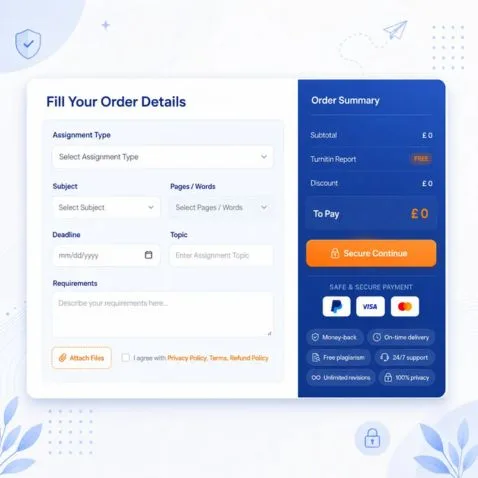
UK chemical engineering degrees pile technical reports, lab write-ups, and assessed coursework into the same academic year. Workingment provides chemical engineering help aligned to your brief, your module, and your university's marking standard.



Get Your Free Academic Quote
No hidden fees · Instant response · 100% confidential
There are several reasons why you should choose Workingment's Chemical engineering assignment writing services over other platforms:

Every writer on Workingment's chemical engineering assignment help UK panel holds a minimum BEng or MEng from a UK institution. Before submitting any numerical answer, writers show all working in full, check that units remain consistent across every step.

Referencing is applied to the style named in your brief. Harvard and APA are the most common across UK engineering departments, and writers apply both accurately. Vancouver and IEEE are also covered where modules require them.

Every order is written from scratch to your brief and is not recycled from previous work. A Turnitin originality report and an AI detection report are included with delivery. Your personal details are not shared with third parties at any stage.

We understand the financial threats that students often face. Therefore, we have an affordable pricing structure for our assignment writing services.

Punctuality is our strength. When you choose Chemical Engineering Assignment help from us, you can be confident that your assignments will be delivered on time.

If you need to clarify something mid-order, you can message your writer directly through the platform. Deadlines start from 24 hours for urgent requests, with standard delivery available at 7 days.
Writing with Wisdom, Not Just Algorithms @Workingment

MChem (Master of Chemistry) Expert
Emily holds an MChem (Master of Chemistry) degree and has spent the last six years supporting university students with a wide range of chemistry assignments. She has experience across organic, inorganic, physical, analytical, and biochemistry, and regularly assists with coursework, lab reports, research projects, and dissertations. Emily focuses on producing well-researched, clearly written work that follows university guidelines and proper academic referencing. Every assignment is original, carefully checked, and tailored to meet the required academic standards.
Hire Writer
We can be Yours Chemical Engineering Assignment Helpers
Order Now Thesis Paper
Reaserch Paper
Case Studies
Lab Report Writing
Dissertation
Exam Help
Thesis Paper
Reaserch Paper
Case Studies
Lab Report Writing
Dissertation
Exam Help
Most UK chemical engineering programmes are accredited by the Institution of Chemical Engineers (IChemE). That accreditation matters beyond the qualification itself.
IChemE-accredited programmes map their module learning outcomes to defined graduate attributes covering design, safety, sustainability, and professional practice. When your assignment is marked, those attributes are what the assessor is looking at, not just whether your numbers are right.
The nature of the work changes depending on your level. BEng assignments are typically structured around specific computational tasks: mass balances, reactor sizing, heat exchanger calculations, thermodynamic analysis.
There is usually a defined method and a correct answer range. MEng assignments shift towards open-ended design and research. You are expected to make engineering judgements, justify decisions, reflect on limitations, and demonstrate independent thinking. A calculation-first approach alone will not reach the marks available at MEng level.
Across both levels, the main assignment types include technical reports, process design exercises, lab reports, safety analyses, literature reviews, and coursework problem sets. Each format carries different assessment criteria and structural conventions.
Workingment writers work from your specific brief, module specification, and marking criteria. They do not produce generic chemical engineering help content. The starting point is always what your module requires, not a template that gets reused across every order.
Chemical engineering work is format-specific as much as topic-specific. The structure required in a problem set is nothing like the structure required in a technical report. Writers approach each format as a separate brief.
Writers support both stages of simulation-based assignments: interpreting and writing up outputs the student has already generated, or completing the simulation task from a supplied brief where that is what the module requires.
Aspen Plus and Aspen HYSYS cover steady-state and dynamic process simulation. Writers work with stream tables, heat duty outputs, column convergence reports, and sensitivity analysis results.
HYSYS is used predominantly for gas processing and refinery flowsheets; Aspen Plus handles reaction systems, distillation trains, and absorption columns. Both tools produce outputs that require accurate interpretation and structured write-up to meet the assessment criteria, not just a copy of the simulation report.
MATLAB is used for mathematical modelling, ODE solving for batch and semi-batch reactor design using ode45, and process control assignments involving transfer functions, PID tuning, and Bode plot analysis.
Python work draws on SciPy and NumPy for engineering calculations, curve fitting, and optimisation, and ChemPy for reaction network modelling and speciation calculations.
ChemCAD is used as a process flowsheet simulation platform in several UK university labs. Writers familiar with ChemCAD can support assignments built on this platform specifically, including flowsheet construction and stream result interpretation.
Chemical engineering spans multiple subject areas, each with its own methodology, notation, and assessment conventions. The sections below outline what Workingment writers cover across the full chemical engineering curriculum, from foundational thermodynamics to process safety documentation.
Thermodynamics assignments at BEng and MEng level go well beyond Hess's law. Students regularly work with equations of state such as Peng-Robinson and Soave-Redlich-Kwong for non-ideal gas behaviour, activity coefficient models for vapour-liquid equilibrium, and enthalpy and entropy calculations across multi-unit process flowsheets.
Writers handle the numerical data students provide, apply the correct thermodynamic model for the system in question, and present solutions in the format the module assessment requires.
Fluid mechanics coursework tests understanding of viscous flow regimes, Bernoulli and continuity applications, Navier-Stokes equations in simplified geometries, and pipe network pressure drop calculations using the Darcy-Weisbach equation and Moody friction factors.
Transport phenomena extends this to momentum, heat, and mass transfer analogies. This material appears in two distinct assignment formats: tightly structured individual problem sets, and group design reports where pipe sizing and pump selection feed into a wider plant design.
Reaction engineering assignments typically ask students to design or analyse batch reactors, CSTRs, or plug flow reactors using rate laws, the Arrhenius equation, and Levenspiel-style design equations. Conversion, selectivity, and yield calculations for multiple reaction systems are commonly assessed.
A solution that is set up correctly but loses marks due to unit inconsistency is one of the most common failures at this level. Writers check dimensional consistency throughout, not just at the final answer.
Process design assignments are the highest-weighted deliverables in years three and four of most UK chemical engineering degrees. Work includes producing process flow diagrams, developing piping and instrumentation diagrams, sizing heat exchangers using the LMTD method, specifying distillation columns, and justifying equipment choices against process requirements.
These assignments require both technical calculation and written engineering judgement. Writers handle the full scope: calculation sections, diagram annotation, written discussion, and reference to relevant standards.
Process safety is a compulsory module in most IChemE-accredited UK programmes. Assessment typically involves completing a HAZOP study using structured guide words, writing up consequence models for identified deviations, conducting Layer of Protection Analysis, or producing a fault tree for a specified failure scenario.
The documentation methodology matters as much as the technical content. Workingment writers with HAZOP study experience understand both the process engineering basis and the specific format these assessments require.
Unit operations assignments cover the physical separation and transfer processes that run throughout chemical engineering: distillation, absorption, liquid-liquid extraction, evaporation, drying, and membrane separation.
Calculations frequently involve McCabe-Thiele diagrams for binary distillation, theoretical stage determination, reflux ratio optimisation using the Underwood equation, and number of transfer unit calculations for absorbers.
These are among the most calculation-intensive assignments in the curriculum, and writers lay out working clearly so the method is as traceable as the result.
Materials selection assignments ask students to justify choices for specific process environments, often using Ashby selection charts to balance material properties against design constraints. Corrosion assignments cover galvanic corrosion mechanisms, stress corrosion cracking, and prevention strategies.
On the biochemical side, writers cover fermentation modelling using Monod kinetics, bioreactor design parameters including oxygen transfer rate and mixing, and enzyme kinetics based on Michaelis-Menten equations. Both areas carry their own specialised assessment criteria within UK chemical engineering programmes.
UK university assignments are not marked against a single correct answer standard. Marks are distributed across defined criteria: how well the work addresses the brief, technical accuracy, depth of analysis in the discussion section, correct application of the specified referencing style, and clarity of written communication.
The difference between a first class answer (70 and above) and an upper second (60 to 69) sits largely in analytical depth and independent thought.
A 2:1 response demonstrates competence: calculations are correct, the method is followed, and the discussion summarises what was found.
A first class response goes further. It interrogates the assumptions behind the chosen method, acknowledges model limitations, considers alternative approaches, and draws conclusions that interpret results rather than restate them.
In chemical engineering assignments at UK universities, the most consistent mark-losers are unit errors in calculations, discussion sections that describe results without analysing them, and conclusions that restate the method rather than address what the findings mean. Vague statements like "the results were broadly in line with theory" cost marks at every level.
Workingment writers read the marking criteria and module learning outcomes alongside the brief before producing any content. Where a student can provide the marking rubric, the written work is structured to address each criterion directly, not to follow a generic format.
Workingment provides chemical engineering help to students across the UK's leading IChemE-accredited programmes. Below are the universities most commonly served.
If you're searching for academic help , here are some top-quality academic services available to you:
What Do Our Writing Experts Offer?
Get access to our premium assignment solutions to get academic success whether it's a report, dissertation, report, ppt, case study, and essay. Our Writers are always ready to help you.
Book qualified writers to guarantee an A+ in academic papers.

It was looking difficult to complete my thermodynamics assignment on time because it was hard to understand Mathematical concepts by my own so I decided to take support from Workingment and it became very easy to understand the concepts step by step with the support of the expert team. I am very impressed and highly recommend it to every UK student.
Sustainable energy was the topic of my Chemical Engineering assignment and I was not sure about it. With the support of professional writers of Workingment, all my doubts were cleared and I submitted my assignment before the deadline to my professor and he appreciated it which made me score good marks.
I was stressed because of the report submission of the chemical engineering assignment then one of my friends suggested I get help from workingment and their support was beyond my expectations. I got the final draft which was 100% free from AI and plagiarism and made in stricture of my university guidelines. Thank you so much team it was very difficult without your help.
I needed help workingment on the assignment writing for chemical process safety because their services our best in the UK. Their team delivers the document that fulfills all the requirements and is 100% plagiarism-proof. 100% reliable service and I absolutely like to recommend it.
I had problems with critical topics in my chemical engineering assignment. However, the work team understood my problem and solved it very quickly, even before the deadline. The final draft I got was completely fulfilling all my requirements.
My chemical reaction in chemical engineering assignment was so risky and difficult to complete without the help of workingment. Their professional team of writers provided me with the best final solution which perfectly fulfills all my requirements. Thanks to this amazing team and highly recommend their amazing service.
My heat transfer in chemical processes assignment was very lengthy and I was so stressed about it. But workingment gave me very simplified solutions and explanations with all calculations. They made it easy to submit the assignment on time. Highly recommended services!
Catalyst design and development assignment writing is a difficult task for me because I was unable to understand the concepts but workingment helped me to understand the topics and explain them in a very simplified way. If you want to take this professional and affordable help in the UK, I recommend it to you.
The Green Chemistry assignment topic made me because of its tough topics and research analysis. But Workingment provided professional help which made it easy and gave me a step-by-step process and explanation. The final draft was amazing and in structure that meets the university guidelines.
For my Mass Transfer Operations assignment, I need correct theories and references. Workingment helped me to fulfill every requirement and I understand the complete project easily. The final draft of the assignment was very professional and perfect. Thank you for such great assistance!
I was facing challenges related to Security threats in doing my Nanotechnology assignment, but when I trusted on Workingment it became very easy for me to focus on my team end exams because I submitted my well-structured and well-organised assignment before the deadline. I got very positive feedback and also top grades.
I had to complete an organic chemistry assignment and I took practical tips from Workingement which made my assignment well-structured and full of real-world examples. I am very impressed with their timely delivery service and professional approach. Highly recommended.
I had difficulty understanding the research methods of the Pharmaceutical assignment. Workingment's professional writer team resolved all my doubts and made the content easy to understand and high-quality! You should try their service for once at least.
Workingment covers thermodynamics, fluid mechanics, reaction engineering, process design, unit operations, HAZOP analysis, materials science, mass transfer, and biochemical engineering. If your topic sits outside this list, upload your brief and the team will confirm whether a suitable writer is available.
Writers use Aspen Plus and HYSYS for steady-state simulation tasks. If you have already run a simulation and need the results interpreted or written up as part of a report, writers can handle that too. Upload your simulation files alongside your brief.
Writers read your marking criteria and module learning outcomes before starting. Where a rubric is provided, the assignment is structured to address each criterion directly. Attach your full assessment brief, module handbook, and any feedback from previous submissions when placing your order.
Workingment offers three delivery options: urgent (24 hours), express (3 days), and standard (7 days). The deadline runs from the point your order is confirmed and payment is received. Select your required deadline when submitting your brief.
A Turnitin originality report and an AI detection report are included with every completed order at no extra charge. Both reports are sent alongside your assignment when it is delivered.
Lab report writing is one of the most commonly requested formats. Writers follow standard academic structure: abstract, introduction, methodology, results, discussion, conclusion, and references. Provide your raw data, experimental procedure notes, and marking criteria for the module when submitting your order.
Student details are not shared with third parties. Orders are stored securely and are only accessible to the assigned writer and the Workingment team handling your order. Completed work is not shared publicly or used in samples without your consent.
Let's Book Your Work with Our Expert and Get High-Quality Content