Looking for Plagiarism-Free Answers for Your US, UK, Singapore, New Zealand, and Ireland College/University Assignments?
Talk to an Expert| Category | Assignment | Subject | Law |
|---|---|---|---|
| University | University of Hull (UOH) | Module Title | 772102 International Business in Practice |
| Module Title | International Business in Practice |
| Module Code | 772102_A25_T3A |
| Assessment Element | Individual Assignment - 100 % weighting |
| Module Leader | Farhan Qureshi |
| Word Count | 4000 words (+ 10 % allowance) |
| First Sit / Resit | First Sit |
| Reassessment | Resubmission |
| Submission Date | e-Submission via Canvas by 3rd September 2026 before 02.00 pm |
|
Programme Competencies (PC) |
PC6: Demonstrate global-mindedness and intercultural sensitivity and show a heightened critical appreciation of diversity and inclusivity in business decision-making in cross-cultural settings. PC7: Locate, embrace and leverage digital mediums, technologies, tools and platforms to deliver and evaluate business value, and technological and organisational implications. |
|
Where possible elements of an ABL approach have been integrated into the assessment |
Yes |
|
If YES, please indicate which of the following ABL elements have been used:
-Live Projects -Business Pro Tools, eg databases, analytics tools -Business Startups -Other Business Collaborations Internationalisation X Alternative Authentic Assessments, e.g. presentation, video, professional report X
|
|
Imagine yourself in the role of a professional working for an organisation that is contemplating expanding its operations into a foreign country. The top management team must decide on a potential international destination. Your task is to evaluate the benefits and challenges of entering a specific foreign market. Recommend the best host market and justify your choice. Additionally, propose the most suitable entry method for the expansion.
Note: Select a single target country for international expansion, focusing on the most suitable option based on your analysis. If the organisation has already established operations or businesses in that market through its subsidiaries, consider either selecting a different country or diversifying within the existing market by offering new or unrelated businesses.
| Format |
Project Report (Not an essay format) Your project report contains: • Title of Project & Infographic-Style Executive Summary • Headings (sub-headings if appropriate) • End reference list |
| Lengths |
Max 4000 Words (+ 10 % allowance) The word length breakdown provided for each section is for guidance purposes and can be adjusted to better suit the specific context of your research. The word counts • Include: an executive summary, all the main texts, in-text citations, and quotations • Exclude: Project title of assignment, end reference list, infographics, dashboard, images, logos, graphics, diagrams, tables, charts, and figures. An erroneous word count declaration may be treated as a suspected use of academic misconduct. The following penalties will be applied to work that is over the specified limit: a. 10-20% over the specified limit (4401-4799 words), a penalty of 10 points of the available marks or reduction to the pass mark of 50, whichever is higher. b. 20-50% over the specified limit (4800-5999 words), the maximum mark awarded will be the pass mark of 50. c. More than 50% over the specified limit (over 6000 words), the work will not be marked and a mark of zero will be recorded. There is no penalty for under-length work. |
The Title of the Project Report (outside of word count)
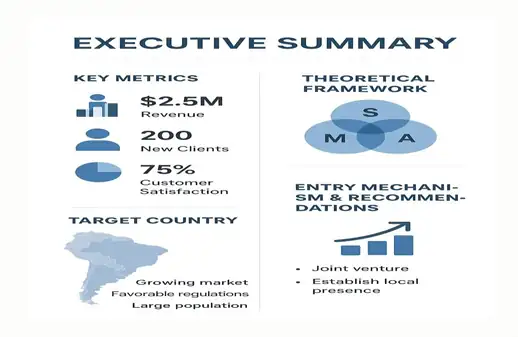
Infographic-Style Executive Summary (max. 300 words): Provide a summary of the key points of your report that contains the following.
o Organisation’s key metrics
o Theoretical concepts/framework
o Characteristics of the target country
o Entry mechanism & recommendations
Include 1 or 2 pages of a visual representation or infographic/dashboard with icons plus 3-4 key metrics (an example below) of data, images, logos, charts, diagrams, symbols, information, or knowledge to summarise your report (outside of word count).
1. Background (approx. 200 words): Begin by selecting ONE organisation from the following categories:
• An existing for-profit organisation (e.g., multinational enterprise, small or medium-sized enterprise, state-owned enterprise, start-up firm, or family business)
• An existing non-profit or non-governmental organisation (NGO or NPO) • An existing governmental organisation
Within this section, provide a concise overview of your chosen organisation's historical background, the location where it was originally founded, and the range of products/services it currently offers. Emphasise how these products/services contribute to the betterment of the host/recipient economy. Furthermore, identify and discuss key competitors of the chosen organisation in the home and/or host markets, highlighting the organisation's distinctive strengths and potential weaknesses.
To locate suitable organisations for your assignment, feel free to utilize publicly accessible resources. These resources may include the World Investment Reports by UNCTAD, Forbes' Global 2000 for the year 2024, the Fortune Global 500, or the FT's Africa's fastest-growing private companies (See Canvas Link Here). You have the flexibility to select any organisation beyond these listed resources.
2. Product/Service/Target Country (approx. 200 words):
Present a succinct description of your chosen new or existing product/service, highlighting its potential to contribute to increased profits or returns for your organisation through international expansion. This offering could either represent an entirely new business activity or an extension of existing product lines, strategically positioned within the context of a new host country.
Furthermore, it is essential to provide a well-founded justification for your selection of the specific overseas country for international expansion. The chosen destination must be located outside of your organisation's home country. While articulating this rationale, your response should also reflect your global-mindedness and intercultural sensitivity, considering key factors that make the chosen destination suitable. This section can be merged with the Background section 1.
3. Theoretical Concepts/Literature Reviews (approx. 1000 words):
In this section, your task is to thoroughly interpret, contrast, critique, evaluate and/or synthesise pertinent international business concepts, theories, frameworks, and/or models. Place your focus on literature that directly relates to your chosen context and is applicable to the subsequent sections of your assignment. It's important to draw from a range of high-quality sources, published within the past five years, as well as older seminal works.
Include a literature map or table, like the one used in the formative group assignment, to illustrate how the theories and frameworks complement or contradict one another. Explain how this informs your analysis of the chosen market and entry strategy in the subsequent sections.
Examples of a literature table and mapping
| Theory / Framework | Key Contribution | Strengths | Limitations | Relevance to Case |
| Uppsala Model (Johanson & Vahlne, 1977; 2017 update) |
|
|
|
|
| Eclectic Paradigm (Dunning, 1980; 2000) |
|
|
|
|
| Theory / Framework | Key Contribution | Strengths | Limitations | Relevance to Case |
| Institutional Theory (North, 1990; Peng, 2002) |
|
|
|
|
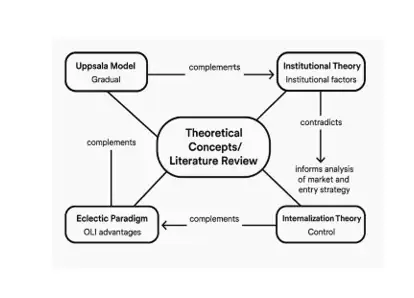
The content in this section can be integrated with sections 4 and/or 5 of your assignment, ensuring a coherent and well-structured presentation of your theoretical foundation.
4. Analysis of the Host Country and Industry Characteristics (approx. 1000 words):
In this section, evaluate the potential benefits and drawbacks associated with your chosen destination (one host country). Your analysis should be in-depth covering key formal and informal institutional factors. To ensure the relevance of your analysis, it's crucial to tie it directly to specific lines of business activities. Be selective and evaluative, focusing on three or four key factors that are most relevant to your context. Use relevant visuals—tables, charts, figures, or diagrams—to enhance your discussion.
Consider such as
a. Formal Institutional Factors:
o Institutional effectiveness in fostering investment, innovation, and productivity; income distribution; human capital; trade competitiveness; and sectoral strengths. Ease of doing business—institutions that enhance economic efficiency and promote investment and entrepreneurship. Development of digital networks, transport, and distribution systems. o Political and legal systems, including assessments of political risks and freedoms, government policies and regulations, property rights, intellectual property protection, and other pertinent indicators.
b. Informal Institutional Factors:
o Demographic characteristics, cultural norms, social responsibilities, environmental considerations, ethical practices, religious influences, linguistic diversity, consumer preferences and behaviours, prevailing attitudes, shared values, beliefs, and considerations related to bribery and corruption.
5. Entry Mechanism (approx. 1000 words):
Suggest the most suitable market entry mode (e.g., export, licensing, franchising, management contract, joint venture, or wholly owned subsidiary, etc.). If you advocate for a partnership with another host country organisation, then provide a comprehensive blueprint of how this partnership should be established.
Support your choice of entry mechanism using relevant international business theories and the specific host-country/industry context you have analysed
6. Recommendation (approx. 300 words):
Suggest how the organisation should manage various strategic issues related to seizing opportunities and managing risks in the chosen market. Discuss wider issues related to diversity and inclusivity in the decision-making process of international operations, hiring practices, international investment and trade, business ethics, or other important considerations. Include theoretical implications.
References (outside of word count):
Include full references using the Harvard referencing system. Sort the list of end references alphabetically by the last name of authors or publishers. Incorporate important tables, figures, diagrams, graphs, and charts directly into the main body of the report and avoid appendices (except AI generated transcripts) and footnotes. (Note: Examiners are not obligated to read appendices and footnotes, which are outside the marking scheme.)
Assessment Criteria and Programme Competence (PC):
PC6. Demonstrate global-mindedness and intercultural sensitivity and show a heightened critical appreciation of diversity and inclusivity in business decision-making in cross-cultural settings.
| Criteria & PCs | Your report is expected to: | Distinction (70-100%) |
Merit (60-69%) |
Pass (50-59%) |
Marginal Fail (45-49%) |
Fail (0-44%) |
|
Critical Appreciation & Integrated Knowledge of Global Business Environments (30%) PC: 6,12 |
1. Critique, evaluate, and/or synthesise relevant theories, concepts, models, and/or frameworks from scholarly sources. Include a literature review map, table, or flowchart where appropriate. 2. Demonstrate global-mindedness and intercultural sensitivity when examining international expansion decisions. 3. Justify the selection of the overseas country and the chosen product or service offering, grounded in critical reasoning. 4. Apply integrated knowledge and skills to show how real-world international business activities are shaped by global contexts. |
All aspects are excellently and outstandingly addressed and evident at the appropriate level AND provide substantial contributions and insights to the existing knowledge |
Almost all aspects are addressed and evident, but ONE aspect requires major improvements. OR Some aspects need minor improvements to reach the expectations and assessment criteria, but no aspect needs major improvements. |
TWO aspects need major improvements to reach the expectations and assessment criteria. | THREE aspects need major improvements to reach the expectations and assessment criteria. | All aspects need substantial and major improvements to reach the expectations and assessment criteria. |
|
Analysis and Evidence in International Expansion (30%)
PC: 7,12 |
1. Discuss institutional environments (formal and informal) in relation to the chosen sector, activity, and country. 4. Develop strategic solutions that benefit the home organisation, host country, and wider stakeholders. |
All aspects are excellently and outstandingly addressed and evident at the appropriate level AND provide substantial analysis and evidence |
Almost all aspects are addressed and evident, but ONE aspect requires major improvements. OR Some aspects need minor improvements to reach the expectations and assessment criteria, but no aspect needs major improvements. |
TWO aspects need major improvements to reach the expectations and assessment criteria. | THREE aspects need major improvements to reach the expectations and assessment criteria. | All aspects need substantial and major improvements to reach the expectations and assessment criteria. |
PC7. Locate, embrace and leverage digital mediums, technologies, tools and platforms to deliver and evaluate business value, and technological and organisational implications.
PC9. Design and develop advanced specialist business projects, activities and plans, mirroring or based on real-world management practice.
PC12. Demonstrate integrated and synthesised understanding of the global dimensions of the business environment and intercultural mix in a local and international context.
| Criteria & PCs | Your report is expected to: | Distinction (70-100%) |
Merit (60-69%) |
Pass (50-59%) |
Marginal Fail (45-49%) |
Fail (0-44%) |
|
Design and Development of an Advanced International Business Project (30%) PC: 9 |
1. Produce a project title and infographic-style executive summary that captures the key elements of the project. Include 1-2 page(s) of dashboard or infographic with icons plus 3-4 key metrics. 2. Present a clear background and context, detailing the organisation, its products or services, and the chosen overseas location. 3. Incorporate theoretical concepts and a literature review, critically engaging with relevant scholarly materials and frameworks. 4. Provide a structured analysis of institutional environments (formal and informal), host-country/industry characteristics, and their implications. Use relevant visuals—tables, charts, figures, or diagrams—to enhance your discussion. 6. Develop actionable recommendations, ensuring they are coherent, feasible, and directly linked to earlier analysis. |
All aspects are excellently and outstandingly addressed and evident at the appropriate level |
Almost all aspects are addressed and evident, but ONE aspect requires major improvements. OR Some aspects need minor improvements to reach the expectations and assessment criteria, but no aspect needs major improvements. |
TWO aspects need major improvements to reach the expectations and assessment criteria. | THREE to FIVE aspects need major improvements to reach the expectations and assessment criteria. | All aspects need major improvements to reach the expectations and assessment criteria. |
|
Digital Literacy & Referencing (10%) PC: 7 |
1. Engage with a broad range of highquality scholarly sources, prioritising recent publications from the past five years, while also acknowledging seminal works published earlier. 2. Use accurate in-text citations throughout the report. |
All aspects are excellently and outstandingly addressed and presented to the academic and professional standards | All aspects are consistently addressed and presented to the academic and professional standards with minor errors | Almost all aspects are addressed and presented but TWO require major improvements. OR | THREE aspects need major improvements to reach the expectations and assessment criteria. | All aspects need substantial and major improvements to reach the academic and professional standards |
| Criteria & PCs | Your report is expected to: | Distinction (70-100%) |
Merit (60-69%) |
Pass (50-59%) |
Marginal Fail (45-49%) |
Fail (0-44%) |
|
|
3. Compile a full reference list, alphabetically ordered, in line with Harvard Referencing conventions. 4. Ensure consistency between in-text citations and the reference list.
|
|
|
Some aspects need minor improvements to reach the academic and professional standards, but no aspect needs major improvements. |
|
|
Important Note: This is the copyrighted material of the University of Hull. Sharing or posting it outside authorised channels may result in severe legal consequences. Refrain from unauthorised distribution.
• Be aware of limitations: AI tools can produce plausible sounding but inaccurate information. They may lack critical analysis and real-world relevance, which are essential for achieving high marks.
• Maintain criticality: AI-generated text often lacks depth. You must supplement it with your own analysis and real-world examples. Referencing AI Use
• Include a complete transcript of your AI interaction in the Appendix, titled “AI Discussion Transcript.”
• Treat AI-generated text as original content. If you quote it directly, use quotation marks and cite the page number from your transcript. For support in using and referencing AI tools, visit the Library’s AI skills guide.
• Example:
“Digital assets encompass a wide range of intangible elements that pose unique considerations and intricacies, making their conceptualization and management a formidable task” (ChatGPT, p.4).
Enhancing AI Output
• Always supplement AI-generated content with at least one additional academic or industry source.
• Do not copy AI-generated text without proper referencing. Unreferenced use will be considered academic misconduct and may result in penalties as per university policy.
Penalties are a percentage of the maximum mark available for the assessment component which has been submitted late.
i) Up to and including 24 hours after the deadline, a penalty of 10% (10 points) or the mark is reduced to the pass mark of 50, whichever results in the higher mark.
ii) More than 24 hours and up to and including 5 working days after the deadline the mark awarded is reduced to the pass mark of 50. iii) Work that does not achieve the pass mark and therefore does not demonstrate that competencies have been met will not be subject to a late penalty.
iv) Where work is submitted outside of the stipulated late period (greater than 5 working days late) it should not be marked and a mark of zero awarded.
Important Note: This is the copyrighted material of the University of Hull. Sharing or posting it outside authorised channels may result in severe legal consequences. Refrain from unauthorised distribution.
If the maximum mark for the assessment is 100 and a student submits the assessment 2 hours after the deadline, the student’s mark will be reduced by 10 or reduced to the pass mark of 50 – whichever results in the higher mark. For example, a mark of 65 will be reduced to 55. A mark of 58 will be reduced to 50. A student will not fail work due to the application of late penalties alone.
eSubmission is the approved method for your programme of study. You must submit your assessed assignment(s), for all modules that you are taking during the 2025/26 Academic Year via the Assignments menu on Canvas. Submission of a printed copy is NOT allowed.
Assignments must be submitted by the date and time stipulated. Deadlines will be strictly adhered to. Students submitting late, and who do not have additional consideration approved by the Additional Consideration Committee, will be subject to penalties for late submission specified by the University. Please note that Saturday and Sunday are treated as “working days” for the purposes of the late submission policy.
Are you stressed about your assignment of 772102 International Business in Practice? Don't worry! Our business law assignment help service guides you step-by-step with report writing services. Whether you need help with assignment or want to see a free assignment samples, our experts will provide you the best content. Our expert team provides AI free and plagiarism free content written by PhD writers that have original content. Get help with your assignment today and improve your grades with high-quality solutions!
If you want to see the solution to this Assignment then Click here: 772102 International Business in Practice Assessment Report Example

Get Your Free Academic Quote
No hidden fees · Instant response · 100% confidential

Let's Book Your Work with Our Expert and Get High-Quality Content