Workingment provides diploma assignment help across BTEC, HND, HNC, CIPD, ILM, CMI, NVQ, ATHE, and OTHM qualifications, written by qualified subject specialists who work directly from your unit handbook and awarding body standards.



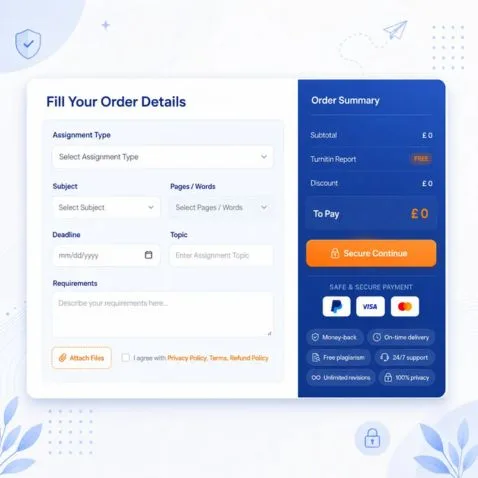
Get Your Free Academic Quote
No hidden fees · Instant response · 100% confidential
Here are all the features that’s why students choose our diploma assignment writing Service.

Signup with us to get diploma assignment help from the best diploma certified writers.Seek professional assistance for all diploma courses.

Our online diploma assignment help guarantee top grades by guiding you to produce flawless, high-scoring papers even under the tightest deadlines.

Our diploma writing services provide you 24*7 support for all your diploma queries or doubts. You can contact us at any time according to your convenience.

Get genuine and AI-free diploma assignments from our skilled writers who always provide customized and plagiarism-free work.

Opting for our Diploma assignment help UK gives you a free license to access our free resource database and browse millions of pre-existing assignment samples and answers for reference and exam preparation.

You can't get diploma assignment writing help at a lower price than us. We are known for providing the best services at the most affordable prices.

If you are not satisfied with our diploma assignment and need some modifications, enjoy free revision on your diploma assignment help.

From weekly homework to final year projects, our experts provide comprehensive and personalized diploma assignment help online for everything.

Your privacy is our first priority. We don’t share any professional and personal information with anyone. We maintain 100% confidentiality.
Connect with Our Professionals for an Affordable Diploma Assignment

Professional & Vocational Qualifications Expert
Dr. Rachel Summers holds a PhD in Occupational Health from the University of Sheffield and carries professional certifications in NEBOSH, CIPS, and CII. She specializes in vocational and professional qualification coursework, having supported thousands of working professionals upgrade their credentials through quality academic submissions.
Hire Writer
 Animation diploma assignment
Banking & Finance diploma assignment
Nursing diploma assignment
Hotel management diploma assignment
Mechanical engineering diploma assignment
Computer engineering diploma assignment
Business administration diploma assignment
Biomedical biotechnology diploma assignment
Architecture assistantship diploma assignment
Automobile engineering diploma assignment
Animation diploma assignment
Banking & Finance diploma assignment
Nursing diploma assignment
Hotel management diploma assignment
Mechanical engineering diploma assignment
Computer engineering diploma assignment
Business administration diploma assignment
Biomedical biotechnology diploma assignment
Architecture assistantship diploma assignment
Automobile engineering diploma assignment
UK diplomas sit within the Regulated Qualifications Framework (RQF), managed by Ofqual. The RQF runs from Level 2 through to Level 8, covering everything from introductory vocational qualifications to postgraduate-level study. Most diploma students are working at Levels 3, 5, or 7 depending on their qualification and career stage.
What sets diploma assignments apart from standard academic essays is the assessment structure. Each qualification is built around units. Every unit contains learning outcomes, which define what you must demonstrate, and assessment criteria, which define how your response will be judged. Your marker is not reading for general quality or argument strength. They are checking whether you have addressed each criterion as written.
This is where most students first run into difficulty. A diploma assignment is a structured response to a set of criteria, not an open essay with a conclusion. Writing a well-argued piece that does not address the stated criteria directly will not pass, regardless of the quality of the underlying thinking.
Command verbs make this more demanding still. Terms such as Analyse, Evaluate, Justify, and Critically Assess are not interchangeable. Each one signals a specific depth and type of response. "Describe" requires factual coverage. "Evaluate" requires judgement, evidence, and a reasoned conclusion. Misreading the verb is one of the most common reasons students are referred.
Each awarding body also sets its own standards and grade descriptors. Pearson BTEC, City and Guilds, NCFE, CIPD, ILM, CMI, ATHE, and OTHM all publish separate qualification specifications. What passes at merit grade in one qualification may be structured differently in another. Writing effective diploma assignments requires familiarity with the specific standards of your awarding body, not generic academic writing skills.
UK diploma grading does not work like a percentage mark out of 100. A Pass, Merit or Distinction is awarded based on whether your response meets the specific performance descriptors written into the unit specification, not on how many marks you accumulated.
Workingment writers are briefed on the grade descriptors for your specific unit before they start writing, not just on the assignment topic.
Diploma assignments are marked against fixed assessment criteria, not general writing quality. A strong response has to hit the right learning outcomes, at the right RQF level, using the right command verbs, referenced to the right standard.
Here is exactly how our diploma assignment writing process works, from your first brief to final delivery.
Our diploma assignment writing process starts with your unit handbook and specific brief, not a general reading of the topic.
Before writing begins, every marking descriptor, command verb, and learning outcome is identified and mapped against the question asked.
Diploma marking is criteria based, not general essay marking, so missing one learning outcome costs marks regardless of overall writing quality.
How diploma assignments are written in the UK depends heavily on RQF level. Treating a Level 3 brief the same as a Level 7 brief is a common reason work underperforms.
A Level 3 response needs clear understanding and correct application of concepts. A Level 7 response, such as CIPD Level 7 or ILM Level 7, needs critical synthesis and strategic evaluation built on judgement, not description.
Vocabulary, sources and argument depth are adjusted to match the level before drafting starts.
Analyse, evaluate, justify and critically assess are not interchangeable. Each verb signals a distinct intellectual operation, and assessors mark the assessment criteria diploma students are graded against by checking whether that operation was actually performed, not just whether the topic was covered.
A response that describes when it should evaluate loses marks even when the content is accurate. Writers apply each command verb deliberately.
Harvard referencing is the default across most UK diploma work, but the detail varies by awarding body. CIPD assignments use Harvard through CIPD's own Standard Bibliographic Format, which sets specific rules for citing sources such as the CIPD Profession Map.
ILM does not mandate one style centrally, so requirements can differ by delivery centre. Writers confirm the exact standard required before submission, not after.
Every completed assignment is reviewed for coherence, full learning outcome coverage, and referencing accuracy before it reaches you.
BTEC assignments are marked at Pass, Merit or Distinction against Pearson's grade descriptors. Descriptive writing that mirrors a textbook caps out at Pass.
Merit and Distinction require synthesis, application, and evaluation against the assignment's given scenario.
Workingment covers all BTEC levels and pathways, including Business, Health and Social Care, IT, Engineering, Hospitality, Sport, and Education.
HNC (Level 4) and HND assignments (Level 5) are credit-bearing qualifications awarded by Pearson or City and Guilds. Assignments must show understanding and application, not just knowledge recall.
Unit briefs vary by centre and awarding body, so Workingment works from the exact brief you provide rather than a generic template.
CIPD assignments are marked against the CIPD Profession Map and its core behaviours, not generic HR theory.
Level 7 work must show strategic thinking and critical analysis at master's-equivalent depth. See our CIPD Assignment Help page for level-specific detail.
NVQ assignments are competency-based, not essay-based. Evidence must map directly to National Occupational Standards and often includes reflective accounts describing real workplace practice, not theoretical answers.
Workingment writes NVQ evidence that is accurate to the standard and grounded in the scenario you supply.
(Institute of Leadership and Management) ILM assignments assess leadership behaviour, workplace decision-making, and management practice. Generic leadership theory will not pass on its own.
Assessors expect applied, contextual evidence tied to a real team or organisation, which is why Workingment builds each answer around your specific workplace situation.
(Chartered Management Institute) CMI assessments are marked against the Professional Standards on a Pass/Refer basis. Level 7 work sits at master's-equivalent depth and requires strategic organisational analysis, not operational description.
Workingment writers structure each answer around the specific command verb and assessment criteria in your brief.
ATHE and OTHM assignments are regulated awarding organisations offering Level 3 to Level 7 qualifications, common in business, law, health management, and hospitality.
Each awarding body has its own mark scheme and learning outcome structure, so Workingment matches every answer to the specific specification you are studying under.
Most people studying for a UK diploma today are not school leavers. They are adult learners already in work, including managers, healthcare workers, engineers and HR professionals taking BTEC, HND, CIPD, ILM, CMI or NVQ qualifications part-time, often around a full diary of family commitments as well as a job. That mix of work, study and home life is normal, not something to apologise for.
For this group, the real obstacle is rarely the subject itself. It is time. A 3,000-word CIPD assignment needs proper reading, research and drafting, and that is difficult to find once a 40-hour working week and the commute either side of it are accounted for, let alone everything else waiting at home in the evening.
48-hour turnaround, and whether it holds across all assignment lengths gives you a fixed point to plan your week around, and the person working on your assignment has handled workplace-related diplomas before, so the examples make sense to someone who has done the job, not only read about it.
Everything you share with us, including any detail about your employer or workplace, stays confidential. Getting started with our online diploma assignment help, whether you need part-time diploma help or wider diploma coursework help, takes a few minutes: send your brief, confirm the details, and we take it from there.
UK diploma qualifications span RQF Levels 2 to 7. The level defines the complexity expected in your response, not its length, so a strong answer looks different at each level.
Level 3 diploma assignment help covers foundation-level qualifications such as BTEC Level 3, NVQ Level 3, and City and Guilds Level 3. Responses need to demonstrate knowledge and understanding of the topic.
Accurate, well-structured descriptive writing usually reaches a Pass. Merit grades require some application, showing you can use the knowledge in context, not just state it.
Level 4 diploma assignments sit at HNC level, equivalent to the first year of a bachelor's degree. HNC and some BTEC Level 4 qualifications are assessed here.
Description alone is not enough. Responses need analysis and reasoning, applying theory to context rather than summarising it.
Level 5 diploma assignment help supports HND-level qualifications, equivalent to the second year of a bachelor's degree, along with some ILM Level 5 and ATHE Level 5 assignments.
Assessors look for critical analysis and synthesis of multiple sources, not just accurate coverage. Independent thinking and evidence-based argument separate a Merit from a Distinction.
Level 7 diploma assignment work sits at master's degree level and includes CIPD Level 7, ILM Level 7, CMI Level 7, and OTHM Level 7.
These are the most demanding diploma assignments Workingment supports, needing strategic-level analysis, critical evaluation of competing theories, and clear evidence of professional judgement.
If you're searching for academic help , here are some top-quality academic services available to you:
What Do Our Writing Experts Offer?
Get access to our premium assignment solutions to get academic success whether it's a report, dissertation, report, ppt, case study, and essay. Our Writers are always ready to help you.
Book qualified writers to guarantee an A+ in academic papers.

Hey everyone! It's Charlie Here, I just wanted to share useful information about the assignment help service of Workingment. Indeed, I adopted it for my final year subject and it was a game-changer. Because of the great details that they provided, I achieved 70 marks out of 100 in my final year assignment project. It was great to have their support, they were very experienced and provided quality work.
Hey folks, Raheem here! I completed my Environment and Health course, all thanks to Workingment who is doing an exemplary job in the assignment section. As time went by, I was having a really tough time but their assistance was excellent. I must say that I didn’t have much expectations for this exam, but I was able to score 60 marks and I can only imagine how much better I could have done if I had paid more attention. I would like to suggest Workingment for assignment help.
Hey everyone, it's Mia! ended my course recently with an A+ Grade, and I can’t fail to give a shoutout for this magnanimous service from Workingment. I was really struggling a lot with my course however, with their assistance I was able to keep up and get a 80 percent score. They were incredibly friendly, and they made everything very clear and understandable, even when I had numerous questions.
Hey folks, it's Amelia! Hi, I hope everyone had a great week. I have just completed my Contemporary Marketing course and had a good experience today using Workingment’s assignment help service. It was really annoying that I felt ill but with their help, I passed by somehow with a 65% score. They always made me understand everything that was tough and did not mind helping whenever I asked. I would highly recommend their service.
I wish I could have contact with such an excellent team then I could have passed in my last assignment without fail. However, I feel it is not too late to connect with such a team who provide this type of excellent academic support. I received the result today of the last assignment that I submitted. I got 76 out of 100 which was beyond my expectation. Your service is really recommended to other students.
It was a great achievement for me to complete my research work on time and it was only possible for your excellent support. I would like to thank all the experts who contributed to producing excellent research work. I have received excellent guidance from your team and the insightful feedback that I have received helped me in improving. I really appreciate your service.
I am writing this to highlight before the readers that this organization really provides excellent dissertation help with the knowledgeable experts. I took services for the dissertation help which was highly beneficial for me. I am very happy to declare that I am fully satisfied with your dissertation help. Just try it and find excellent results.
I was anxious about doing my coursework, however excellent support that I received from your team is highly appreciable. You guys are extremely knowledgeable, and I really appreciate your all-encompassing support. I appreciate your help.
Hello, I received my results today and I'm delighted to share with you all that I received 71 out of 100 on my failing file, which was completed by you guys. I really appreciate it. Thanks again for your excellent support. This is the second time I am using your services. I already recommended your excellent services. I will definitely recommend others again.
My friend recommended their help and I am very happy to say I never expected a higher grade in the very first assignment where I took help from them. I would recommend others who are struggling to tackle challenging topics and looking for higher grades.
Hello guys. The topic that I assigned them seemed to be highly complicated however I got exceptional guidance from their exports and did my assignment excellently. They have knowledgeable exports and their application of knowledge in doing the course work is excellent.
I can say that the assignment help services which are delivered by you guys are really amazing. Highly appreciable. I really found my lacking when I compared my previous coursework that I personally did with your work. It was a good learning experience for me. Thanks.
You guys are really knowledgeable and your comprehensive support is really appreciable. Thanks for your support. Yesterday I got the results of my final assignment. I got 81 out of 100 in the HRM assignment. Thank you.
It was an invaluable service and I am glad to reveal that the assignment help that I received made a big difference. There is no doubt that your experts really work hard to deliver excellent service. I especially want to thank the experts who did my economics assignment. It really helped me in improving my grades.

A UK diploma assignment is marked against specific learning outcomes and criteria set by your awarding body, such as Pearson, City and Guilds, or CIPD. A university essay is judged on argument and critical writing. A diploma assignment is judged on whether you have met every criterion, nothing more.
We cover BTEC (Level 3 to 5), HNC, HND, CIPD (Level 3, 5 and 7), NVQ (Level 1 to 7), ILM (Level 2 to 7), CMI (Level 3 to 7), ATHE, OTHM, and NCFE qualifications. Don't see your course listed? Contact us directly, since our coverage is updated regularly.
Merit means going beyond accurate coverage: applying theory to your specific context, using command verbs correctly, and citing sources beyond the obvious ones. Distinction goes further, critically evaluating theory, comparing competing frameworks, and drawing evidence based conclusions. Purely descriptive answers will not reach Merit, however accurate.
Harvard is the default across most UK diploma courses. CIPD has its own referencing guidance, based on Harvard but with specific conventions. A few centres ask for APA instead. Our writers use whatever your unit brief specifies, and adapt if your centre's standard differs.
Standard turnaround is 7 days from a confirmed brief to delivery. Urgent turnaround is available from 48 hours. Tell us your exact deadline and word count when you order, and we will confirm whether it fits our urgent option before you commit to anything.
Yes. Every writer works from your unit handbook, your specific brief, and any extra guidance from your tutor before starting. The response is structured around your learning outcomes and marked against your awarding body's grade descriptors, not a generic academic standard.
Let's Book Your Work with Our Expert and Get High-Quality Content