Get top-quality NVQs Assignment Help in the UK from expert diploma writers. We assist with all NVQ levels, ensuring plagiarism-free, well-researched assignments that meet assessment standards and help you achieve top grades easily.



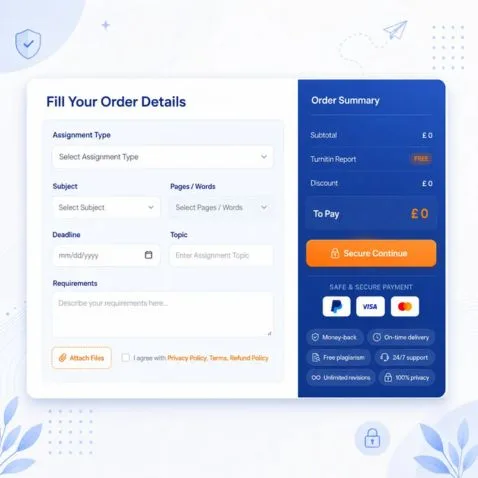
Get Your Free Academic Quote
No hidden fees · Instant response · 100% confidential
Workingment has been delivering trusted NVQ assignment Help services to UK students since 2018. Over 5,000 UK students have chosen Workingment for assignment help. Here are the reasons they consider us the best:

We have a team of professional expert NVQ diploma writers who have been providing NVQ assignment help for so many years. Those professional writers have complete knowledge of NVQ for each level of recent guidance.

Our NVQ diploma experts are familiar with all NVQ level and provide you assistance that help you to achieve your dream grades, no matter you are seeking help for level 1 or level 7, you get professional assistance.

We have built an expert team where all our experts should maintain the quality of the academic work and we also provide AI and plagiarism reports while delivering your work.

If you have doubts and questions about our work, we provide all NVQ assignment samples, you can select any one as per your professor's guidelines and get the idea how we deliver our work.
We have 24/7 customer support for students, because we know that students are also facing many problems during their NVQ assignments. That's why we provide 24/7 customer service so students can reach us whenever they want.

We understand the value of money for NVQ Diploma students, that is why we have made our NVQ assignment writing service available at an affordable price, so that every student can complete their assignments from here.

If you have urgent query and want to talk with the assigned writer please let us know we will set-up a meeting with the writer who will resolve your query as soon as possible.

If your NVQ assignment professor is not satisfied with the deliver assignments or some parts of the assignment we will provide you changes, which will cost you nothing.

Several students are facing issues while choosing the NVQ assignment topics then contact us we have a dedicated team who provide you free assistance.
Writer Credentials That Matter for a UK Assignment

Professional & Vocational Qualifications Expert
Dr. Rachel Summers holds a PhD in Occupational Health from the University of Sheffield and carries professional certifications in NEBOSH, CIPS, and CII. She specializes in vocational and professional qualification coursework, having supported thousands of working professionals upgrade their credentials through quality academic submissions.
Hire Writer
100% Plagiarism-Free & On-Time Delivery Guaranteed
Order Now Health and Social Care NVQ
Construction and Building NVQ
Business Administration NVQ
Teaching and Education NVQ
IT and Computing NVQ
Hospitality and Catering NVQ
Childcare and Early Years NVQ
Engineering NVQ
Plumbing and Heating NVQ
Customer Service NVQ
Health and Social Care NVQ
Construction and Building NVQ
Business Administration NVQ
Teaching and Education NVQ
IT and Computing NVQ
Hospitality and Catering NVQ
Childcare and Early Years NVQ
Engineering NVQ
Plumbing and Heating NVQ
Customer Service NVQ
A National Vocational Qualification is a competency-based qualification assessed entirely on workplace performance. Awarding bodies such as Pearson and NOCN structure each NVQ into units, and within every unit sit specific learning outcomes and performance criteria that a candidate must satisfy.
There are no exams. Instead, success depends on submitting a portfolio of evidence that demonstrates what you know and what you consistently do in a real working environment.
This is where most students run into difficulty, and it is rarely about ability. The problem is the format. Writing an NVQ unit response is not the same as writing an academic essay. An essay asks you to argue, analyse, and reference theory.
An NVQ response asks you to prove competence, which means describing what you did, why you did it, how it met the unit criteria, and what the outcome was. Those are four completely different cognitive moves from anything a traditional degree or A-level prepares you for.
Evidence must be valid, authentic, current, and sufficient, meaning a single piece of writing rarely satisfies an entire unit on its own. Students searching for NVQ coursework help are not struggling with difficulty in the conventional sense.
They are struggling with a writing genre that nobody taught them, one that sits between professional report writing and reflective practice, and that is judged against criteria, not academic convention.
NVQs across the UK are not all structured the same way. Each approved awarding body sets its own unit framework, evidence descriptors, and assessment language, and what an assessor expects to see from a City and Guilds submission can differ from what they require under a Pearson or ProQual qualification at the same level.
Workingment writers are familiar with the unit criteria and evidence requirements of the five main NVQ awarding bodies active in the UK:
Send your unit specification when placing an order, and your writer will align every answer to the correct awarding body standard.
Workingment provides assignment help across all major NVQ sectors. Each sector has its own awarding body requirements, regulatory context, and evidence standards. The brief descriptions below outline what assignment work typically involves in each area.
Construction NVQs run from Level 2 through to Level 7 and cover trades, site supervision, and senior site management roles. Completing a construction NVQ is the recognised route to obtaining a permanent CSCS card, which is required on the majority of UK construction sites.
Assignment submissions are evidence-based and typically include work products from the live site environment, such as method statements, risk assessments, and records of supervisory activity, alongside reflective accounts and assessor observations.
Level 3 and Level 4 are the most common entry points, delivered by City and Guilds and Pearson. These qualifications are designed for people in supervisory and senior administrative roles.
Assignment work requires candidates to document workplace processes, describe how they manage communications and decisions, and reflect analytically on their own professional practice across multiple units.
Early years qualifications are awarded by NCFE CACHE, Pearson, and City and Guilds, and must meet the DfE Early Years Qualifications criteria to count as full and relevant for Ofsted staff ratio purposes.
Assignment work requires candidates to link reflective accounts to specific observed interactions with children, referencing the Early Years Foundation Stage (EYFS) statutory framework throughout. Assessors look for direct evidence that the candidate's practice supports children's learning and development as defined by EYFS.
Hairdressing and beauty therapy NVQs are primarily awarded by VTCT and City and Guilds. Practical assessments carried out in a salon or training environment form the core of the qualification, with written assignments providing the underpinning knowledge evidence.
Workingment writers are familiar with the unit structure across both pathways and can support the written components at Levels 2 and 3.
Health and safety NVQs are available from Level 3 through to Level 7. Level 3 sits at the same point on the RQF as the NEBOSH General Certificate and is recognised as an equivalent competency-based alternative. Levels 6 and 7 are primarily awarded by ProQual and target senior health and safety managers and directors.
Assignment submissions at all levels require workplace documentation as evidence: risk assessments, incident investigation records, safety policy documents, and legislation references drawn from the Management of Health and Safety at Work Regulations 1999 and related statutory instruments.
When an assessor reviews your submitted evidence and finds it does not fully meet a unit's performance criteria or knowledge requirements, they will request a resubmission. This is not a rare outcome. Assessors regularly identify gaps where evidence is too vague, not clearly mapped to the correct criterion, or lacks sufficient detail to demonstrate competence. Receiving that feedback does not mean starting the unit from scratch.
In most cases, the issue is targeted. One or two criteria within a unit need stronger evidence, a reflective account needs to be grounded more specifically in a workplace scenario, or a knowledge answer needs to reference the correct legislation or standard. The rest of the work may already be sound.
When you receive NVQ assessor feedback requesting changes, send Workingment the original submission alongside the assessor's comments. Our writers read the feedback in full, identify exactly which criteria have not been met, and rewrite or strengthen only the sections that need it. We do not rework content that has already passed.
Resubmission work is typically turned around within 24 to 72 hours depending on the volume of changes required. Send your assessor's feedback and we will confirm a timeline before you commit.
NVQ qualifications sit on the Regulated Qualifications Framework (RQF) and run from Level 2 through to Level 7. Each level corresponds to a specific occupational tier, not just a difficulty band.
The type of assignment work required changes significantly as you move up, from short competency accounts at Level 2 to multi-unit portfolio submissions backed by strategic evidence at Levels 6 and 7.
Workingment provides assignment help across all six levels, matched to your sector and awarding body.
Level 2 sits at the same point on the RQF as five GCSEs at grades 4 to 9, and it is the entry-level benchmark for a wide range of vocational roles. It covers positions such as care assistant, retail operative, hospitality team member, construction tradesperson, and junior hairdresser or beauty therapist.
Assignment work at this level focuses on demonstrating basic workplace competency through short written accounts. Students are typically required to describe how they carry out specific tasks, link those tasks to the relevant unit criteria, and show that they understand the underpinning knowledge for their role.
Reflective accounts are usually concise, and the evidence standard is clear and achievable once you understand what your assessor is checking for.
Level 3 corresponds to A-Level standard on the RQF and is the qualification associated with supervisory, skilled-trade, and senior practitioner roles. Common sectors include childcare, social work, business administration, electrical, and plumbing. At this level, the assignment work becomes more demanding.
Students are expected to go beyond describing what they did and begin explaining why, including the impact on colleagues, service users, or outcomes. Personal accounts need to show independent judgement and some analytical reflection on practice.
Unit answers are longer, and the assessor will look for evidence that the candidate can work with reduced direction and take responsibility for their own decisions.
Levels 4 and 5 correspond broadly to HNC and HND standards, respectively, and they target professionals moving into management, specialist, or senior practitioner positions. Typical roles include assistant care home manager, early years setting leader, construction site supervisor, business operations manager, and appointed person for lifting operations.
Assignment work at these levels is substantially more involved. Students must produce extended unit answers that demonstrate strategic thinking, record and reflect on their continuing professional development (CPD), and show they can lead, plan, and make decisions that affect others.
For health and social care candidates, this often includes evidence of how they have implemented policy, managed staff performance, or responded to regulatory requirements. Length and depth are both expected to increase significantly at Levels 4 and 5 compared to earlier stages.
Levels 6 and 7 are equivalent to degree and postgraduate level, respectively, and they are designed for professionals operating at senior management, strategic, or organisational leadership level.
Each unit requires candidates to provide documented evidence of professional judgement across complex, high-stakes situations. Assessors expect evidence of how the candidate has shaped organisational policy, managed risk at scale, led teams across multiple sites or departments, and contributed to strategic planning.
Professional discussions and corroborated workplace evidence form a core part of the submission alongside written unit answers.
Health and Social Care is one of the most common NVQ pathways in the UK, with hundreds of thousands of care assistants, support workers, and healthcare assistants working through Level 2 and Level 3 qualifications each year.
It is also one of the areas where students most frequently search for help with specific unit answers, which is why Workingment provides dedicated support for this pathway at every level.
What makes NVQ health and social care assignments different from other academic writing is the evidence standard. Your assessor does not mark for academic argument. They make a pass or fail decision based on whether your written answers demonstrate actual workplace competence. That means each unit answer must be grounded in a specific workplace scenario you have experienced, not written in general terms.
Reflective accounts must describe what you did, why you did it, and what the outcome was, all linked clearly to the unit criteria. Witness testimonies from a line manager or senior colleague confirm that the described practice actually took place. Where relevant, answers should also reference Care Certificate standards and reflect awareness of CQC inspection requirements, as CQC expects evidence of competency-based training during service inspections.
Workingment writers structure every health and social care unit answer to meet the sufficiency standard your assessor applies. Answers are written around your workplace context, mapped to the correct unit criteria, and written in the first person to read as genuine, practice-based evidence.
The portfolio of evidence is the primary submission vehicle for every NVQ qualification. Your assessor does not sit an exam or set a written test. Instead, they review the portfolio to decide whether the evidence you have submitted is valid, authentic, current, and sufficient to meet every performance criterion and knowledge statement across each mandatory unit. If any criterion is not covered, the unit fails regardless of how strong the rest of the submission is.
A complete NVQ portfolio typically contains several categories of evidence working together. Written assignments and reflective accounts form the core, with each account describing a real workplace situation, the actions taken, and the outcome, explicitly linked to the relevant unit and performance criteria.
Witness testimonies from a line manager or senior colleague confirm that the described practice actually took place in a real work environment. Records of professional discussions with the assessor capture the knowledge elements of units that are harder to evidence through documents alone.
Supporting workplace documents round out the submission: policies, risk assessments, emails, meeting notes, care plans, method statements, and logs, depending on the sector.
The most common reason portfolios are returned is that evidence is not clearly mapped to the correct unit and criterion. Volume alone does not satisfy an assessor. Each piece of evidence needs to be tagged to the specific performance criteria it covers.
Before writing a single line, Workingment writers read the unit specification for your qualification and awarding body. Every answer and reflective account is written with the full criteria list open, so nothing is missed and every criterion is addressed with sufficient, sector-specific evidence.
If you're searching for academic help , here are some top-quality academic services available to you:
What Do Our Writing Experts Offer?
Get access to our premium assignment solutions to get academic success whether it's a report, dissertation, report, ppt, case study, and essay. Our Writers are always ready to help you.
Book qualified writers to guarantee an A+ in academic papers.

Hey everyone! It's Charlie Here, I just wanted to share useful information about the assignment help service of Workingment. Indeed, I adopted it for my final year subject and it was a game-changer. Because of the great details that they provided, I achieved 70 marks out of 100 in my final year assignment project. It was great to have their support, they were very experienced and provided quality work.
Hey folks, Raheem here! I completed my Environment and Health course, all thanks to Workingment who is doing an exemplary job in the assignment section. As time went by, I was having a really tough time but their assistance was excellent. I must say that I didn’t have much expectations for this exam, but I was able to score 60 marks and I can only imagine how much better I could have done if I had paid more attention. I would like to suggest Workingment for assignment help.
Hey everyone, it's Mia! ended my course recently with an A+ Grade, and I can’t fail to give a shoutout for this magnanimous service from Workingment. I was really struggling a lot with my course however, with their assistance I was able to keep up and get a 80 percent score. They were incredibly friendly, and they made everything very clear and understandable, even when I had numerous questions.
Hey folks, it's Amelia! Hi, I hope everyone had a great week. I have just completed my Contemporary Marketing course and had a good experience today using Workingment’s assignment help service. It was really annoying that I felt ill but with their help, I passed by somehow with a 65% score. They always made me understand everything that was tough and did not mind helping whenever I asked. I would highly recommend their service.
I wish I could have contact with such an excellent team then I could have passed in my last assignment without fail. However, I feel it is not too late to connect with such a team who provide this type of excellent academic support. I received the result today of the last assignment that I submitted. I got 76 out of 100 which was beyond my expectation. Your service is really recommended to other students.
It was a great achievement for me to complete my research work on time and it was only possible for your excellent support. I would like to thank all the experts who contributed to producing excellent research work. I have received excellent guidance from your team and the insightful feedback that I have received helped me in improving. I really appreciate your service.
I am writing this to highlight before the readers that this organization really provides excellent dissertation help with the knowledgeable experts. I took services for the dissertation help which was highly beneficial for me. I am very happy to declare that I am fully satisfied with your dissertation help. Just try it and find excellent results.
I was anxious about doing my coursework, however excellent support that I received from your team is highly appreciable. You guys are extremely knowledgeable, and I really appreciate your all-encompassing support. I appreciate your help.
Hello, I received my results today and I'm delighted to share with you all that I received 71 out of 100 on my failing file, which was completed by you guys. I really appreciate it. Thanks again for your excellent support. This is the second time I am using your services. I already recommended your excellent services. I will definitely recommend others again.
My friend recommended their help and I am very happy to say I never expected a higher grade in the very first assignment where I took help from them. I would recommend others who are struggling to tackle challenging topics and looking for higher grades.
Hello guys. The topic that I assigned them seemed to be highly complicated however I got exceptional guidance from their exports and did my assignment excellently. They have knowledgeable exports and their application of knowledge in doing the course work is excellent.
I can say that the assignment help services which are delivered by you guys are really amazing. Highly appreciable. I really found my lacking when I compared my previous coursework that I personally did with your work. It was a good learning experience for me. Thanks.
You guys are really knowledgeable and your comprehensive support is really appreciable. Thanks for your support. Yesterday I got the results of my final assignment. I got 81 out of 100 in the HRM assignment. Thank you.
It was an invaluable service and I am glad to reveal that the assignment help that I received made a big difference. There is no doubt that your experts really work hard to deliver excellent service. I especially want to thank the experts who did my economics assignment. It really helped me in improving my grades.

An NVQ assignment is not marked for academic argument or critical analysis. The assessor decides whether your answer provides sufficient evidence of competency against a specific unit criterion. That means every answer must be grounded in your actual workplace context and mapped to the correct standard. Generic essay writing fails NVQ assessment because it does not meet that evidence requirement.
Yes. Health and Social Care is one of the most common NVQ pathways Workingment supports. Writers are familiar with unit criteria at Levels 2 and 3, covering safeguarding, duty of care, person-centred approaches, communication, and infection control. Every answer is written to the assessment criteria of your specific awarding body, whether that is City and Guilds, Pearson, or NOCN.
Send us the assessor's feedback alongside the original work. Our writers read the comments, identify which criteria have not been met, and revise only the sections that need strengthening. You do not need to reorder the full assignment. Resubmission support is available for all NVQ levels and sectors.
Workingment supports NVQ assignments across City and Guilds, Pearson/Edexcel, NOCN, Highfield (HABC), and ProQual. Each awarding body uses different unit language and evidence descriptors. Writers are matched to your specific qualification so every answer aligns with the terminology and evidence standard your assessor will apply.
Turnaround depends on the number of units, the level, and your deadline. Single-unit answers are typically completed within 24 to 48 hours. Full portfolio support is planned around your submission date. When you send your requirements, Workingment confirms a realistic deadline before you place the order.
Yes. All work is written from scratch using your specific unit criteria and workplace context as the brief. Nothing is recycled from previous orders. Your personal information and assignment details are kept confidential. Workingment does not share, resell, or reuse any work produced for a customer.
Let's Book Your Work with Our Expert and Get High-Quality Content