OFFERS!
 Get Expert-crafted assignments
Get Expert-crafted assignments
Save 51%
Get Expert-crafted assignments
Looking for Plagiarism-Free Answers for Your US, UK, Singapore, New Zealand, and Ireland College/University Assignments?
Talk to an Expert| Category | Dissertation | Subject | Education |
|---|---|---|---|
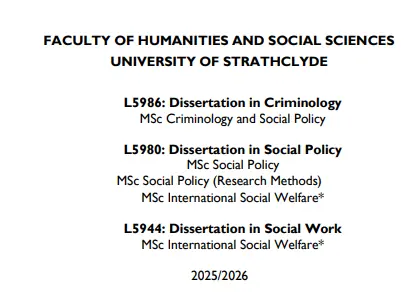
| University | University of Strathclyde | Module Title | L5986\L5980\L5944 MSc Dissertation Handbook |
| Word Count | 15,000 Words |
|---|---|
| Academic Year | 2025-26 |
The draft dissertation schedule (subject to minor changes) is set out below. Part-time students should get in touch with Emma to discuss alternative timetabling options:
|
Dissertation schedule |
Dates, Times and Locations |
|
Workshop 1: Introduction to the Dissertation
|
Thursday 19th March, 13.00-15.00 GH617 |
|
Workshop 2: Dissertation tips for planning & design
|
Thursday 26th March, 13.00-15.00 GH617 |
|
Workshop 3: Student presentations |
Tuesday 28th April, Presentation slots to be confirmed GH617 |
|
Workshop 4: Student presentations |
Wednesday 29th April, Presentation slots to be confirmed GH617 |
|
Workshop 5: Student presentations |
Thursday 30th April, Presentation slots to be confirmed GH617 |
|
Students upload dissertation plans to MyPlace
|
8th May |
|
Exam Boards ratify marks – formal progression to dissertations (or other outcome, e.g. resits) confirmed** |
Early June |
|
Dissertation supervision 1 (feedback on dissertation plan) |
Late May |
|
Dissertation supervision 2 |
Late June |
|
Dissertation supervision 3 |
Late July |
|
Dissertation submission |
5th August |
For those students who start the programme in September, 120 credits must have been accumulated from the programme curriculum and have submitted a satisfactory proposal for a dissertation, to progress to the degree of Master's. For those students who start the programme in January, 60 credits must have been accumulated from the programme curriculum and have submitted a satisfactory proposal for a dissertation, to progress to the degree of Master's.
All four MSc programmes outlined above place a strong emphasis on the dissertation, which is an extended piece of writing of up to 15,000 words, based on independent study, assessed at SCQF Level 11. The dissertation is your chance to undertake an extended piece of scholarship. It allows you to pursue in-depth a topic that is of interest to you. You are expected to demonstrate your ability to engage critically and analytically with the literature in the field, building upon relevant concepts and theory covered in the taught element of your MSc degree and, where appropriate, apply this to empirical situations.
The subject will be determined based on your own interests, its relevance to your MSc programme policy, and what is feasible in terms of the literature, data and time available. You are expected to develop your own argument and conduct your own analysis on a specific and limited research problem, though it is not required that you collect new data (some students, for example, undertake extended literature reviews for their dissertation projects - many others analyse data that are already available, such as policy documents and secondary data sets).
Whilst demonstrating knowledge from other modules is not explicitly part of the marking criteria, the dissertation module is designed to draw on the skills and knowledge you have gained in your MSc studies so far. The result should be a piece of academic research relevant to your programme (e.g. criminology/social policy/international social welfare), demonstrating, to a level appropriate for an MSc qualification, knowledge of: the topic chosen; relevant academic and other literature; and social scientific method.
As you start planning, it is also worth having in mind what a dissertation is not. A dissertation is not a review or discussion of everything you have learned about your chosen topic – it must address a defined aim or set of research questions. The dissertation is also not a collaborative effort between you and your supervisor. This is your own piece of research. Supervisors will not tell you what to read or do, nor will they take responsibility for the dissertation. Staff provide initial guidance, via the three workshops and feedback on the dissertation plan, to get you started, and your supervisor then advises you at certain strategic points to ensure you are on track and to alert you to any problems. Additionally, if you are finding the process challenging or encountering difficulties or uncertainties, you can approach your supervisor for advice. Your supervisor will act as a safety net, providing academic and practical guidance.
Below is an indicative chapter outline, contents and word length. It is intended as a general guide to the structure of the dissertation. Individual dissertations may have a slightly different structure, contents and employ different chapter lengths, as the topic and approach require. If you would like more specific guidance, please discuss your proposed outline with your assigned supervisor, noting any concerns or uncertainties you have.
| Chapter | Words |
|---|---|
|
Abstract
|
150-200 words [excluded from word limit] |
|
Introduction
|
2000 |
|
Critical Academic Reflection: Part 1 This section should draw on learning and feedback from your taught modules to reflect on:
|
1000 |
|
Literature Review Purpose: Explain what the Literature Review is setting out to do. This is likely to include:
LR method: Explain how the review was conducted, giving a sense of how you identified, critically assessed and then synthesised relevant literature. Also, explain how your literature review chapter is structured (it is usually more effective to present the LR by thematic sections, rather than source-by-source). |
2500 |
|
Methodology
This section should also highlight where any previous learning from taught modules has been used, and how it has been further developed. |
2500 |
|
Findings
|
2,500 |
|
Analysis
|
3000 |
|
Conclusion
|
1000 |
|
Critical Academic Reflection: Part 2. This section should link to the Critical Academic Reflection: Part 1, and should discuss how the work you have completed in your dissertation has developed your skills and academic knowledge. This section should provide specific examples of development, drawn from the dissertation process. It should also include a reflection on what these mean for your future development, beyond the dissertation. |
500 |
| References | |
|
Appendix should contain:
|
The following aspects may help think through potential topics:
In addition, the topic must be relevant to your specific dissertation pathway. The following sections provide some pathway-specific guidance on choosing a relevant topic.
Postgraduate taught students in the MSc Criminology and Social Policy must complete a Dissertation in Criminology of 15,000 words to gain the MSc qualification.
This should be a piece of academic research relevant to Criminology, showing, to a level appropriate for an MSc qualification, knowledge of the topic chosen; of relevant academic and other literature, and of social scientific methods.
Whilst demonstrating knowledge from other modules is not explicitly marked against, the dissertation module is designed to draw on the skills and knowledge students have gained in the degree course so far. For instance, students can apply concepts and theories from all the modules taught in Semester 1, utilising the research methods training from the core methods class L2909 Qualitative Methods.
Each student will be assigned a supervisor. All our Criminology and Social Policy staff have extensive academic research experience, and can advise on more general issues around research design, methods and organisation and, where appropriate, on topic-specific issues. An effort will be made to assign each student to the most appropriate supervisor based on the degree of match between their topic and the academics available to supervise, and students are also invited to make a choice of supervisor, which will be accommodated as far as possible.
The module is offered at SCQF Level 11 and has the following learning objectives:
This dissertation pathway intends that students should pursue their own interests within Social Policy. The topic covered must have clear relevance to Social Policy as an academic subject, though this is interpreted broadly. The Social Policy Association provides a good overview of Social Policy as an academic discipline: http://www.social-policy.org.uk/what-is-social-policy/
To help you think about potential topics, you might want to apply concepts and theories from, or of the type taught in, the L8924 and L8927, L5976: Welfare Concepts and Ideas module; knowledge of welfare models and contemporary policy change covered in the L8925 Comparative Social Welfare module; different philosophies of research from the L5981: Perspectives on Social Research module, research methods from the Quantitative and Qualitative Research Methods modules, and a range of ideas from the optional modules studied.
The Dissertation in Social Policy has the following Learning Objectives:
It is usual for dissertations on this pathway to build on the conclusions to develop some policy recommendations (or similar, e.g. recommendations for advocacy work / further research to help achieve policy change).
This dissertation pathway intends that students should pursue their own interests within Social Work. The aims of the Dissertation in Social Work are:
The Dissertation in Social Work has the following Learning Objectives:
It is usual for dissertations on this pathway to build on the conclusions to develop some practice-focused recommendations (or similar, e.g. recommendations for policy that will impact on social work concerns/practices).
The first two dissertation workshops and the MyPlace page will both be used to signpost relevant resources. In addition, the following resources may be helpful:
Biggam, J. (2021/2014) Succeeding with your master’s dissertation: a step-by-step handbook. Maidenhead: McGraw-Hill/Open University. (Strathclyde University Library holds copies of both the 2014 and the 2021 versions of this book.
Chamberlain,. J. M. (2013). Understanding Criminological Research: A Guide to Data Analysis. London: Sage (the library offers online access)
Davies, P., Francis, P. and Jupp, V. (2018, 3rd edition). Doing Criminological Research. London: Sage (Strathclyde University holds copies of this version and previous ones)
Gadd, D., Karstedt, S. and Messner, S. F. (2011) The Sage Handbook of Criminological Methods. London: Sage (the library offers online access)
Hart, C. (2018) (2nd Ed.) Doing a literature review: releasing the social science research imagination. London: SAGE (Strathclyde University Library holds copies of this version and an earlier, 1998, version)
Hart, C. (2005). Doing your master's dissertation: realising your potential as a social scientist. London: Sage. (Strathclyde University Library holds multiple copies)
Rudestam, Kjell Erik (2015). Surviving your dissertation: a comprehensive guide to content and process. Thousand Oaks, California: SAGE. (Strathclyde University Library holds multiple copies)
Swetnam, D. (2007). Writing your dissertation: how to plan, prepare and present your work successfully. Oxford: How to Books (available online via University Library).
Wincup, E. (2017, 2nd edition). Criminological Research: Understanding Qualitative Methods. London: Sage (the library offers online access)
Strathclyde University Library also has access to the SAGE Methods database, which includes loads of resources to support you in developing your methodological and analytic approach, including videos and podcasts as well as books and articles.
Assessment is by a 15,000-word dissertation, which counts for 100% of the mark.
This must be uploaded to the relevant link on MyPlace by the deadline of 12 noon on 5th August, unless an extension has been provided.
The final dissertation must be:
The following provides an indicative outline of the criteria used to award a particular grade/classification at the PGT level.
| Class | Marking range | Grades awarded in this range | Descriptor |
|---|---|---|---|
| PG: Distinction | 90 – 100 | 100 92 |
Exceptional demonstration of the learning outcomes Exceptional in most or every respect, the work demonstrates all of the characteristics noted for First class in the Outstanding range below and is also well beyond the level expected of a highly competent student at their level of study, and could not be bettered for the level of study. |
| 70 – 79 | 84 |
Outstanding demonstration of the learning outcomes Outstanding in most respects, the work is what might be expected of a highly competent student at their level of study. The work demonstrates most of the following attributes:
|
|
| 70 - 79 | 78 75 72 |
Excellent demonstration of the learning outcomes. Excellent in most respects, the work is what might be expected of a very competent student at their level of study. The work demonstrates:
|
|
| PG: Merit | 60 – 69 | 68 65 62 |
Comprehensive demonstration of the learning outcomes Very good or good in most respects for the level of study in displaying attainment of the learning outcomes, with marks at the higher end of this scale reflecting stronger and more consistent attainment of the learning outcomes. This work demonstrates:
|
| PG: Pass | 50 – 59 | 58 55 52 |
Satisfactory demonstration of the learning outcomes: The work is satisfactory for the level of study and clearly meets the requirements for demonstrating the relevant learning outcomes. Marks at the higher end of this scale reflect stronger and more consistent attainment of the learning outcomes for this standard of work. This work demonstrates:
|
| PG: Fail | 40 – 49 | 48 45 42 |
Marginal fail: Limited demonstration of the learning outcomes. The work meets the minimum requirements for demonstrating the relevant learning outcomes for the level of study in years 1 to 4, but not at the year 5 and PGT level. Marks at the higher end of this scale reflect stronger and more consistent attainment of the learning outcomes for this standard of work, although ultimately insufficient at year 5 and PGT level. This work demonstrates:
|
| PG: Fail | 30 – 39 | 38 35 32 |
Inadequate demonstration of the learning outcomes. The work fails to meet the minimum requirements for demonstrating the relevant learning outcomes for the level of study. Marks at the higher end of this scale reflect stronger and more consistent attainment of the learning outcomes within this range of marks. This work demonstrates:
|
| 20 – 29 | 20 |
Clear fail: Weak demonstration of the learning outcomes. The work is very weak or shows a decided lack of effort. This work demonstrates:
|
|
| 1 - 19 | 10 |
Minimal demonstration of the learning outcomes The work is very weak or shows a decided lack of effort. The work demonstrates:
|
|
| 0 | 0 | No relevant work submitted for assessment |
Achieve Higher Grades of L5986\L5980\L5944 MSc Dissertation Handbook & Raise Your Grades
Order Non-Plagiarised AssignmentNeed expert help with your L5986\L5980\L5944 MSc Dissertation Handbook? We provide AI-free and plagiarism-free Assignment Help. Our team of professional writers delivers top-quality assignments that are original and crafted without AI tools, ensuring the highest academic standards. We also offer a free list of assignment samples and answers, written by experts, to guide your work. Get your assignment checked with an AI and plagiarism report for complete peace of mind. Contact us today for reliable, expert assignment help in the UK and boost your grades!
If you want to see the solution to this brief, then click here: MSc Dissertation


Hire Assignment Helper Today!
Let's Book Your Work with Our Expert and Get High-Quality Content