| Category |
Dissertation |
Subject |
Management |
| University |
Middlesex University London |
Module Title |
MGT4923 Global Supply Chain Management & Sustainability |
MGT4923 Module Handbook
MGT4923 Module Overview
Aims
This module aims to analyse the international nature of supply chains and how companies develop and manage their global supply chains using various management techniques. The module will also provide a wider understanding of competitive advantage in global marketplaces. Students will have the opportunity to analyse the decisions that organisations make in managing international networks in supply chain management. The module will also teach students various sustainability practices employed by local and international businesses to make supply chains effective and efficient.
Learning Outcomes
- Critically analyse the complexity of diverse global supply chain networks
- Critically evaluate the importance of technology/knowledge transfer in the success of global supply chains
- Interpret and justify international outsourcing and insourcing decisions.
- Critically evaluate the techniques for coordination of global supply chains.
- Construct conceptual frameworks to solve the global supply chains related problems of an organisation in the existing business environment.
- Select appropriate Data Analytics tools and Operations Research techniques to solve global supply chain management issues.
Syllabus
- Introduction to Supply Chain and Operations Management
- Competitive Business & Supply Chain Strategies
- International Strategies & Global SC
- Supply Chain Drivers & Performance Metrics
- Supply Cain Network Design at Global Level
- Supply Chain Relationships – Sourcing
- Demand Forecasting
- Inventory Management
- Outsourcing and Sourcing
- Logistics Management
- Sustainability and Logistics
- Sustainability and Operations Management
Learning and Teaching Strategy
The teaching comprises weekly lectures and workshops. Online lectures are designed to deliver background material to enable analysis of the theory of global supply chain management and its applications. In-class workshops are designed to deliver materials to enable students to analyse the theory of Global Supply Chain Management. Each workshop will introduce the students to a particular topic with a relevant case study, and the workshops will be interactive, also supported by additional materials on MyUnihub.
Assessment Scheme
Prerequisite: None Assessment Weighting 100% Coursework Assessment Scheme
Formative Assessment:
Students will be expected to complete seminar questions each week, and the answers will be discussed in class, where students will have the opportunity to clarify their understanding. Students can also seek one-to-one feedback during tutors' scheduled office hours.
Summative Assessment:
Students will be graded based ON their performance in ONE assessment component, selected to ensure students demonstrate an overall understanding of relevant concepts and techniques as well as the ability to apply and critique them in an appropriate context.
The Assessment Components Are:
Students will have to select a real-life company and analyse issues related to international supply chain networks and sustainable practices adopted by that company.
Please include a simple chart which shows as a percentage the proportion of time a student on this module will spend in each of the following:
- Scheduled teaching
- Independent study
|
Type
|
Hours
|
|
Lectures and Workshops
|
72
|
|
Independent Learning
|
228
|
Research Ethics:
Statement:
- The teaching, learning, assessment and research activities undertaken in this module have been considered and are not likely to require ethical approval.
- However, please seek advice if undertaking the module entails carrying out any research activities involving human participants, human data, animals/animal products, precious artefacts, materials or data systems. If you submit work that includes data gathered from or about people, this may be treated as academic misconduct and could lead to a failing grade being awarded.
Learning Resources
Learning Materials
No single book covers this module. Throughout the lecture, references to relevant Books chapter and journal articles will be provided. Students are expected to read these Book chapter and journal articles for each lecture. This is provided in the folder marked “Weekly Reading” on the Unihub. Besides, there will be links to short videos available in this folder.
Text Books
- Chopra, S. (2019), Supply Chain Management: Strategy, Planning & Operation, 7th Edition, Pearson Prentice Hall
- Operations Management: Sustainability and Supply Chain Management (Global edition). Pearson.
- Hill, CWL, (2017), International Business, 7th Edition, McGraw- Hill, Higher Education
- Van den Berg, J.P. (2007). Integral Warehouse Management, Management Outlook Publications.
- Heizer, J., Render, B., & Munson, C. (2017). Principles of
- Slack, N., Chambers, S., & Johnston, R. (2016). Operations management. Pearson Education.
- Rugman, AM, and Collinson, S, (2012), International Business, 5th Edition, Financial Times and Prentice Hall
- Daniels, J, Radebaugh, L, and Sullivan D, (2012), International Business, 12th Edition, PearsonEducation
- Ivanov, D., Tsipoulanidis, A., & Schönberger, J. (2017). Global supply chain and operations management. A decision-oriented introduction to the creation of value, 2.
- Cavusgil, T, Knight, G, and Riesenberger, J (2007). International Business: Strategy, Management and New Realities, Prentice Hall
Journals & Periodicals
You are expected to regularly consult academic journals for recent developments in supply chain management. The following are highly recommended:
- Journal of Operations Management
- Production and Operations Management
- International Journal of Operations and Production Management
- Journal of Supply Chain Management
- Supply Chain Management: an international journal
- Production Planning and Control
- Computers and Industrial Engineering
- Journal of Business Logistics
- International Journal of Physical Distribution and Logistics Management
- Expectations of studying this module
Expectations of Studying this Module
Attendance and Engagement
Engaging with online and on-campus in-person learning and activities is integral to your success. Middlesex University supports you to achieve your full potential through a number of strategies, all of which provide a supportive learning environment online, remotely, face- to-face, or blended.
Professional Behaviour and Online Conduct
The programme of study you are undertaking is underpinned by developing professional behaviour and attitude. You are expected to behave in a professional, supportive manner toward your peers and teachers. You must come to sessions prepared and ready to contribute where appropriate. Please remember that your University ID should be carried with you always whilst on campus, and you must be able to identify yourself if asked to do so. Please conduct your email communication with fellow students, tutors and all relevant staff formally and courteously.
Academic Integrity and Misconduct
Academic Integrity is a set of principles and values to show that you work in a professional, honest and ethical way. You should be aware of the University's academic integrity and misconduct policies and procedures. Taking unfair advantage over other students in an assessment is considered a serious offence by the University. Action will be taken against any student who contravenes the regulations through negligence, foolishness or deliberate intent. Academic misconduct takes several forms, in particular:
- Plagiarism – using extensive unacknowledged quotations from, or direct copying of, another person's work and presenting it for assessment as if it were your own effort. This includes the use of third-party essay writing services.
- Collusion – working together with other students (without the tutor's permission), and presenting similar or identical work for assessment.
- Infringement of Exam Room Rules – Communication with another candidate, taking notes to your table in the exam room and/or referring to notes during the examination.
- Self-Plagiarism – including any material which is identical or substantially similar to material that has already been submitted by you for another assessment in the University or elsewhere.
- Unauthorised use of Artificial Intelligence – using artificial intelligence without referencing it as such in your submission. Appropriate use of Artificial Intelligence (AI) is detailed in the assessment requirements grid in section 7.5
Links to the relevant University regulations and additional support resources can be found here: Student Success Essentials Course includes useful information about how to approach your assessments and complete them with honesty. The course also describes what plagiarism (cheating) is and how to avoid it so you don't face any disciplinary action. For complete this course, you will be awarded a certificate that will verify the knowledge you have gained. Certificates can be shared and promoted via LinkedIn and other digital channels. You will have to log in to MyMDX and then MyLearning to access the course. h
The Academic Integrity and Misconduct policy is available in our Public Policy Statements (under Academic Quality) at: Our policies |
The Middlesex University Students' Union (MDXSU) Advice Service offers free and independent support in making an appeal, complaint or responding to any allegations of academic or non-academic misconduct.
Extenuating Circumstances:
There may be difficult circumstances in your life that affect your ability to meet an assessment deadline or affect your performance in an assessment. These are known as extenuating circumstances or 'ECs'. Extenuating circumstances are exceptional, seriously adverse and outside of your control. For further information, search 'Extenuating circumstances' in MyMDX.
Assessment
Formative Assessment: Formative assessments help show that you are learning and understanding the material covered in this module and allow us to monitor your progress towards achieving the learning outcomes. Although formative assessments do not directly contribute to the overall module mark, they do provide an important opportunity to receive feedback on your learning.
Summative Assessment: Summative assessment is used to check the level of learning for the module. It is summative because it is based on accumulated learning during the course. It is the summative assessment that determines the grade that you are awarded for the module.
The table below specifies the associated deadlines:
|
Summative assessment
|
Weighting
|
Deadline
|
Feedback
|
|
Assessment 1
|
100%
|
10th April 2026, 11:59pm
|
15 working days after
submission
|
To pass this module, you need to pass all assessments with a minimum grade of 40% or equivalent.
Before you submit your work for final grading, please ensure that you have accurately referenced the work. It is your responsibility to check the spelling and grammar, as all written assessments will assess technical proficiency in English. This means accurate and effective spelling, punctuation and grammar. Details of how it will be assessed will be provided in the marking criteria for each assessment, and the University's overall approach can be found within the Grade Criteria Guide in the University Regulations.
Reasonable adjustments will be made for those students who have a declared disability/specific learning condition that would affect performance in this area.
Reassessment for this module normally takes place in the following way:[Refer to the Learning Framework 2031 Learning Framework Guidance and Support Material (mdx.ac.uk).
Feedback on your Assignments
You will be provided with feedback on all assessments that is helpful and informative, consistent with aiding the learning and development process. The nature of the feedback shall be determined at programme level but may take a variety of forms, including: written comments; individual and group tutorial feedback; peer feedback; or other forms of effective and efficient feedback. If you have submitted a formative or draft assessment, you will receive feedback but no grade. The comments should inform you about how well you have done or tell you about the areas for improvement. All assignments should be submitted online unless specified in the assessment briefs.
Feedback on summative assessments will normally be provided within 15 WORKING DAYS of the published submission date.
7.3 How is your Assignment Mark Agreed?
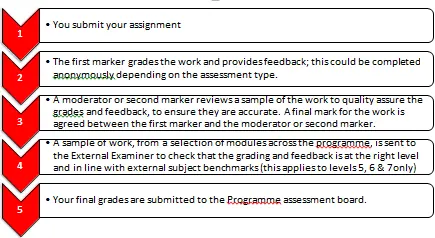
External Examiners (external academic experts) review what we deliver at a programme level. The University reviews a sample of your work to quality assure the grades and feedback you received from the person who marked your work. Our External Examiners will sample a selection of modules from a programme, with more focus on outcomes between modules within a programme.
The following diagram provides an overview of the marking process for your module assessment. Further information on the role of external examiners can be found at.
Results Confirmation
First Semester: Provisional Grades: At the end of your first semester, you can see your module grades in the Grades and Progress tile within MyMDX. These grades are provisional and not yet confirmed.
Second Semester: Final Grades and Progression: After your second semester, the Programme Assessment Board will confirm your grades. Then, your final module results, progression status, or finalist classification will be posted in the Grades and Progress tile within MyMDX.
Need Help or More Info?
- University Guide: Find detailed information in the University Guide in the Grades and Progress tile within MyMDX.
- Support Team: Ask your Progression and Support Team Officer for advice.
- Regulations: Check the University regulations for more details.
Anonymous Marking Assessment Policy
We have worked with the Middlesex University Students' Union (MDXSU) to create an anonymous marking policy in response to student feedback. Anonymous marking ensures that your identity (your name, student number and other personal/identifiable information) is not made available to academics when they are marking your work. This means that you can have confidence that your assessments will be marked fairly and consistently. However, there are some forms of assessment for which anonymity cannot be guaranteed, and these are recognised in the policy.
We now look at each component of summative assessment for this module in detail. Each of the following tables provides an overview of the requirements. The support provided for each component, along with the feedback arrangements, is also detailed below.
Assessment
The following table provides an overview of the assessment requirements from PaCMan to assist in completing the sections below. Remove before final versioning
|
Assessmentsents
|
|
|
|
|
|
|
|
|
|
Assessment
|
Assessment Type
|
Description
|
Submission date, time
|
Feedback type & date
|
Word count (or equivalent)
|
Assessed learning outcome (s)
|
Assessment weighting
%
|
|
Assessment 1
|
Summative
|
Case Study
|
10th April, 2026,
11:59 pm
|
15 working days after submission.
|
2,000 +/-
10%
|
1,2,3,4,5,
6,
|
100%
|
|
Example - Assessment Brief Presentation
|
|
Module code
|
MGT4923
|
|
Module title
|
Global Supply Chain Management & Sustainability
|
|
Submission date, time
|
10th April 2026, 11:59 pm
|
|
Feedback type & date
|
15 working days after submission.
|
|
Word count
|
2,000 +/- 10%
|
|
Assignment type
|
Case Study
|
|
Assignment structure, format and details
|
The structure of the coursework should be:
1. Introduction (10%)
Question # 1 should be discussed here.
a. Brief background, introduction to the company and its supply chain management.
|
|
|
2. Main body (80%)
Q# 2, 3,4 and 5 should be answered in this section.
- International business strategy adopted by your chosen company and evaluate its impact on sustainability (20%)
- Supply chain strategy of your chosen company, which includes lean/agile/leagile (discuss only ONE) and evaluate its impact on sustainability (20%)
- Competitive advantage strategies adopted by your chosen company using supply chain drivers (five drivers), and evaluate its impact on sustainability (20%)
- Role of technology and knowledge transfer within the supply chain network of your chosen company and evaluate its impact on sustainability (20%).
3. References (10%)
- You are expected to use a minimum of 10 Academic journal references.
Note: You can use Middlesex University Library at: https://librarysearch.mdx.ac.uk/discovery/search?vid=44MUN
_INST: Hendon
- You should use recent supportive facts regarding the company, not older than 5 years
- You can use reports of non-academic content for introducing your case and reporting the statistics. But you should use academic publications for concepts, fundamentals, and theories.
You should use the Harvard/APA style referencing for preparing your coursework.
|
|
Appropriate use of AI
|
AI can be used in an assistive/supporting role. Particular permitted roles for AI should be explicitly identified and referred to in the assessment under the acknowledgement section. For example
- planning, drafting and structuring
- proofreading
- testing code
- producing supplementary images for presentations
|
|
Assessed learning outcome (s)
|
- Critically analyse the complexity of diverse global supply chain networks
- Critically evaluate the importance of technology/knowledge transfer in the success of global supply chains
- Interpret and justify international outsourcing and insourcing decisions.
- Critically evaluate the techniques for coordination of global supply chains
- Construct conceptual frameworks to solve the global supply chains related problems of an organization in the existing business environment.
- Select appropriate Data Analytics tools and Operations Research techniques to solve global supply chain management issues.
|
|
Assessment weighting%
|
100%
|
|
Key reading and learning resources
|
Please refer to learning resources mentioned-above.
|
|
- 1. Select a multinational company that is famous for Supply chain strategy including outsourcing. Please ensure no two students are working on same organisation. First come first serve based selection of the company.
2. Analyse the international business strategy of the company.
How has the company evolved its international business strategies over time and its impact on sustainability?
3. Analyse the supply chain strategy of the company which includes lean/agile/leagile.
How does the company balance cost and responsiveness and its impact on sustainability?
4. Explain the strategies employed by the company to have a competitive advantage.
How the company maintained competitive advantage with the help of international supply chain drivers (five drivers) and its impact on sustainability?
Note: Supply Chain Drivers: Facilities Planning, Outsourcing/Insourcing, Inventory management, Transportation/Distribution, Information sharing.
Note: Clarify how these five drivers are connected in the global supply chain of company. You should draw your distribution network of the company.
5. Analyse the role of technology and knowledge transfer within the supply chain network of the company.
How do the new technologies and knowledge transfer enhance the international supply chain and its impact on sustainability?
Note: Examples of international Supply Chain technologies: Internet of Things, 3-D Printing, Big Data, Drones, Flying Taxis, Self-driving cars/trucks, Faster transport (Hyper loop, Space X), Block Chain, and Robotics. Note 2: Clarify how these technologies can help the company to enhance its international supply chain. For example, facilitating the information sharing by big data, remote manufacturing by robotic and 3-d printing, secure and fast payment by block chain technology.
Note: Provide evidence of the company’s efforts to transfer technologies into international partners. For example, support supplier to setup new manufacturing line based on the 3-D printing technology. In this manner, the company can guarantee the quality of final products and customise products according to customers’ needs.
|
|
Criteria
|
1-4 First
|
5-8 Upper Second
|
9-12 Lower Second
|
13-16 Third
|
17-20 Refer
|
|
|
70%+
|
60%-69%
|
50%-59%
|
40%-49%
|
Less than 40%
|
|
Introductio n: Setting the
scene by succinctly explaining the
case study problem and organisatio nal background
|
Demonstrate s
an excellent understandin g
about the case
study by not only explaining the problem but also explaining the root cause
|
Good description of the case study organisation
|
Evidence of some discussion, some facts missed
|
Adequate discussion but
ignores some major facts, lacks a thorough understandin g about the case study
|
Discussion is inadequate
|
|
Discussion Content: relevant and informative, applying depth of knowledge and understanding
|
Excellent and well- informed understandin g
of theories and
concepts involved
|
Good understanding of theories and concepts involved
|
Demonstrate s satisfactory knowledge and understanding theories and concepts
|
Adequate content; limited depth of knowledge and understanding shown
|
Inadequate content; limited depth of knowledge and understandin g shown
|
|
Conclusion: Clear conclusions from the literature
|
Tightly structured, logical and draws coherent conclusions to
the topics covered
|
Undertakes a systematic analysis of the issues and draws coherent conclusions to the topics covered
|
Sound conclusions to
the topics covered
|
Adequate conclusions to
the topics covered
|
Inadequate conclusions to
the topics covered
|
|
References: Reference to sources including directions for further study
|
Broad and relevant readings examined and
used selectively in the work
|
Good range of appropriate references used during the review
|
Conventional references and readings used within the review
|
Adequate but limited use of references during review
|
Review relies
on no or one reference; evidence of unexamined personal opinion
|
|
Presentatio n: Clearly presented with limited spelling and grammatica l
errors
|
Very well expressed and understandin g
of content with
limited spelling or
grammatical errors
|
Very well expressed; good understandi ng of content with some spelling and/ or grammatical errors
|
Well expressed; understandin g of content with several spelling and/ or grammatical errors
|
Unclear expression of information; little understandin g of content; several spelling and grammatical errors
|
Several spelling and grammatical errors
|
The following table details the support you will be receiving for this assessment and the feedback opportunities you will have.
|
Support and draft feedback sessions for ssessment 1
|
|
Coursework briefing
Initial briefing will be provided in class and happy to provide additional support during office hours and scheduled appointments.
|
|
Draft feedback opportunities
Happy to provide feedback on the draft versions, either by e-Mail or in person.
|
|
Additional support
Assessment briefing will be provided during lectures and I suggest you to undertake research on case study analysis and develop critical analysis skills.
|
Learning Planner
|
Week
|
Topic
|
|
1
|
Module induction
|
|
2
|
Introduction to Supply Chain, Sustainability and Operations Management
|
|
3
|
Competitive Business, Supply Chain Strategies & Sustainability
|
|
4
|
International Strategies & Global SC & Sustainability
|
|
5
|
Supply Chain Drivers & Performance Metrics
|
|
6
|
Supply chain network design techniques
|
|
7
|
Demand Forecasting & Sustainability
|
|
8
|
Inventory Management & Sustainability
|
|
9
|
Sourcing, Outsourcing and Global Sourcing & Sustainability
|
|
10
|
Logistics Management & Sustainability
|
|
11
|
Sustainability and Logistics
|
|
12*
|
Self-reading: Knowledge transfer and absorptive capacity
|
University 20-point Scale
|
20-point scale
|
General scale
|
General scale (full ranges)
|
Percentage used for aggregation purposes only
(for areas marking directly to the 20 point scale on modules with multiple assessment components)
|
|
1
|
80% - 100%
|
79.50% - 100%
|
90%
|
|
2
|
76% - 79%
|
75.50% - 79.49%
|
77.5%
|
|
3
|
73% - 75%
|
72.50% - 75.49%
|
74%
|
|
4
|
70% - 72%
|
69.50% - 72.49%
|
71%
|
|
5
|
67% - 69%
|
66.50% - 69.49%
|
68%
|
|
6
|
65% - 66%
|
64.50% - 66.49%
|
65.5%
|
|
7
|
62% - 64%
|
61.50% - 64.49%
|
63%
|
|
8
|
60% - 61%
|
59.50% - 61.49%
|
60.5%
|
|
9
|
57% - 59%
|
56.50% - 59.49%
|
58%
|
|
10
|
55% - 56%
|
54.50% - 56.49%
|
55.5%
|
|
11
|
52% - 54%
|
51.50% - 54.49%
|
53%
|
|
12
|
50% - 51%
|
49.50% - 51.49%
|
50.5%
|
|
13
|
47% - 49%
|
46.50% - 49.49%
|
48%
|
|
14
|
45% - 46%
|
44.50% - 46.49%
|
45.5%
|
|
15
|
42% - 44%
|
41.50% - 44.49%
|
43%
|
|
16
|
40% - 41%
|
39.50% - 41.49%
|
40.5%
|
|
17
|
35% - 39%
|
34.50% - 39.49%
|
37%
|
|
18
|
30% - 34%
|
29.50% - 34.49%
|
32%
|
|
19
|
0% - 29%
|
0.01% - 29.49%
|
15%
|
|
20
|
Non- participation
|
0%
|
0% (non-submission of a component)
|
Marking Rubric
|
Section
|
Excellent
|
Good
|
Average
|
Poor
|
|
Introduction of the company (10%)
|
Provides a thorough and insightful overview of the company, including history, mission, vision, and core activities.
Tailored to
context. [9 - 10]
|
Clear introduction with most important details covered, but lacks depth in areas like history or future vision. [7
- 8]
|
Basic company introduction with missing details on mission or core activities.
Connection to context is limited. [5 - 6]
|
Incomplete or vague company introduction.
Major omissions such as core activities, mission, or lack of clarity. [0 - 4]
|
|
International business strategy & sustainability (20%)
|
Comprehensive and insightful explanation of the company's international business strategy.
Strong, well- supported examples and global insights.
[16 - 20]
|
Good analysis of international strategy with some relevant examples.
However, the strategic insight may lack depth or specificity. [11-15]
|
Strategy discussed briefly but lacks strong examples, clear international focus, or depth of analysis. [6-
10]
|
No clear international strategy provided, or analysis is superficial, poorly structured, or irrelevant. [0-5]
|
|
Supply chain strategy(lean/agile/leagi le) & sustainability (20%)
|
Thorough explanation of supply chain strategy. Clear, in-depth understanding of lean/agile/leagi le principles and how they are applied. [16
- 20]
|
Good understanding of supply chain strategy with some application of lean/agile/leagi le principles, but lacks detailed examples. [11-
15]
|
Basic explanation of supply chain strategy, but limited application or understanding of lean/agile/leagi le principles.
[6-10]
|
No clear supply chain strategy identified.
Lacks understanding or explanation of lean/agile/leagi le approaches. [0-5]
|
|
Competitive advantage & sustainability (20%)
|
Clearly identifies and analyzes competitive advantage with strong, well- supported examples.
Provides insights into
differentiation
|
Identifies competitive advantage with some examples, but lacks depth or comprehensive analysis of differentiation. [11-15]
|
Mentions competitive advantage, but analysis is shallow and not clearly supported by evidence or strong examples. [6-
10]
|
No clear identification of competitive advantage.
Weak or missing analysis. [0-5]
|
|
|
or cost leadership. [16
- 20]
|
|
|
|
|
Role of technology and knowledge transfer & sustainability (20%)
|
Deep, insightful analysis of how technology and knowledge transfer impact the company. Strong, relevant examples are included. [16 -
20]
|
Good analysis of the role of technology and knowledge transfer with some examples, but lacks in-depth explanation. [11-15]
|
Basic explanation of technology’s role and knowledge transfer but lacks strong examples or clear link to company
strategy. [6-10]
|
Little or no mention of the role of technology or knowledge transfer.
Examples are missing or concepts poorly explained. [0-5]
|
|
References (10%)
|
All sources are correctly cited in the required format. Sources are relevant, diverse, and credible, providing a strong foundation. [9 -
10]
|
Most sources are correctly cited with minor formatting errors. Sources are generally relevant but lack diversity. [7 - 8]
|
Some sources are correctly cited, but major formatting errors or a lack of credible or relevant sources are present. [5 - 6]
|
References are either missing, incorrectly cited, or the sources used are of poor quality, irrelevant, or few in number. [0 - 4]
|
 Get Expert-crafted assignments