Looking for Plagiarism-Free Answers for Your US, UK, Singapore, New Zealand, and Ireland College/University Assignments?
Talk to an Expert| Category | Online Exam | Subject | Science |
|---|---|---|---|
| University | University College Dublin | Module Title | CHEM00020 |
| Academic Year | 2026 |
|---|
All answers to be graded are to be written on the provided single-page MCQ answer sheet. The exam has 25 multiple-choice questions. Each question is worth 4 marks. There is no negative marking on the multiple-choice questions. No loose rough worksheets are to be used or submitted. A periodic table (page 9), table of polyatomic ions (page 2), table of constants (page 2) and selected conversations (page 2) is provided on the question sheets. Instructions to Invigilators: A molecular model kit contained in a clear plastic bag is allowed. A standard non-programmable calculator is allowed.
Questions 1 to 25: Multiple Choice Questions. Each question is worth 4 marks for a total of 100 marks. Write only letter answers on the provided single-page MCQ answer sheet.
1. Using the rules for significant figures, convert 0.0009450 into the correct scientific notation.
(a) 9.450 * 10-1
(b) 9.450 * 10-4
(c) 9.45 * 105
(d) 9.450 * 10-5
(e) 9.45 * 10-6
2. Which answer correctly corresponds to 5.40 mg/mm3 converted into g/cm3?
(a) 5.40 * 102 g/cm3
(b) 5.4 * 101 g/cm3
(c) 5.400 * 10-1 g/cm3
(d) 5 * 10-3 g/cm3
(e) 5.40 * 100 g/cm3
3. A batch of the Scottish beer Beihir Firebrew was prepared by skilled brewers. The wort started with an initial specific gravity (SG) of 1.563 and finished with a SG of 1.064. What is the alcohol by volume value (ABV) of this beer?
(a) 75.5%
(b) 62.4%
(c) 47.3%
(d) 87.9%
(e) 100.0%
4. A hollow metal sphere was filled with 164.2 kg of absolute ethanol at -20.0°C. The sphere was sealed and over a period of 6.5 hours, the metal sphere was warmed to 20°C.
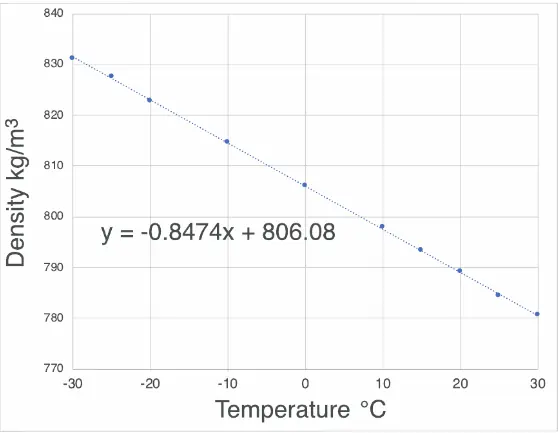
Using the above graph showing the change in density of ethanol with temperature, determine the change in volume of the liquid which is closest to which of the following?
(a) 3.4 *101 m3
(b) 7.1 *10-1 m3
(c) 8.6 * 10-3 m3
(d) 4.4 * 10-4 m3
(e) 4.2 * 10-2 m3
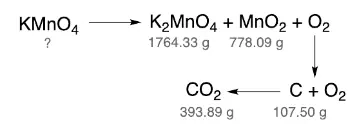
5. Potassium permanganate (KMnO4) is an essential and successful compound for treating equine canker sores that occur on horse's hoofs. It can also be thermally decomposed to release pure oxygen, as shown in the reaction below. Determine the starting amount of KMnO4.
(a) 4573.09 g
(b) 101.77 g
(c) 787.78 g
(d) 2542.42 g
(e) 2828.81 g
6. An extract from liquorice roots, enoxolone (glycyrrhetinic acid), has been proposed as an alternative to sweeteners that are caloric, such as glucose. However, enoxolone is 100 times sweeter than sugar, and causes dangerously high blood pressure.
If 57.55 g of actual enoxolone was isolated and 44.06 g of the element C was found, what is the relative mass of C if the total relative parts mass of enoxolone is 470.70?
(a) 470.70 parts per mass
(b) 360.43 parts per mass
(c) 64.00 parts per mass
(d) 46.36 parts per mass
(e) 178.21 parts per mass
7. Which ion from the list below does not have a complete octet in the 2nd shell?
(a) Ca+2
(b) S-2
(c) K+1
(d) Cl-1
(e) Ar+1
8. Identify the element X from the following anionic electron configuration.
X-4: 1s2 2s2 2p6 3s2 3p6
(a) Si
(b) P
(c) C
(d) Ca
(e) Be
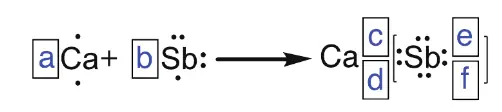
9. The following ionic reaction between two neutrally charged elements results in a salt. Select the answer that matches the correct values for boxes a, b, c, d, e and f.
(a) a = 1, b = 1, c = +1, d = 1, e = -1, f = 1
(b) a = 3, b = 1, c = +1, d = 3, e = -3, f = 2
(c) a = 2, b = 3, c = +2, d = 3, e = -3, f = 3
(d) a = 3, b = 2, c = +2, d = 3, e = -3, f = 2
(e) a = 2, b = 3, c = +2, d = 1, e = -2, f = 3
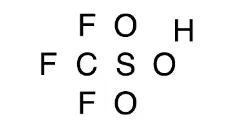
10. The skeletal arrangement of the atoms within triflic acid is shown below. Which answer corresponds to the correct number of electrons in bonds and lone pairs when a charge-separated model is considered?
(a) 16 bonding and 34 in lone pairs
(b) 18 bonding and 22 in lone pairs
(c) 14 bonding and 8 in lone pairs
(d) 20 bonding and 30 in lone pairs
(e) 26 bonding and 16 in lone pairs
11. For the reaction below, determine the coefficients represented by a, b, c and d.
aCuS + bO2 → cCuO + dSO2
(a) a = 1, b = 1, c = 2, d = 1
(b) a = 2, b = 3, c = 2, d = 2
(c) a = 1, b = 2, c = 1, d = 2
(d) a = 4, b = 2, c = 4, d = 2
(e) a = 2, b = 1, c = 2, d = 2
12. The molecular mass (MM) of bilirubin was determined by a veterinary nurse for analytical purposes. Using titration, the concentration (C) of bilirubin in water was determined to be 0.17 M and V = 7.85 101 mL. The water was boiled off, and the mass of the bilirubin was found to be 6.28 g. The molecular mass of bilirubin is which of the following?
(a) 80.35 g mol-1
(b) 579.04 g mol-1
(c) 976.10 g mol-1
(d) 470.60 g mol-1
(e) 372.22 g mol-1
13. Potato late blight (Phytophthora infestans) remains a significant problem in Ireland. The compound dithane 945 is excellent at controlling blight, but is about to be banned due to long-term health effects in animals and humans. To protect a crop of potatoes, a farmer prepared a solution of dithane 945 using 287.00 L of a 1.62 M water-based solution requiring 1238.6 kg of the fungicide. To finish spraying, a second solution with only half the concentration was prepared with a volume of 76.37 L. What mass of dithane 945 was needed to make up the second solution? Select the closest value.
(a) 142.1 kg
(b) 164.8 kg
(c) 329.6 kg
(d) 87.4 kg
(e) 7.9 kg
14.Which of the following indicates the presence of strong intermolecular forces in a liquid?
(a) Low heat of vaporisation
(b) A low vapour pressure
(c) A low boiling point
(d) A low critical temperature
(e) A low melting point
15. An ideal gas is placed in a 6 L container. What will be the final volume if the temperature of the gas was increased from 25 ºC to 54 ºC?
(a) 6.58 L
(b) 12.76 L
(c) 4.45 L
(d) 7.56 L
(e) 25.66 L
16. A gas placed in a 10.5 L container was heated to 100 ºC. After heating, an increase in volume was observed, and the new volume of the gas was 15.5 L. What is the initial temperature of the gas?
(a) 44.2 ºC
(b) -20.4 ºC
(c) 65.4 ºC
(d) -105.5 ºC
(e) -77.3 ºC
17. A mixture of gases in a closed vessel contains 20 moles of nitrogen (N2), 45 moles of hydrogen (H2) and 25 moles of ammonia (NH3). What is the partial pressure of hydrogen at a total pressure of 40 atm?
(a) 10 atm
(b) 5 atm
(c) 20 atm
(d) 14 atm
(e) 31 atm
18. Which of the following would form a buffer solution when equal moles are mixed together?
(a) HCl and NaCl
(b) HCN and NaCN
(c) KNO3 and KOH
(d) Na2SO4 and NaOH
(e) HNO3 and NaOH
19. Which of the following represents the predominant reaction between HCO3-1 and water?
(a) 2HCO3-1 H2O + 2CO2
(b) HCO3-1 + H2O H2CO3 + OH-1
(c) HCO3-1 + H2O H3O+1 + CO32-
(d) 2HCO3-1 + H2O H3O+1 + CO32- + OH-1 + CO2
(e) 2HCO3-1 + H2O H3O+1 + CO2 + 2OH-1
20. If it takes 25 mL of 0.05 M HCl to neutralise 345 mL of NaOH solution, what is the concentration of the NaOH solution? Select the nearest value.
(a) 3.60 10-3 M
(b) 2.50 10-1 M
(c) 1.6010-2 M
(d) 9.50 10-3 M
(e) 8.80 10-1 M
21. The first law of thermodynamics states which of the following?
(a) The entropy of a system approaches a constant value as the temperature approaches absolute zero
(b) Energy can neither be created nor destroyed in chemical reactions and physical changes
(c) The combined amount of energy in the universe is constant
(d) The state of the entire universe, as an isolated system, will always increase over time
(e) Energy can be converted into matter
22. Which of the following actions or reactions is endothermic?
(a) A pinch of salt dissolves in water
(b) Methane reacts with oxygen in a combustion reaction
(c) A match burns
(d) Drops of molten candle solidify
(e) Water is freezing into ice
23. How much electrical energy is consumed by a 75 W bulb burning for 1 h?
(a) 150 kJ
(b) 75 kJ
(c) 270 kJ
(d) 310 kJ
(e) 63 kJ
24. Burning 1 mol of propane (C3H8) releases 2201 kJ of energy. How much energy is released when 15 mol of propane is burned? Choose the closest value?
(a) 2200 kJ
(b) 5000 kJ
(c) 33000 kJ
(d) 14000 kJ
(e) 7800 kJ
25. A vessel contains 500 g of water at a temperature of 3 ºC. The vessel is heated, and the internal energy of water increases by 21 kJ. What is the temperature of water after heating? The specific heat capacity of water is 4200 J/kg ºC.
(a) 6 ºC
(b) 12 ºC
(c) 13 ºC
(d) 42 ºC
(e) 23 ºC
Get Answer of QUALIFI L6 Diploma in Global Teaching Unit 1: Assessment Before Deadline
CHEM00020 is an Introductory Chemistry module at University College Dublin (UCD). It covers basic topics like atomic structure, chemical bonding, and acids and bases. Students often look for assignment help with exams and practical work. For balancing equations, simple calculations, and written answers, online exam help services can support core chemistry concepts.

Get Your Free Academic Quote
No hidden fees · Instant response · 100% confidential

Let's Book Your Work with Our Expert and Get High-Quality Content