Workingment thesis writing service covers Masters, MPhil, and PhD level work across all disciplines, with writers assigned by subject area, not by availability. If you need a thesis paper writing service that understands UK academic requirements.



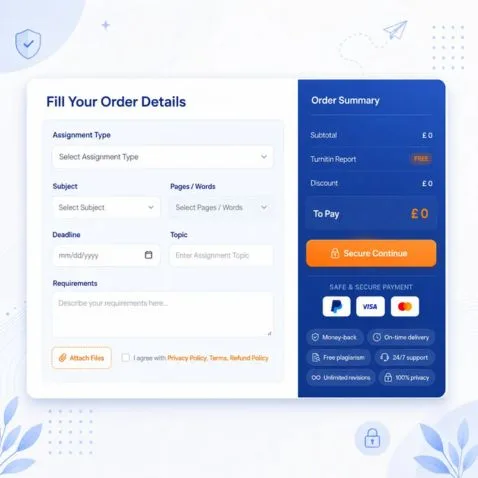
Get Your Free Academic Quote
No hidden fees · Instant response · 100% confidential
Every feature below is a confirmed part of how Workingment operates, not a marketing position.

Every completed thesis order is delivered with a Turnitin originality report at no extra cost.

All thesis writing is produced in British English, matching the conventions expected by UK universities.

Writers follow the referencing version your department uses, not a generic interpretation of the style.

Your thesis goes to a writer whose postgraduate background covers your discipline, not whoever is next available.

If the delivered work does not meet your agreed brief, revisions are made at no extra charge until it does.

Your personal details, order information, and institution are never shared with third parties.
If you are unsatisfied with our best thesis writing service, contact us immediately for a free revision.

You can contact the team at any point during your order if you need to update requirements or ask a question.

If your expectations are not met, we offer a money back guarantee, ensuring a risk-free experience. Rest assured of your investment in us.
Our professional thesis writers will help you reduce your academic stress!

Professional & Vocational Qualifications Expert
Dr. Rachel Summers holds a PhD in Occupational Health from the University of Sheffield and carries professional certifications in NEBOSH, CIPS, and CII. She specializes in vocational and professional qualification coursework, having supported thousands of working professionals upgrade their credentials through quality academic submissions.
Hire Writer
Hire a thesis writer from Workingment today!
Order NowStudents do not always need a full thesis written from the first page. Some need a single chapter. Others need their existing draft edited to meet their university's standards. Our custom thesis writing service is built around what you actually need, not a fixed package that forces you to order more than that.
Here is what you can order:
In UK academic conventions, the two terms refer to different things, but the picture is not as clean as most guides suggest. The general rule is this: a dissertation is the extended research project submitted at taught Masters level (MA, MSc, MBA), while a thesis is the document submitted for a research degree such as an MPhil, PhD, or DBA. That distinction holds at most UK institutions.
The complication is that some universities apply the terms differently or use them interchangeably. UCL uses "thesis" for PhD and MPhil submissions. At Nottingham, research Masters students submit a dissertation.
Some departments within the same university use both words for an identical document. If you are unsure which applies to you, check your department handbook rather than relying on a general definition.
What does not vary is the scale of what each level requires. A Masters dissertation typically runs 15,000 to 20,000 words. An MPhil thesis sits in the range of 40,000 to 60,000 words. A PhD thesis is commonly between 80,000 and 100,000 words, though the precise maximum differs by institution.
Workingment's thesis writing service UK covers all of these. Whether your university calls it a thesis or a dissertation, and whether you are writing at Masters, MPhil, or PhD level, the service applies.
Every writer on the Workingment team holds at least a Master's degree in their subject area. We do not use generalist academic writers.
Each member of the team was recruited for a specific discipline, which means when your order comes in, it goes to someone who already understands the conventions, terminology, and academic expectations of your field.
Subject matching works as follows: your thesis is assessed against the topic and discipline you submit, then allocated to one of our 50 or more writers whose postgraduate background aligns with that area.
A business management thesis does not go to a writer whose expertise is in social sciences, and a nursing thesis does not go to a writer whose background is in law.
Standard turnaround for a Masters thesis chapter is seven days from order confirmation. Full PhD thesis projects require a longer window depending on word count and chapter scope. If your deadline is closer, urgent turnaround is available from 24 to 48 hours.
Thesis writing service UK pricing starts from £9 per page. The final cost depends on your academic level, word count, subject, and deadline. PhD-level orders and urgent deadlines carry a higher rate than standard Masters work.
Rather than a fixed price table that may not match your order, we provide a confirmed quote based on exactly what you need. Tell us your topic, word count, and deadline and we will send you a price before any work begins.
Every thesis chapter has a specific job. Knowing your research topic is not enough if the chapters do not each do what UK examiners expect them to. Below is what each one must achieve at Masters and PhD level.
This is where students who need thesis writing help most often find the clearest answers, because supervisors frequently leave this detail out.
The introduction must establish why your research exists. It opens with background context, narrows to a specific problem or gap in existing knowledge, then states your research aims and objectives precisely.
From there, it explains the significance of the study, why this gap matters and what answering it adds to the field. The chapter closes with a roadmap that tells the examiner exactly what each subsequent chapter does. At Master's level, this chapter typically accounts for around five to seven per cent of your total word count.
The literature review is not a summary of sources. UK examiners at both Masters and PhD level expect critical engagement, meaning you compare studies, identify where scholars disagree, evaluate methodological strengths and weaknesses, and build a case for the gap your research fills.
The most effective structure for a UK thesis is thematic, grouping the literature by key debates or concepts rather than listing studies by author or date. On source recency, most disciplines expect sources published within the past ten years, with older landmark works cited only where they remain foundational and justified as such.
The methodology chapter is the most technically demanding section of any thesis, and the one where the most marks are lost. It requires you to state your philosophical stance, your ontological position on the nature of reality and your epistemological position on how knowledge is produced and explain how that stance justifies the research design you chose.
From there, you must cover your data collection methods, your sampling strategy with inclusion and exclusion criteria, and your analytical approach. Ethical approval must be addressed explicitly: whether approval was granted by your institution's ethics committee, on what date, and by which body.
Describing what you did without justifying why you chose that approach over alternatives is the single most common methodology error at UK postgraduate level.
The findings chapter presents your data as it is without interpretation. Its job is to report results in a structured, neutral manner, organised by research question or theme, so the examiner can follow what your study actually produced.
For primary research, this means presenting interview themes, survey data, or experimental results clearly. For secondary data studies, it means reporting the patterns identified through your analytical method. No new literature belongs here, and no conclusions should be drawn in this chapter. Those come next.
The discussion chapter is where your findings become knowledge. Each result is interpreted against the literature you reviewed, confirming, extending, or contradicting what prior studies found.
UK examiners treat this chapter as the intellectual test of the thesis: they want to see you move confidently from data to meaning. Limitations must be addressed here directly and honestly, not buried or minimised.
Acknowledging the boundaries of what your data can support is a mark of scholarly maturity, not weakness. Avoid broad claims the data cannot carry.
The conclusion is not a summary of the thesis. Its specific job is to state your original contribution to knowledge in plain, direct terms, return to each research objective and confirm it has been met, and identify the limitations of the study.
Concrete recommendations follow, tied specifically to your findings rather than offered as general observations. The chapter closes with two to three directions for future research that arise logically from what your study left open.
No new data or new arguments belong here; introducing either at this stage is a common and serious error that examiners notice immediately.
Workingment assigns each order to a writer from the relevant subject discipline, not the next available person on a list. Below are the four main subject clusters our professional thesis writers cover, with examples of the research areas they regularly work across.
Our writers support MBA, MSc, and DBA students across the full range of business research: corporate strategy and competitive positioning, human resource management and organisational behaviour, financial performance and capital markets, marketing strategy and consumer behaviour, and entrepreneurship and new venture creation.
DBA students working on applied management problems are assigned writers with prior doctoral-level business writing experience, not generalist academic writers.
This cluster covers nursing, psychology, social work, public health, and education. Whether your thesis examines patient outcomes, clinical practice, mental health interventions, social care policy, or educational attainment, the writer assigned holds a postgraduate qualification in your specific area.
Our PhD writing service for health students also accounts for the ethical approval requirements and clinical referencing conventions that thesis work in this discipline demands.
We support thesis writing across computer science, software engineering, data science, environmental science, and related engineering disciplines.
Research in this cluster often involves quantitative data, computational methods, and technical literature that requires subject-level understanding to present accurately. Writers in this group hold postgraduate STEM qualifications and are experienced in technical academic writing at MSc and PhD level.
This cluster includes LLM thesis writing, history, English literature, international relations, and criminology. Law thesis work is handled by writers with working knowledge of OSCOLA referencing and experience in both doctrinal and socio-legal research approaches.
Humanities writers are trained in the close reading and textual analysis conventions that distinguish postgraduate work in literature, history, and international relations from undergraduate-level writing.
Referencing errors are among the most common reasons UK thesis marks are reduced at submission. Our writers format every thesis to the style your university specifies, taken directly from your department handbook rather than a generic version of the style.
The thesis referencing styles we work with:
If your university uses an adapted version of any of these styles, send us the handbook and your writer will follow it exactly.
If you're searching for academic help , here are some top-quality academic services available to you:
What Do Our Writing Experts Offer?
Get access to our premium assignment solutions to get academic success whether it's a report, dissertation, report, ppt, case study, and essay. Our Writers are always ready to help you.
Book qualified writers to guarantee an A+ in academic papers.

Workingment thesis writing service made my academic life quite easy. It gave me clarity and confidence on my topic, which was missing earlier. Their expert team refined my research and delivered a high-quality thesis. I would highly recommend their services!
Writing the hospitality management thesis was very challenging for me, but Workingment's help made everything manageable for me. They completed my thesis writing task and guided me step-by-step. Thanks to their professional approach, I submitted my thesis on time and scored good.
The experts at Workingment are very knowledgeable. They guided me through every step of my biochemistry thesis and cleared my doubts. With their help, I wrote an impactful thesis which helped me to score high in my all batch.
Workingment's thesis writing service for all subjects is very reliable and efficient to every UK Student. They helped me take my research to an advanced level. Due to their support, I completed my submission confidently. Highly recommend their service!
I had a lot of confusion about the structure and content of my MBA thesis, but Workingment solved all my problems. I really liked their professional approach and timely feedback. Now I have full confidence in my thesis.
Going through the business management thesis writing process with the Workingment team has made me feel that my academic worries have been reduced. They not only improved my writing but also helped me understand concepts more deeply. Definitely a game-changer for me! Thanks to all workingment team.
There can be no better option than Workingment for engineering thesis writing in the UK. They added clarity and depth to my research. Their editing and proofreading work is exceptional. I am very impressed with his service. They not only delivered thesis report but also along with this a report of plagiarism and AI-free content was attached.
Workingment made my international marketing thesis writing journey stress-free. Their team is very supportive and experienced in writing a thesis for any topic accurately. They refined my research and created an impactful thesis. It was a great experience for me, I would like to recommend it to all UK students.
I found the topic of my machine learning thesis very complex, but the experts at Workingment simplified every complexity. They gave me timely feedback and improved my writing skills a lot. Highly recommend their services to UK students!
Workingment's help was very valuable and comfortable. With their help, I forgot the pressure of writing my software engineering thesis. They helped me structure my research and improve my writing. Now, I am confident that I can submit my assignment before the deadline. I want to approach their services again. Thank you, Workingment!
I was very nervous about the topic that I got for the statistics thesis, I never knew where to start so one of my friends recommended the services of Workingment. It was really amazing and beyond my expectations as I got 100% human-made content that was well structured and accurate and met my university guidelines. I highly recommend it.
The working team gave me the clarity and guidance I needed in economics thesis writing. They helped me take my research to the next level. Their services were very helpful to me. I got good score and it was really appreciating for me. Thanks to the supportive team of Workingment.
I took the services of Workingment for my Python programming thesis writing, and it was a great decision. Their team guided me at every step and discussed the process with me. It was very helpful to me to appreciate in front of the whole class professor. Now I am feeling proud of my work. Thanks a lot.
Writing the hotel management thesis was initially a very difficult task, but the Workingment team put an end to my stress. They streamlined my research and made my writing polished. Their professional and reliable support is very valuable!

In most UK universities, a thesis refers to the document submitted for a research degree - typically an MPhil or PhD. A dissertation is the equivalent at Masters level, such as an MA, MSc, or MBA. Some institutions use the terms interchangeably, so it is worth checking your own university's guidance. Workingment covers both.
Yes. You can order a single chapter - a literature review, methodology, findings section, or any other part - without commissioning the full document. Just specify which chapter you need and provide the brief when placing your order.
Your thesis writer will follow whichever referencing system your university specifies. Workingment covers Harvard, APA, OSCOLA, Vancouver, MLA, MHRA, and Chicago. State the required style clearly in your order brief.
Turnaround depends on the scope of work. A single chapter can typically be delivered within 2 days. A full Masters thesis usually takes between 1 and 2 weeks. Urgent delivery is available if you have a pressing deadline.
Every order is run through Turnitin before it is sent to you. Your originality report is included with the delivered work.
Revisions are included as part of your order. If the delivered work does not match the agreed brief, your writer will revise it at no additional charge.
Our thesis writing service covers all postgraduate levels - Masters, MPhil, and PhD - across a range of subject disciplines. Whether you need a single chapter or complete support with your PhD thesis, we handle both.
Workingment does not share any student information with universities or other third parties. Every order is handled with complete confidentiality.
Let's Book Your Work with Our Expert and Get High-Quality Content




 Statistics Thesis Help


