Workingment's business law assignment help in the UK is delivered by writers with a minimum LLM from University College London, fully OSCOLA-referenced and structured around your module marking criteria.



Get Your Free Academic Quote
No hidden fees · Instant response · 100% confidential
There are specifics behind every point below. None of them are generic promises.

Every assignment we produce is referenced in OSCOLA, the citation style required at UK law schools, as standard. If your module specifies a different referencing format, we follow that instead.

Your writer reads the assignment brief and marking rubric before writing begins. The structure and argument are built around the grade descriptors for your target band, not general topic coverage.

A contract law assignment goes to a writer with documented experience in contract law specifically, not a general legal writer. The same principle applies across every subject area we cover.

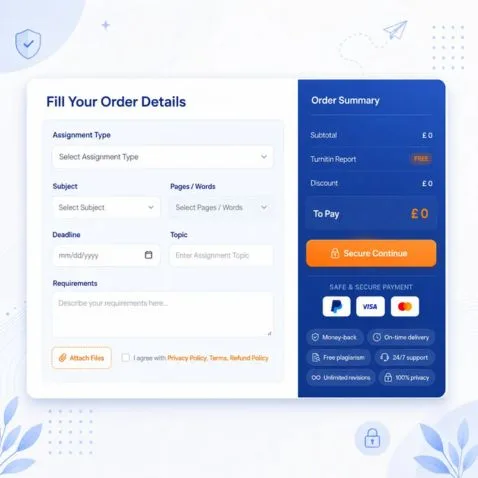
A Turnitin originality report is included with every completed assignment. You receive it alongside the finished work so you can check it yourself before handing anything in to your institution.

If the delivered work does not meet your original brief, you have seven days from the delivery date to request a revision. All revisions are included at no additional cost.

Standard assignments are delivered within seven days. If you are working to a tighter deadline, a 48-hour urgent turnaround is available. You can select this option when placing your order.
Business law homework help from professional law experts

Law & Legal Studies Specialist
Michael O'Brien is a graduate legal practitioner with an LLM at University College London, and an LLB Hons at the University of Bristol. He is a specialist in various fields of law and has produced high-quality legal writing, on a consistent basis, to students in the UK, Ireland and Australia.
Hire Writer
Resolve All Your Issues with the Best Business Law Assignment Writing Service
Order Now International Business Law
Banking and Finance Law
Dispute Resolution
Regulatory Compliance
International Business Law
Banking and Finance Law
Dispute Resolution
Regulatory Compliance
Business law assignments set by UK universities are not tests of a single legal area. A typical LLB assignment in business law can require you to engage with company law, contract law, tort, employment law, competition law, intellectual property, and commercial law within the same question.
Two assignment formats are common. Problem questions give you a scenario and ask you to advise a party on their legal position, answered using the IRAC structure: identify the Issue, state the applicable Rule, apply it to the facts, then give a Conclusion.
Legal essays require you to critically analyse a legal principle, a statute, or a case, and description alone is not enough. A First-class answer requires an argued position supported by primary and secondary sources.
Business law assignment writing in the UK demands OSCOLA referencing, not Harvard or APA. Cases are cited with their law report reference and statutes by section number. Getting this wrong costs marks regardless of the strength of your legal argument.
UK universities grade on three bands:
Each band expects a different depth of legal reasoning and citation accuracy. Primary sources, Acts of Parliament, binding case law, and academic commentary are what separate one band from the next.
Business law tasks vary in format, and the approach changes depending on what your module requires.
These apply a set of facts to the relevant law using the IRAC method: Issue, Rule, Application, Conclusion. Marks depend on accurate case citation, statutory reference, and structured legal argument, not just identifying the correct area of law.
Essays require critical engagement with a statute, principle, or academic debate, not description. Your writer will construct a clear argument, use relevant academic commentary, and format citations in OSCOLA throughout.
A case note summarises a legal decision and analyses its significance, reasoning, or impact on the law. These appear frequently in company law and contract law modules and require more than a basic case summary.
Longer pieces often span multiple topics or combine practical application with reflective commentary. Your writer structures the response to address each requirement of the brief in sequence.
Doctrinal legal research at this level requires a focused research question, a literature review, a methodology section, and a sustained argument across the full word count.
Shorter tasks that are often set but rarely prioritised. We cover these alongside major assignments, so nothing on your module list is left unaddressed.
Our writers cover all major business law topics, with accurate reference to UK legislation and case law across every subject area.
A valid contract requires offer, acceptance, and consideration, and assignments typically test what happens when formation fails or one party breaches.
Remedies vary: damages are standard, but specific performance and rescission apply in particular circumstances, and misrepresentation under the Misrepresentation Act 1967 carries its own consequences.
Consumer-facing contracts fall under the Consumer Rights Act 2015, while the Sale of Goods Act 1979 continues to apply in business-to-business transactions.
The Companies Act 2006 governs incorporation, separate legal personality, and the seven general duties directors owe to their company under sections 171 to 177.
Assignments regularly address shareholder rights, minority protection, and derivative claims under section 260, often through scenario-based questions.
The UK Corporate Governance Code applies to listed companies and sets standards on board structure, audit, and accountability alongside the statutory framework.
Negligence dominates this area, and Donoghue v Stevenson [1932] AC 562 remains the foundational authority for duty of care and the neighbour principle.
Assignments require students to work through duty, breach, causation, and remoteness applied to the given facts. .
Occupiers' liability under the 1957 and 1984 Acts, and product liability under the Consumer Protection Act 1987, extend these principles into commercial contexts.
Unfair dismissal is governed by the Employment Rights Act 1996, requiring a potentially fair reason and reasonable employer conduct.
Discrimination claims fall under the Equality Act 2010, which covers nine protected characteristics including age, sex, race, and disability.
TUPE, the Transfer of Undertakings (Protection of Employment) Regulations 2006, and whistleblowing protections under the Public Interest Disclosure Act 1998 are also regularly examined.
Business law IP assignments cover copyright under the Copyright, Designs and Patents Act 1988, trade marks under the Trade Marks Act 1994, and patents under the Patents Act 1977.
Passing off provides common law protection where no registration exists. Digital and software contexts require students to apply these rules to domain disputes, open-source licensing, and software ownership questions.
The Competition Act 1998 contains two prohibitions: Chapter I bans anti-competitive agreements including price-fixing and market-sharing, and Chapter II prohibits abuse of a dominant market position.
The Competition and Markets Authority (CMA) enforces both under an independent UK regime since Brexit, with no EU Commission involvement.
Case study questions ask whether a commercial arrangement breaches either prohibition and what enforcement action the CMA could take.
Cross-border contracts raise questions about governing law, jurisdiction, and dispute resolution. International arbitration under the UNCITRAL Model Law or the rules of the London Court of International Arbitration is the standard mechanism for resolving disputes between parties in different countries.
Trade agreements, Incoterms, and conflict of laws rules regularly appear in scenario questions on international sale of goods contracts.
If you're searching for academic help , here are some top-quality academic services available to you:
What Do Our Writing Experts Offer?
Get access to our premium assignment solutions to get academic success whether it's a report, dissertation, report, ppt, case study, and essay. Our Writers are always ready to help you.
Book qualified writers to guarantee an A+ in academic papers.

Hey everyone! It's Charlie Here, I just wanted to share useful information about the assignment help service of Workingment. Indeed, I adopted it for my final year subject and it was a game-changer. Because of the great details that they provided, I achieved 70 marks out of 100 in my final year assignment project. It was great to have their support, they were very experienced and provided quality work.
Hey folks, Raheem here! I completed my Environment and Health course, all thanks to Workingment who is doing an exemplary job in the assignment section. As time went by, I was having a really tough time but their assistance was excellent. I must say that I didn’t have much expectations for this exam, but I was able to score 60 marks and I can only imagine how much better I could have done if I had paid more attention. I would like to suggest Workingment for assignment help.
Hey everyone, it's Mia! ended my course recently with an A+ Grade, and I can’t fail to give a shoutout for this magnanimous service from Workingment. I was really struggling a lot with my course however, with their assistance I was able to keep up and get a 80 percent score. They were incredibly friendly, and they made everything very clear and understandable, even when I had numerous questions.
Hey folks, it's Amelia! Hi, I hope everyone had a great week. I have just completed my Contemporary Marketing course and had a good experience today using Workingment’s assignment help service. It was really annoying that I felt ill but with their help, I passed by somehow with a 65% score. They always made me understand everything that was tough and did not mind helping whenever I asked. I would highly recommend their service.
I wish I could have contact with such an excellent team then I could have passed in my last assignment without fail. However, I feel it is not too late to connect with such a team who provide this type of excellent academic support. I received the result today of the last assignment that I submitted. I got 76 out of 100 which was beyond my expectation. Your service is really recommended to other students.
It was a great achievement for me to complete my research work on time and it was only possible for your excellent support. I would like to thank all the experts who contributed to producing excellent research work. I have received excellent guidance from your team and the insightful feedback that I have received helped me in improving. I really appreciate your service.
I am writing this to highlight before the readers that this organization really provides excellent dissertation help with the knowledgeable experts. I took services for the dissertation help which was highly beneficial for me. I am very happy to declare that I am fully satisfied with your dissertation help. Just try it and find excellent results.
I was anxious about doing my coursework, however excellent support that I received from your team is highly appreciable. You guys are extremely knowledgeable, and I really appreciate your all-encompassing support. I appreciate your help.
Hello, I received my results today and I'm delighted to share with you all that I received 71 out of 100 on my failing file, which was completed by you guys. I really appreciate it. Thanks again for your excellent support. This is the second time I am using your services. I already recommended your excellent services. I will definitely recommend others again.
My friend recommended their help and I am very happy to say I never expected a higher grade in the very first assignment where I took help from them. I would recommend others who are struggling to tackle challenging topics and looking for higher grades.
Hello guys. The topic that I assigned them seemed to be highly complicated however I got exceptional guidance from their exports and did my assignment excellently. They have knowledgeable exports and their application of knowledge in doing the course work is excellent.
I can say that the assignment help services which are delivered by you guys are really amazing. Highly appreciable. I really found my lacking when I compared my previous coursework that I personally did with your work. It was a good learning experience for me. Thanks.
You guys are really knowledgeable and your comprehensive support is really appreciable. Thanks for your support. Yesterday I got the results of my final assignment. I got 81 out of 100 in the HRM assignment. Thank you.
It was an invaluable service and I am glad to reveal that the assignment help that I received made a big difference. There is no doubt that your experts really work hard to deliver excellent service. I especially want to thank the experts who did my economics assignment. It really helped me in improving my grades.

Business law at UK universities covers the legal rules governing commercial activity. Core areas include contract law, company law, tort law, employment law, intellectual property, competition law, and international trade law. Most modules require students to apply UK statutes, analyse case law, and reference in OSCOLA.
Structure depends on the task type. Problem questions follow the IRAC format: Issue, Rule, Application, Conclusion. Legal essays require a clear argument in the introduction, body paragraphs that develop the case using statutes and case law, and a conclusion that draws the argument together. Both require OSCOLA citations throughout.
Yes. Workingment offers a 48-hour urgent turnaround for business law assignments. Standard delivery is seven days. Select the turnaround option that matches your deadline when placing your order, and confirm any specific requirements in your brief.
Yes. OSCOLA is used as standard on all business law assignments, since it is the referencing system required by UK law schools and most university law departments. If your module specifies a different style, state it in your brief and the writer will follow it.
Every assignment is written from scratch against your specific brief. A Turnitin originality report is provided with the completed work. Writers draw on primary legal sources, including statutes and case law, and reference all secondary material rather than reproducing existing content.
Company law and contract law generate the most complex assignments. Directors' duties under the Companies Act 2006, corporate personality, and the rules on consideration require precise statutory interpretation and accurate case citation. Tort law in commercial contexts, particularly negligence, demands careful application of the standard of care and precedent hierarchy.
Yes. Workingment writers include LLM graduates and PhD researchers in law. Postgraduate assignments require a higher degree of critical analysis, engagement with academic debate, and independent doctrinal research using legal databases such as Westlaw UK and LexisNexis. State your level clearly in the brief.
Let's Book Your Work with Our Expert and Get High-Quality Content