Looking for Plagiarism-Free Answers for Your US, UK, Singapore, New Zealand, and Ireland College/University Assignments?
Talk to an Expert| Category | Assessment | Subject | Economics |
|---|---|---|---|
| University | University of st. Andrews | Module Title | EC1002 Microeconomics |
|
MODULE CODE:
|
EC1002 |
| MODULE TITLE: | Microeconomics |
|
EXAM DURATION:
|
2 hours |
|
EXAM INSTRUCTIONS: |
(a) This exam has 8 questions, each with subquestions. Answer all questions and subquestions. (b) The weight of each question out of 100% is given in brackets. |
|
|
(c) Calculators are permitted. |
You Must Hnnd In This Paper at the End Of the Exam
Please Do Not Turn Over this Exam Paper Until You Are Instructed to do so
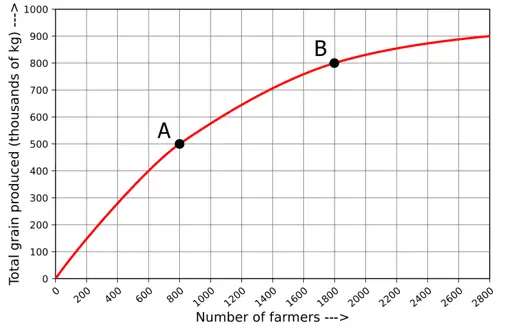
1) [10%] Produc.on func.on. Consider the produc/on func/on below, showing grain produc/on as a func/on of the number of farmers working a large plot of land.
a) Compare points A and B on the figure. At which point is the average product of labour higher? In 1 sentence, explain how you determined this.
b) Is the marginal product of labour higher at A or at B? State your answer.
c) Is the marginal product of labour increasing, decreasing or constant with the number of farmers? In 1 sentence, explain how you can see this on the graph.
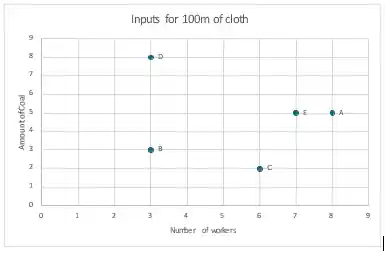
2) [10%] Different technologies. Consider the graph below, which plots the inputs required to produce 100 meters of cloth using 5 different technologies.
a) Are any of the technologies dominated? List any dominated technologies, describing in 1 sentence how you know they are dominated.
b) Suppose wages w=4 and cost of coal p=2. Which is the cost-minimizing technology? Show your work.
3) [20%] Consump.on-leisure. Suppose Sam has 3 weeks (21 days) in January before classes start. Sam has a job that pays £50 a day, and she can choose how many days to work. On a carefully-labelled graph with days of free /me on the x-axis and consump/on on the y-axis:
a) Illustrate Sam’s op/mal choice for these 3 weeks (label this point A).
b) Suppose now Sam’s job increases her daily wage to £75. Draw Sam’s new feasible fron/er and illustrate her new op/mal choice (label this point B).
c) Decompose the change in Sam’s choice of free /me between A and B into the income and subs/tu/ons effects, illustra/ng these on your graph with precise arrows.
d) Is the net effect of this change on Sam’s free /me posi/ve or nega/ve? State your answer in one sentence.
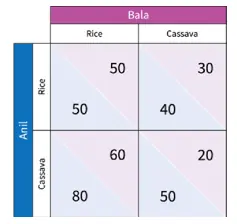
4) [15%] Pareto Criterion. Consider the 2x2 game in matrix format below.
a) Find any Nash equilibria of this game. State your answer.
b) Pu]ng Anil’s payoffs on the x-axis and Bala’s payoffs on the y-axis, represent the four sets of payoffs graphically as four points.
c) Are any of the four payoffs Pareto efficient? Does any of the four sets of payoffs Pareto-dominate the others? Explain in 1-2 sentences how you can tell this.
d) Will this game result in a Pareto efficient outcome? Explain in 1 sentence.
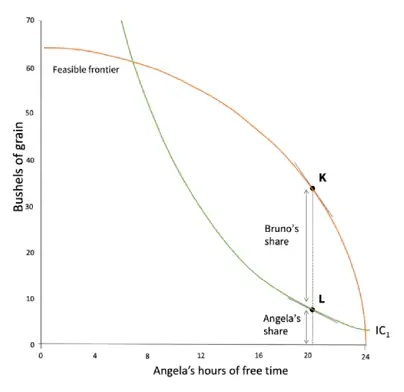
5) [10%] Bruno and Angela. Consider the figure below, which plots Angela and Bruno’s consump/on, and Angela’s free /me. Angela is a farmer, and Bruno is a landowner. Bruno can make a take-it-or-leave-it offer to Angela determining how much grain and how much free /me she gets. If Angela doesn’t work for Bruno, she can take an outside op/on which is on the indifference curve labelled IC1 (the outside op/on is not shown).
a) Could point L be Bruno’s op/mal offer to Angela? Explain why or why not: your explana/on should be precise and technical (1-3 sentences).
b) What condi/on(s) must be sa/sfied for Bruno’s offer to Angela to be his op/mal offer? Express this or these condi/on(s) in equa/on form, and explain them briefly (1-2 sentences).
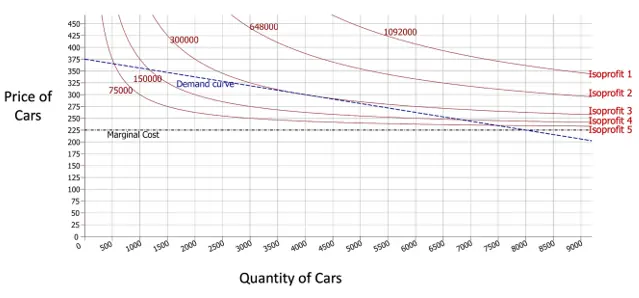
6) [15%] Monopoly. Consider the figure below, illustra/ng the market for Preay Cars.
a) What is the monopolist’s profit-maximising price and quan/ty? How much profit does the monopolist make at this point?
b) Calculate the producer and consumer surplus at the profit-maximising point.
c) What is the socially op/mal price and quan/ty? Calculate the deadweight loss when produc/on takes place at the monopolist’s profit-maximising level.
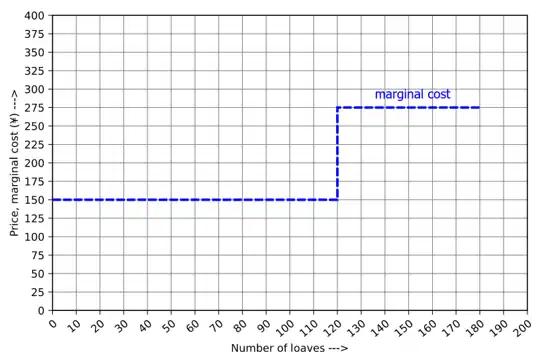
7) [10%] Compe..ve markets. Consider the figure below, showing the marginal cost of a single bakery selling bread in a compe//ve market. The bakery can make at most 180 loaves per day
a) Calculate the producer surplus when the market price is ¥225. Show your work.
b) Suppose the market price drops to ¥175. How much bread will the bakery produce? Calculate the producer surplus in this case. Show your work.
c) Suppose the market price drops to ¥1.00. What is the producer surplus now? Explain in 1-2 sentences.
8) [10%] Externali.es. Consider the marginal cost of trivets illustrated in the diagram below.
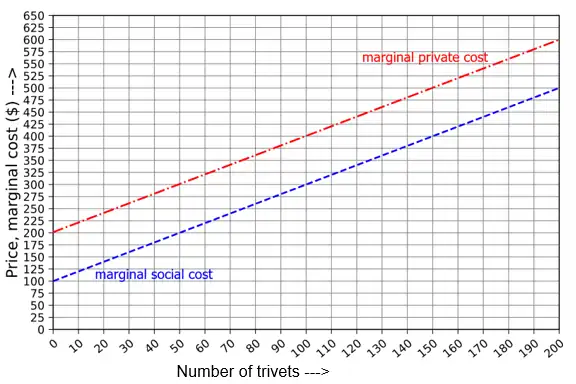
a) Based on the diagram, does the produc/on of trivets have a posi/ve or nega/ve externality? Explain in 1-2 sentences.
b) Suppose the market price for trivets is $400. What is the socially op/mal level of produc/on? What is the privately op/mal level of produc/on?
c) Suppose the government sets a $100 per-unit tax on the sale of trivets. Comment on how this would change the level of produc/on of trivets in the market. Will this internalise the externality? Answer in 1-3 sentences.
Get Answer of EC1002 Microeconomics Assessment Brief
Get Experts Help on WhatsAppFor students studying EC1002 Microeconomics at the University of St Andrews, Workingment Academy Writing Services offers academic guidance with assessment questions covering production functions, labour productivity, cost-minimising technologies, consumption and leisure choices, income and substitution effects, Nash equilibrium, and the Pareto criterion. Get help understanding monopoly pricing, profit maximisation, consumer and producer surplus, competitive markets, and externalities. Our Economics Assignment Help covers key concepts and assessment requirements, while our Assignment Help UK services provide guidance across different academic subjects. Access 100% original, AI-free and plagiarism-free assignment answers with Workingment.

Get Your Free Academic Quote
No hidden fees · Instant response · 100% confidential

Let's Book Your Work with Our Expert and Get High-Quality Content