Looking for Plagiarism-Free Answers for Your US, UK, Singapore, New Zealand, and Ireland College/University Assignments?
Talk to an Expert| Category | Assignment | Subject | Financial |
|---|---|---|---|
| University | Character Insurance Institute | Module Title | AF8-Retirement Income Planning Assignment 3 |
| Word Count | 3000 |
|---|
Recommend and justify a suitable and tax‐efficient investment strategy for Patrick and Jane to enable them to generate a sustainable and tax-efficient income of £45,000 per a
Get AF8-Retirement Income Planning Assignment 3 Answer Help From CII Writers
Chat with a writer and get 100% original workThe purpose of this assignment is to make recommendations for a suitable tax-efficient investment strategy for Patrick and Jane to enable them to generate a sustainable income from their liquid assets from the date of Patrick’s retirement. The information used for the assessment was provided at a meeting with Patrick and Jane.
Patrick has recently been diagnosed with a heart condition which will require ongoing treatment so has decided to retire in a few months’ time.
Patrick and Jane currently have their home on the market and are planning to purchase a new property for approximately £400,000 and will release funds of £200,000 after moving costs, to provide additional income in retirement.
Objectives
Patrick and Jane’s immediate objectives are to ensure that they have sufficient capital for the next few years to cover their £70,000 of travel plans and other expenditure. Over the longer term, they want to ensure that they are able to generate a joint gross income of £45,000 per annum, in today’s terms throughout retirement.
There is an immediate requirement to ensure capital of £70,000 is available for travel costs over the next 3 years. Once Patrick retires, the only income they will only have initially is Jane’s reduced annual salary of £10,000 plus their investment income. There is also an immediate need for additional monies to meet the shortfall on their income following Patrick’s retirement and Jane’s partial retirement.
Patrick is currently a higher rate taxpayer, and Jane is a basic rate taxpayer. However, Patrick may be a basic rate taxpayer for the 2025/2026 tax year depending on when he actually retires. Jane’s savings income is within her Personal Savings Allowances of £1,000 and her dividends are below her Dividend Tax Allowance of £500. For Patrick his half of the savings income will be covered by his £500 Personal Savings allowance, but the excess of £112.50 will be subject to tax at 40% (depending on his final tax status for the 2025/2026 tax year) which equates to £45. His half of the dividend allowance will fall within his allowance of £500. The balance of their investment income comes from their ISAs and is tax-free.
The onshore Investment Bond is a single premium life insurance policy and as such, the life company pays the equivalent of Basic Rate Tax on the funds’ income and profits. They are both likely to be basic rate taxpayers for the 2025/2026 tax year. Therefore, if the Investment Bond is surrendered in full, they are unlikely to have a tax charge due to top slicing.
The Managed fund in which the investment is currently held has 40% in UK equities and 40% in global equities. The Investment Bond has been held since June 2013 during which time the FTSE All Share Index has risen approximately 12% and the MSCI International World Index has increased by 79%. This compares to the Investment Bond’s increase of 13% over the same period.
The Investment Bond does not allow the use of their annual ISA and CGT allowances. Together with the apparent under-performance, I recommend encashing it to help fund their travel costs and income shortfall over the next three years. In order to calculate any potential tax payable, the gain of £30,000 is divided by the number of years held i.e., 12. This slice of £1,250 is divided equally between Patrick and Jane and added to their respective incomes for the current tax year. This is likely to result in both Jane and Patrick remaining as Basic Rate taxpayers, so there will be no further tax payable on the gain. However, Patrick’s exact tax position should be checked depending on when he retires and if he does turn out to be a higher rate taxpayer for the 2025/2026 tax year then the investment bond should be assigned to Jane prior to surrender.
Patrick and Jane require a gross income of £45,000 per annum from the time that Patrick retires. The following is a summary of the capital and pension funds available to meet their income objective and their travel costs.
| Description | Patrick | Jane | Joint |
| Current account | £3,000 | £1,500 |
|
| Savings account |
|
|
£35,000 |
|
OEIC/Unit Trust holdings- UK Recovery funds |
|
|
£42,000 |
|
OEIC/Unit Trust holdings - Emerging Markets Growth |
|
|
£33,000 |
|
Stocks & Shares ISAs - US Equity Tracker fund |
£45,000 |
|
|
|
Stocks & Shares ISAs - UK FTSE 100 Tracker fund |
|
£40,000 |
|
| Released from sale of property |
|
|
£200,000 |
| Balance of proceeds from Bond |
|
|
£85,000 |
| Pension Plans | £210,000 | £85,000 |
|
|
Total |
£258,000 | £126,500 | £395,000 |
Patrick was a higher rate taxpayer but may become a basic rate taxpayer for the 2025/2026 tax year, although he will have utilized his Personal Allowance. From April 2026 he will no longer have a salary so his Personal Allowance will become available again.
Jane will also remain a basic rate taxpayer for the 2025/2026 tax year. From April 2026, her reduced salary of £10,000 will not be sufficient to fully utilise her Personal Allowance.
Pension income is treated as earned income for tax purposes and can be set off against his Personal Allowance. Patrick’s Personal Allowance will be fully available from the start of the 2026/2027 tax year. As it is unlikely that Patrick’s existing pension scheme will offer the new style withdrawal flexibility due to the age of the scheme, he should transfer his Group Personal Pension to a new arrangement. This will allow him to withdraw monies from the fund on a flexible basis enabling the amount to be tailored to Patrick’s circumstances.
The new plan will be segmented so that withdrawals can be made by encashing segments of which 25% of the amount will be Tax-Free cash and the balance treated as income for tax purposes. Alternatively, the Tax- Free cash from all or a number of segments can be taken, leaving the balance of the monies invested from which withdrawals can be taken in the future.
The option I recommend is to encash sufficient segments of Patrick’s pension fund each year using UFPLS so that the income from these segments, after taking Tax-Free Cash, equates to his unused Personal Allowance. Based on the earlier explanation, this will amount to a withdrawal of £16,760 consisting of £4,190 Tax-Free Cash and £12,570 income in the first year. In the second and third years this can be repeated. In the subsequent years the amount can be decreased to take into account the pension income from Patrick’s Defined Benefit pension and both their State Pensions coming into payment from age 67, along with their tax position.
The total withdrawal in the first three years is projected to be £50,280. Ignoring any growth on the pension fund (and accounting for the recommended gross pension contribution of £24,699.98 detailed in assignment 2) this will leave a fund after three years of £184,419.98 from which he will make ongoing withdrawals of approximately £7,376.80 which is just over 4% of the fund, which is a realistic withdrawal rate when taking into account their attitude to risk.
As Jane is still contributing to the workplace scheme though, it is unlikely to be an option available for her as this would trigger the Money Purchase Annual Allowance (MPAA). This would restrict any pension contributions to £10,000 per annum, so her pension should be left in situ until she retires fully in 5 years.
Over the next 5 years, the pension contributions will continue to be paid by herself and her employer at a rate of 5% employee contributions and 6% employer contributions.
She has a two-year period after she fully retires at age 65 before her State Pension comes into payment at age 67. She could utilize her unused Personal Allowance during this period through taking UFPLS payments.
Their Unit Trust/OEIC funds should be gradually moved into both their ISA portfolio, using annual Bed & ISA transactions. The ISA withdrawals can then replace the pension withdrawals. This would remain tax-efficient for both of them and leave residual funds in the pension to draw on in later years if further income was required.
As detailed in assignment 2, the existing unit trusts are invested in higher risk funds and in order to align the portfolio with Patrick and Jane’s low to medium risk profile, I recommended:
The unit trust investments made a reasonable return over the years with the U.K. Recovery fund increasing by £24,000 and the Emerging Markets fund increasing by £18,000. During the tax year of disposal, an individual can realize an amount of gain from all disposals without incurring Capital Gains Tax. This amount is called the Annual Exemption and for 2025/26 the amount is £3,000. Any gains over this amount will be subject to Capital Gains Tax at 18% for Basic Rate taxpayers and 24% for those paying higher rates of tax. As the investments are held in joint names, the gain would be divided by two and they could both use their individual Capital Gains Tax Annual Exemption and then pay tax at the appropriate rate on the balance. As is detailed in assignment two, Jane will be basic rate taxpayer for the current tax year and Patrick is also likely to be so.
I recommend the following partial encashment from your OEIC/Unit Trust holdings for the 2025/26 tax year.
| Existing Fund |
|
% | Proceeds |
|
Estimated Capital Gain |
| Emerging Markets |
|
|
£11,000 |
|
£3,000 |
| U.K. Recovery |
|
|
£10,500 |
|
£3,000 |
|
|
|
£21,000 |
|
£6,000 |
These funds should be used to help meet their income needs and £70,000 travel cost shortfall that will be required over the next three tax years.
They should then wait to make fund switches in the 2026/2027 tax year to reflect Patrick and Jane’s new risk profile. Waiting until the next tax year will ensure any inadvertent CGT charges as a result of this are likely to be avoided as they will both have new CGT allowances that can be utilized.
In future tax years the remaining funds within their OEIC/Unit Trust holdings can be utilized to use their annual CGT allowances and help fund their £20,000 each per annum ISA allowances.
For the 2026/2026 tax year their ISA allowances of £20,000 each should be utilized from the cash assets of £200,000 they will release when they downsize their property.
In addition to moving the unit trusts and cash into ISAs, the existing funds already within the ISA should be switched as detailed in assignment 2 to reflect Patrick and Jane’s new risk profile.
Once the monies are in the ISAs, income can be distributed without incurring any tax. It is difficult to estimate the exact level of income as it will fluctuate and be dependent on the funds chosen, the economic climate and charges. As a guide, balanced mixed asset funds tend to hold between 20% and 60% of equities at any one time, and at present are generating an income of up to 5% p.a. but generally are in the region 4%. A more cautious fund with lower levels of equities up to a maximum of 35% of the fund, tends to have income levels closer to 3%. If we assume a yield of 3.5% on the ISAs, then the income generated will be £4,375 p.a.
New Investment
They already have £39,500 in current and savings accounts that should be retained as an emergency fund. Then £156,780 will be released from UFPLS payments, Investment Bond surrender and partial surrenders on their OEICs/Unit Trusts over the next three tax years to help meet their income requirement and travel expenses shortfall, as detailed in assignments 1 and 2.
The £200,000 funds will then be released from the equity downsize should be allocated as followed.
|
Expenditure shortfall for the next 6 months for the remaining months of the 2025/2026 tax year |
£17,500 |
|
Top up of £156,780 to meet the full shortfall of their income requirement and travel expenses shortfall of £162,895 for the next three tax years |
£6,115 |
|
£20,000 ISA allowance x 2 for the 2025/2026 tax year |
£40,000 |
|
Net pension contribution for Patrick for the 2025/2026 tax year |
£19,760 |
|
Net pension contribution for Jane for the 2025/2026 tax year |
£10,616 |
This leaves £106,009 in cash. When calculating the income requirement and travel expenses shortfall of £162,895 I did not increase these figures by inflation, but any excess due to this could be taken from these excess cash deposit accounts. Therefore, a further £20,000 of cash should be retained for this purpose.
I then recommend using the remaining £86,009 to invest in their OEIC/Unit Trust holdings. Each year, unit trusts can be sold to fund their ISA contributions assuming that the gain is within their individual Capital Gains Tax Annual Exemption.
The moving of the investments into ISAs will take a number of years based on the current and future level of CGT and ISA allowances. During that time, some of the dividends generated from the unit trusts should fall within the Dividend Allowance. This is currently £500 each so only a limited tax liability will be incurred. If the different asset classes within Patrick and Jane’s risk profile are purchased as separate unit trusts. i.e., not Managed funds, then the higher yielding funds can be transferred to the ISA first to reduce the level of yield from the remaining unit trusts as quickly as possible. This will provide some defense against the Dividend Allowance being further reduced in the future.
I recommend that the unit trusts are held in your individual names rather than joint names. It means that if either Patrick’s or Jane’s tax position changes in the future, there is greater flexibility in tailoring which funds to encash each year and will make the Bed & ISA easier as it is moving unit trusts held in one name into an ISA for the same person.
After the withdrawals to utilise this year’s CGT allowances the remaining balance in their OEIC/Unit Trust holdings will be £53,500. This will be topped up by £86,009 making a total of £139,509. Using the same 3.5% income assumption as detailed earlier, the income generated will be £4,882.82 p.a. Based on the current dividend allowance, £500 x 2 of this will be tax-free with the remainder subject to tax at 8.75%, so a tax liability of approximately £330.04. This will reduce each year as the funds are moved into ISAs.
Having taken into account the preceding recommendations, the table on the next page seeks to illustrate their likely income and shortfall during retirement for the next nine years. I have assumed Jane will retire fully in five years’ time. The assumptions for the income in retirement tables are in the appendix.
| Source | 06/04/2026 |
06/04/2027 |
06/04/2028 | 06/04/2029 | 06/04/2030 | 06/04/2031 | 06/04/2032 | 06/04/2033 | 06/04/2034 onwards |
|
|
62/60 | 63/61 | 64/62 | 65/63 | 66/64 | 67/65 | 68/66 | 69/67 | 70/71 |
| Personal Allowance | £12,570 | £12,570 | £12,570 | £12,570 | £12,570 | £12,570 | £12,570 | £12,570 | £12,570 |
|
|
|||||||||
| Patrick |
|
|
|
|
|
|
|
|
|
| State Pension | - | - |
|
|
|
£13,565 | £13,908 | £14,260 | £14,621 |
| Defined Benefit |
|
|
|
£4,700 | £4,818 | £4,941 | £5,067 | £5,194 | £5,325 |
| Personal Pension | £16,760 | £16,760 | £16,760 | £10,493 | £10,336 | £0 | £0 | £0 | £0 |
| ISA Income | £2,275 | £3,021 | £3,782 | £4,558 | £5,350 | £6,158 | £6,983 | £7,823 | £8,681 |
| Investment Income | £2,441 | £1,791 | £1,127 | £560 | £0 | £0 | £0 | £0 | £0 |
| Tax due on dividend income | -£165 | -£110 | -£54 | -£5 | £0 | £0 | £0 | £0 | £0 |
| Tax due on pension | £0 | £0 | £0 | -£0 | -£ | -£1,187 | -£1,281 | -£1,377 | -£1,475 |
| Sub Total | £21,311 | £21,462 | £21,615 | £20,306 | £20,504 | £23,477 | £24,677 | £25,900 | £27,152 |
|
|
|
|
|||||||
| Jane |
|
|
|
|
|
|
|
|
|
| Salary | £10,000 | £10,250 | £10,506 | £10,769 | £11,038 | £0 | £0 | £0 | £0 |
| State Pension |
|
|
|
|
|
|
|
£14,260 | £14,621 |
| Personal Pension | £0 | £0 | £0 | £0 | £0 | £16,760 | £16,760 | £0 | £0 |
| ISA Income | £2,275 | £3,021 | £3,782 | £4,558 | £5,350 | £6,158 | £6,983 | £7,823 | £8,681 |
| Investment Income | £2,441 | £1,791 | £1,127 | £560 | £0 | £0 | £0 | £0 | £0 |
| Tax due on dividend income | -£165 | -£110 | -£54 | £5 | £0 | £0 | £0 | £0 | £0 |
| Tax due on pension |
|
|
|
£0 | £0 | £0 | £0 | -£388 | -£410 |
| Sub Total | £14,551 | £14,952 | £15,361 | £15,887 | £16,388 | £22,918 | £23,743 | £21,695 | £22,892 |
| Total Income | £35,862 | £36,414 | £36,976 | £36,193 | £36,892 | £46,395 | £48,420 | £47,595 | £50,044 |
| Required Income | £45,000 | £46,138 | £47,305 | £48,501 | £49,728 | £50,585 | £52,274 | £53,596 | £54,952 |
| Surplus/Shortfall | -£9,138 | -£9,724 | -£10,329 | -£12,308 | -£12,836 | -£4,190 | -£3,854 | -£6,001 | -£3,408 |
| ISA withdrawal | £9,138 | £9,724 | £10,329 | £12,308 | £12,836 | £4,190 | £3,854 | £6,001 | £3,408 |
The table shows a net income of approximately £36,000 increasing each year which will be topped up with tax-free capital withdrawals from their ISA portfolio. If it transpires that Patrick and Jane need additional income, this could be taken each year depending on their requirements and investment performance. For instance, if growth has been good, additional monies could be taken for the unit trusts within their Annual CGT exemption, tax-free from the ISAs or via Tax-Free Cash from their pension plans.
All of their Unit Trust and OEIC holdings should gradually be transferred into ISA wrappers over several tax years. Based on estimated annual capital growth of 2% per annum along with the income yield of 3.5% which will be paid out to Patrick and Jane to supplement their retirement income, their ISA portfolios should allow them to continue to withdraw the required shortfall as a capital sum each year for the remainder of their lives. This is based on an assumption for linear growth of 2% per annum with no adverse market events. Further assumptions are set out in the enclosed Appendix.
Patrick and Jane can also draw additional lump sums from their pension plans, either as tax-free cash or as additional taxable income should the tax-free element be exhausted in later years.
In the event of death, the ISAs are effectively transferred to the survivor, and the balance of the pension fund is also available to the survivor either as a lump sum (tax free on death before age 75) or via a flexi-access scheme. There would be a reduction in income as the deceased’s State Pension would cease and in the event of Patrick’s death, his Defined Benefit would reduce by 50%. The survivor’s expenditure is likely to reduce but there is room to top up any income requirements from the ISAs or pensions.
This chart demonstrates their fixed income sources throughout retirement from Jane’s reduced salary, Patrick’s Defined Benefit pension and their State Pensions versus their predicted expenditure of £45,000 per annum. The chart assumes that the £200,000 of funds was added to their liquid assets following the house downsize. It also assumes the £70,000 travel costs are assumed to be spread over the first three years.
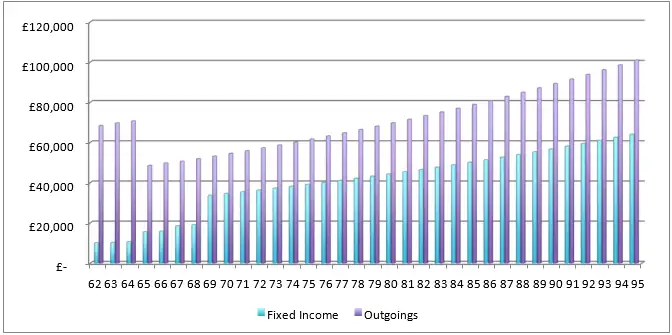
This chart demonstrates drawing down the income shortfall from their investible assets throughout retirement. The chart assumes all funds receive conservative investment returns of 2% per annum.

In summary, I have sought to provide a tax efficient income from investments and pensions by using the various tax allowances. The strategy has a high degree of flexibility to cater for their needs particularly as they settle into their new home which may result in lower outgoings. They need to maintain some savings to act as a reserve in the case of emergencies.
|
Examiner Comments The assignment requires you to provide a detailed recommendation to explain how you would propose to generate the required level of income for the clients in a tax-efficient and suitable manner. This particular assignment is focused on the recommendation process and requires you to demonstrate that you are able to provide a coherent strategy that will meet the client retirement income needs. The mark given to this assignment is 58. Areas where the assignment scored highly include the following:
Areas for further improvement include the following:
|
Looking for support with your AF8 Retirement Income Planning Assignment 3? WorkingMent provides reliable academic assistance to help you understand retirement income planning and complete your coursework effectively. Our CII Assignment Writer can offer guidance with assignment structure, financial planning concepts, and assessment requirements. Students seeking Help with finance assignments can also use our CII Assignment samples for useful ideas on presenting their coursework clearly and professionally.

Get Your Free Academic Quote
No hidden fees · Instant response · 100% confidential

Let's Book Your Work with Our Expert and Get High-Quality Content