OFFERS!
 Get Expert-crafted assignments
Get Expert-crafted assignments
Save 51%
Get Expert-crafted assignments
Looking for Plagiarism-Free Answers for Your US, UK, Singapore, New Zealand, and Ireland College/University Assignments?
Talk to an Expert| Category | Assignment | Subject | Education |
|---|---|---|---|
| University | University of Strathclyde | Module Title | SU902 – Concepts and Theories of Sustainability |
| Academic Year | 2026/27 |
|---|

In Assessment 1, your group presentation analysed a sustainability challenge from a case study, you identified a specific problem (or sub-set of problems) within the challenge, and proposed an intervention. In this second assessment, you will build on that work individually. Your task is to explore how your proposed intervention could be applied in practice, critically reflecting potential pathways of change.
To help you do this, you will use the Three Horizons Framework. You will use this framework to help reflect on your group’s original challenge and intervention proposal and to explore and detail possible transition pathways toward longer-term sustainability.
The Three Horizons Framework is a tool for exploring how current systems (H1) evolve through innovations (H2) towards new paradigms (H3). It emphasises dynamic relationships and co-existence between horizons rather than linear replacement models. As a framework, it helps us to think about the future of a system and how change both occurs and is influenced.
You will individually write a report (2000-words) to discuss this application. Use the details below, of the main activities, plus your own research to help you develop your report:
1. This should be summarised in your own words, do not copy and paste work from the group presentation. Ensure you outline the environmental, social and economic dimensions of your challenge.
Discuss your graph
Using your Three Horizons map/graph that you have created, you may want to discuss the following:
Suggest a Transformation pathway
Using your analysis and development of the Three Horizons Graph for you case study and context – can you identify a pathway forward for a sustainability transformation? Outline this including any relevant information on how it might occur, who is involved, timelines, drivers or inhibitors (etc).
Example Three Horizons Map (simplified for example purposes)
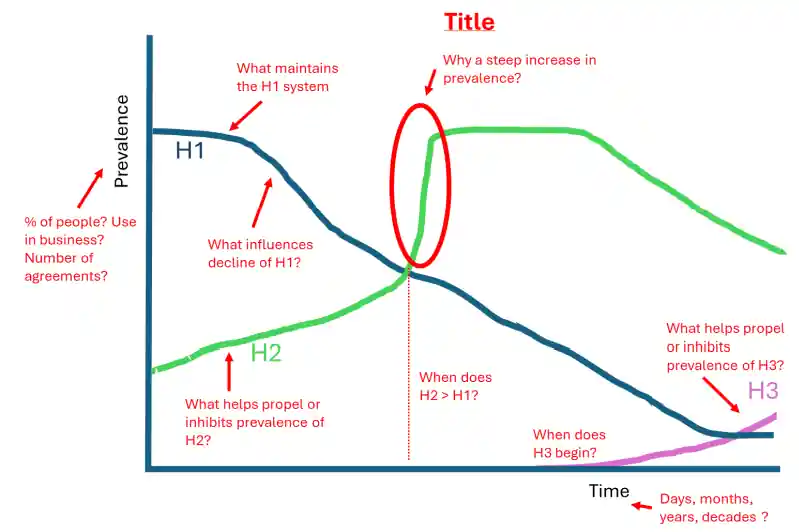
Common report questions:
Tips for your report:
Sharpe, B., Hodgson, A., Leicester, G., Lyon, A., & Fazey, I. (2016). Three horizons: a pathways practice for transformation. Ecology and Society, 21(2). http://www.jstor.org/stable/26270405
Public Health Wales & Future Generations Commissioner for Wales (2020) Three Horizons: A Toolkit to Help You Think and Plan for the Long-Term. Cardiff: Public Health Wales NHS Trust. Available at: https://www.futuregenerations.wales/wp-content/uploads/2020/02/PHW-Three- Horizons_FINAL.pdf
|
|
Criteria |
Marks (/60) |
|
1 |
Introduction and context: · Describe and explain the sustainability challenge and summarise the case study context (environmental, social, economic dimensions). · Identify and analyse how the challenge connects to both local and global contexts. · Present and explain the proposed intervention as appropriate (for example: scope, mechanism, scale, and demonstrate refinement from Assessment 1 feedback). · Integrate any relevant sustainability theories and frameworks (e.g. SDGs). · Evaluate how the proposed intervention addresses the challenge across multiple dimensions of sustainability. |
15 |
|
2 |
Three Horizons Framework Map/Graph · Develop and present a clear, labelled figure (e.g. map, graph) based on the Three Horizons Framework that is tailored to the intervention and case study. · Correctly identify which horizon the proposed intervention most closely represents (H1, H2 or H3) and clearly label this. · Label and illustrate the three horizons with appropriate explanatory elements (e.g. vision outcomes, actors, practices, innovations, system pressures, inhibitors, proponents). Also consider the prominence and timeline axis – adding appropriate explanatory labels where appropriate. · Explain and justify the placement of key features across the three horizons (e.g. cross-over points, graph shape, remaining H1). |
10 |
|
3 |
Discussion and evaluation of Three Horizons: · In reference to your map/figure, define the current H1 ‘system’ regardless of where the intervention sits. (e.g. consider stakeholders, governance, institutions, and existing frameworks.) · Position and justify why the intervention sits within a particular horizon (H1, H2, or H3). · Compare and analyse how the other horizons relate to, or differ from, the chosen intervention horizon. Discuss their relationships in terms of: what the other horizons might look like, their anticipated prevalence, timelines, examples, ideas (etc.). · Evaluate the role of: pressures, levers, drivers, inhibitors, stakeholders, and other appropriate innovations that may shape possible transition pathways. · Critically assess how both the intervention and the pathways for change outlined in the framework map have potential synergies, conflicts, and trade- offs with different SDGs. |
15 |
|
4 |
Defining a transition pathway · A summary ‘transition pathway’ is presented. The pathway presents and explains a clear pathway for transition from the status-quo H1 system to either: your intervention or to another horizon transition. · The transition pathway clearly identifies the relevant change influences and mechanisms. · Critically evaluate your original intervention proposal – discuss any revisions you would make to help aid successful transformation/change. · Critically reflect and evaluate your map to identify any potential; methodological limitations, assumptions, biases, unknowns. |
10 |
|
5 |
Presentation skills: · Organise and structure the report logically and professionally. Report must contain appropriate structure (title page, contents, headings and sub-headings, reference list). · Write and present your work in a clear, concise, and academically appropriate style. · Incorporate and apply any figures, tables, and visuals into your report. Use correct notation and captions. · Evidence and supporting material is correctly cited/referenced (Harvard style). |
10 |
Get Answer of SU902 – Concepts and Theories of Sustainability Assessment 2
Pay & Buy Non Plagiarized AssignmentStruggling with your SU902 – Concepts and Theories of Sustainability Assessment 2 at University of Strathclyde? Get expert Online Assignment Help designed to support your academic success. Our specialists understand the Concepts and Theories of Sustainability and provide well-researched, structured guidance. With reliable Online Assignment Help, you can manage tight deadlines while maintaining high academic standards. We also offer high-quality Assignment Samples Solutions to help you understand the expected format and analysis techniques. Improve your learning outcomes, strengthen your concepts, and submit confidently with professional support tailored to the requirements of University of Strathclyde students. Achieve better grades with confidence.


Hire Assignment Helper Today!
Let's Book Your Work with Our Expert and Get High-Quality Content