Assessment Brief:
Report: Change Strategy and Organisational Transformation Plan for a Vietnamese SME Assessment Overview
In today's dynamic business environment, small and medium-sized enterprises (SMEs) must continuously adapt to survive and grow. This assessment requires you to select a Vietnamese SME and develop an organisational change and transformation plan that addresses key challenges and opportunities within its operating context.
Your report should demonstrate:
- Understanding of change management theories
- Ability to analyse organisational environments and culture
- Application of relevant models and frameworks to propose an effective change strategy
You are required to choose a local Vietnamese small or medium sized enterprise (SME) that operates within Vietnam's national business context. For the purpose of this assessment, you must select a company belonging to one of the following industries:
- Beverage
- Retail
- Pharmacy
- Hospitality/Tourism
- Technology
An SME is defined primarily by its staff headcount:
- Fewer than 50 employees for a small enterprise
- Fewer than 250 employees for a medium sized enterprise
You should choose a real Vietnamese SME that fits within the above criteria and industry scope. Examples of suitable SMEs include but are not limited to:
- A craft beverage shop or local drink brand in Da Nang
- A retail clothing or specialty goods store in Hanoi or Hue
- A family-owned pharmacy in Ho Chi Minh City
- A resort hotel or homestay in Phu Quoc
A small technology startup or digital service provider in HCM or Hanoi
The SME you select will serve as the basis for your analysis throughout the assessment.
Your task is to produce a report upon an action plan (and its approach) relevant to changes your chosen organisation is required to make for its survival in the business field. That is, you will need to describe and analyse both the macro and micro-environment in which the chosen SME operates, point out challenges and opportunities it experiences and suggest a series of changes to be implemented and applied by the firm. For example, suggested changes might be in line to the organisational strategy and leadership, manpower development, daily operations and functions of administrative management, merger and acquisition or expansion, digitalisation of services, marketing campaign and planning, sustainable system of operations, employment regulations' compliance.
Please structure your report according to the following assignment points:
1. Describe and analyse the macro and micro-environment and context within which the chosen SME operates.
2. Describe and analyse the current culture, strategy, technology, operation, stakeholder management... of the chosen SME and comment upon its readiness for change.
3. Propose and justify a change strategy and action plan - supported by specific changes that should be implemented in line with any challenges and opportunities the chosen SME is experiencing given your interpretation from the previous two points.
Your report must address all three assignment points specified in the full assessment brief. Failure to answer any assignment point will result in zero marks for that section.
Your analysis must demonstrate your understanding of the concepts, models and frameworks introduced in the module. All statements should be supported with:
Appropriate contextual evidence and data
Relevant academic literature, including theories and concepts that underpin your arguments All sources must be clearly referenced using the Harvard Referencing System (HRS). Note: Your proposed SME should be approved by your ML.
Guidance Notes
a) Do not include your name anywhere on your assignment.
b) Your assignment should be written in a font size of 12.
c) You must include a correctly formatted Reference List on a separate page at the end of your essay. This must only include references to work that you have directly cited in your essay. d) You must include your accurate word count at the end of your assignment.
e) Use standard margins for the assignment and 1.15 line spacing.
f) Only Microsoft Word files should be used for assignments and only Microsoft PowerPoint files should be used for Presentation assessments. Please allow time for conversion to these formats if required.
g) When you upload your file for submission, you must name the file using your full student number issued by the University.
h) For essays, please do not include any cover sheets, contents pages, or module information in your assignment. Your first page should consist of a title, followed by the first paragraph of your
essay.
i) Students are required to submit their presentation slides on or before the due date published on Canvas by the Exams Office. Slide submission is mandatory for your presentation to proceed as scheduled.
If you are unable to submit your slides by the main deadline, you will have a 7-day calendar late submission window. However, in this case, you must submit an Extenuating Circumstances (EC) form to the Student Information Office, along with appropriate supporting evidence following the EC policy here. Please note:
- The Panel will make the final decision on whether your circumstances are valid. If the Panel accepts the EC, the student will be graded normally, but in case of rejection, the student's final grade shall be capped to 40 marks for that component of the assignment as a late submission penalty.
- If the student fails to submit the EC form, the late submission penalty will apply.
- Failure to submit presentation slides at all will be treated as non-submission and will result in a mark of zero, even if you attend and attempt the presentation.
j) For submissions requested as a report, you may wish to include a cover sheet and contents page. k) The marking scheme that will be used to mark your work is shown at the end of this document in Appendix 1.
Submission Procedure
You are not required to print and submit a hard copy of your work, as all submissions are carried out electronically through Canvas. Please ensure you do not wait until the last minute to carry out your submission; computer problems can happen any time and this will not be accepted as an excuse for late submission. This includes internet connectivity issues. When you submit your assignment, it is in your best interests to save and/or print a copy of your online submission receipt to prove that you have submitted your assignment on time.
If you feel that you can't submit your assessment on time, you should speak to your module leader who will help you to work out how you can hand-in on time.
If unexpected circumstances that you could not have planned for have happened, you may be able to claim for exceptional circumstances to be taken into account. There is more information here.
If you have no exceptional circumstances and you do not submit you will fail the assessment. If you submit within 1 week of the submission deadline we will mark your work as late, meaning the maximum mark you can achieve is the basic pass mark and this will count as your first attempt. If you are taking a re-sit assessment, late submissions will not be accepted.
Please see the Staffordshire University regulations here for more information.
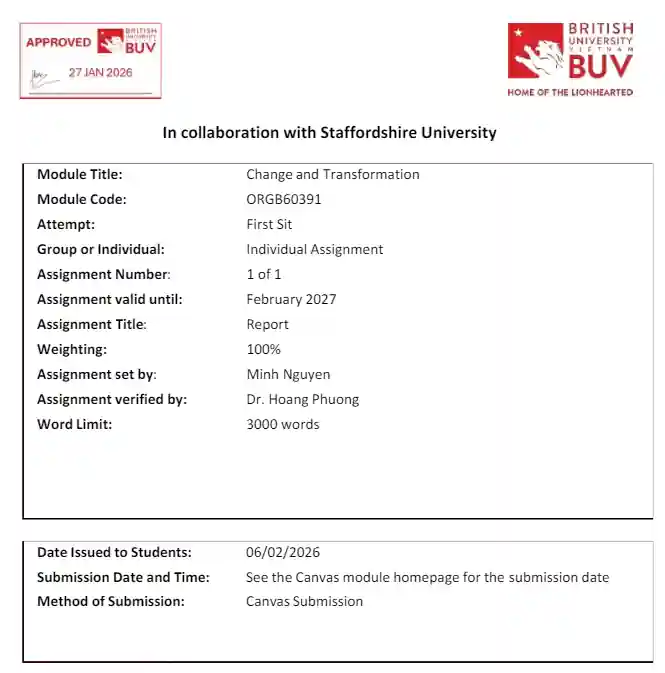
The Maximum word limit is shown on the front cover of the assignment.
You must provide an accurate word count at the end of your assignment. This word count must be placed before your reference list and should include all the written content of your assignment excluding the words used in any cover pages, contents pages, titles, sub-titles, reference lists and appendices.
In the assignment, in addition to the word limit, you may make sensible use of tables, images of academic models, diagrams, figures, and student-created graphics such as Word-Art, etc. without penalty up to a maximum of 30% of the stated word limit of the assignment as shown on the front cover. In no circumstances must your overall use of words in these tables, models, etc. exceed this maximum 30% limit. If a marker feels that you have used tables simply to avoid the word count, they may count these words as part of your word count.
A sliding scale of penalties for excess length will be imposed according to the amount by which the limit has been exceeded.
1-10% excess no penalty
11-20% excess 10% reduction in the mark
21-30% excess 20% reduction in the mark >30% excess
the work will be capped at a pass i.e. 40%
NB. None of the above penalties will be used to change your mark that is above the pass mark, to one that is below the pass mark. Therefore, the maximum penalty for exceeding the word limit will be a reduction to a pass grade.
Please note that students' work is regularly checked to ensure that the stated word count matches to what has actually been submitted.
ORGB60391 Appendix 1: Marking Rubric
| Descriptor and percentages |
0-39% Fail |
40-49% Pass (3rd) |
50-59% Pass (2:2) |
60-69% Pass (2:1) |
70%+ Pass (1st) |
| Introduction and SME Context (10%) Clarity of SME choice, justification, purpose and scope of report |
SME not clearly identified. No justification for choice. Purpose unclear. Poor writing. Inappropriate or undocumented AI use. |
SME is identified but justification is weak. Introduction lacks clarity or structure. At times inappropriate AI use. |
Adequate introduction with basic SME context and defined purpose. Reasonably appropriate AI use but not documented. |
Clear and focused introduction. Strong justification for the SME and outline of the report. Mostly appropriate AI use but not fully documented. |
Excellent, engaging and well structured introduction with clear rationale for SME choice and clear direction. Fully appropriate and documented AI usage. |
| Macro and Micro Environmental Analysis (25%) Use of frameworks and evidence to analyse external and internal environments |
Does not make reference to any theories appropriate to the question. Content covered is inappropriately chosen or incorrect. Inappropriate use of AI and does not follow AI guidelines. None is stated in appendix. Significant mark reduction. |
Makes some reference to relevant theory. Content covered is reasonably appropriate but there may be omissions or inaccuracies. Very basic macro/micro analysis. Weak use of models. Limited relevance to SME. At times inappropriate use of AI. Does not follow AI guidelines. None is stated in appendix. Some mark reduction. |
Satisfactory use of frameworks with some relevant analysis. Limited integration of theory and evidence. Reasonably appropriate AI usage for assignment guidelines. AI usage is not stated in appendix. Some mark reduction. |
Competently includes a range of theories demonstrating some wide reading and understanding around the subject. Strong and well supported analysis using suitable models, with clear links to SME issues and opportunities. Generally appropriate level of AI usage according to assignment guidelines. AI usage is not entirely stated in appendix. Some limited mark reduction. |
Confidently uses a selective range of theories and models relevant to the discussion. Excellent, insightful contextual analysis using multiple frameworks effectively. Strong, up to date evidence and clear strategic relevance. Appropriate level of AI usage according to assignment guidelines. AI usage clearly stated in AI appendix. |
| Organisational Diagnosis (Culture, Strategy, Technology, Operations, Stakeholders) (25%) Depth of internal analysis and assessment of readiness for change |
Almost entirely descriptive content, with limited application of examples and selected alternative models or theories. No evidence of independent thought. Inappropriate use of AI and does not follow AI guidelines. None is stated in appendix. Significant mark reduction. |
Discussions linked to models and theories with occasional error, along with selected alternative research. Little attempt to integrate theories and concepts to produce an effective analysis. Some descriptive content features. Weak use of models. Readiness for change barely addressed. At times inappropriate use of AI. Does not follow AI guidelines. None is stated in appendix. Some mark reduction. |
Adequate organisational analysis using some frameworks. Discussions linked to models and theories accurately. Some evidence of integration of theories to produce an effective analysis. Reasonable but basic evaluation of readiness. Reasonably appropriate AI usage for assignment guidelines. AI usage is not stated in appendix. Some mark reduction. |
Discussions linked to models and theories with confidence and evidence of integration of theories. A number of similarities and differences recognised and integrated with good use of theories or models. Strong organisational diagnosis with effective theoretical integration. Clear links between culture, strategy, processes and readiness for change. Generally appropriate level of AI usage according to assignment guidelines. AI usage is not entirely stated in appendix. Some limited mark reduction. |
Excellent critical analysis with strong evidence of evaluation. Insightful diagnosis demonstrating deep understanding of organisational dynamics. Strong integration of multiple theories. Comprehensive readiness evaluation. Appropriate level of AI usage according to assignment guidelines. AI usage clearly stated in AI appendix. |
| Change Strategy and Action Plan (25%) Quality, feasibility, and theoretical justification of proposed transformation |
Very little evidence of wider reading. Action plan missing or unrealistic. No link to analysis. No use of change models. Inappropriate use of AI and does not follow AI guidelines. None is stated in appendix. Significant mark reduction. |
Some evidence of wider reading. Basic recommendations with weak justification. Minimal theoretical application. Poor alignment with SME context. At times inappropriate use of AI. Does not follow AI guidelines. None is stated in appendix. Some mark reduction. |
Reasonable change strategy with some use of models (Lewin, Kotter, ADKAR etc.). Action plan present but lacks detail or structure. Reasonably appropriate AI usage for assignment guidelines. AI usage is not stated in appendix. Some mark reduction. |
Clear, well justified change strategy aligned to earlier analysis. Strong use of models. Action steps, timelines and stakeholder clarity outlined. Generally appropriate level of AI usage according to assignment guidelines. AI usage is not entirely stated in appendix. Some limited mark reduction. |
Highly strategic, innovative and feasible transformation plan. Excellent use of multiple change models. Robust sequencing, risks, stakeholder engagement and KPIs. Appropriate level of AI usage according to assignment guidelines. AI usage clearly stated in AI appendix. |
| Research Quality, Academic Writing, Structure and Referencing (10%) Quality of sources, clarity of writing, logic, coherence and use of Harvard referencing |
Poor quality or inappropriate sources. Weak structure. Frequent grammar errors. Incorrect or missing references. Inappropriate AI use. Significant mark reduction. |
Basic structure. Limited academic reading. Some referencing inaccuracies. Writing lacks clarity. At times inappropriate. Does not follow AI guidelines. Some mark reduction. |
Brief conclusion, with a tendency to repeat the question sets. Adequate structure and writing. Meets minimum academic requirements. Mostly correct referencing. AI use not documented. Some mark reduction. |
Well organised, clear and academically sound writing. Good use of academic and contextual sources. Accurate referencing. Some limited mark reduction. |
Excellent writing quality, coherent structure, strong integration of academic and industry sources. Appropriate level of AI usage according to assignment guidelines. AI usage clearly stated in AI appendix. |
| Conclusion and Integration of Findings (5%) Ability to synthesize insights into a coherent, logical conclusion aligned with analysis |
No conclusion or irrelevant closing section. No synthesis of key ideas. Inappropriate AI use. Significant mark reduction. |
Basic or descriptive conclusion. Minimal connection to analysis. At times inappropriate use of AI. Does not follow AI guidelines. None is stated in appendix. Some mark reduction. |
Adequate summary of the main points but lacks strong integration. Reasonably appropriate AI usage for assignment guidelines. AI usage is not stated in appendix. Some mark reduction. |
Clear summarisation with some synthesis. Demonstrates understanding of key findings and implications. Generally appropriate level of AI usage according to assignment guidelines. |
Excellent, well synthesised conclusion showing insight and coherence. Appropriate level of AI usage according to assignment guidelines. AI usage clearly stated in AI appendix. |
 Get Expert-crafted assignments