|
This module is assessed entirely by Individual Coursework prepared by students independently (unsupervised).
This coursework is designed to test the module learning outcomes as set out in section 3 of the Module Guide:
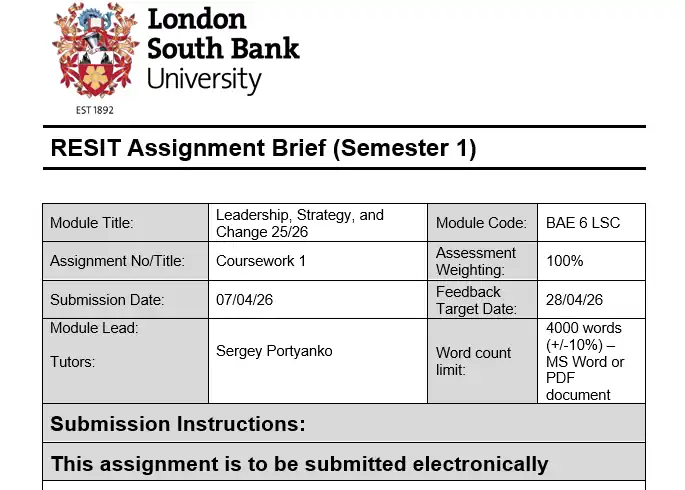
You will write a 4,000-word (+/- 10%) analytical management report in which you use theory from the module to review organisation’s strategic change initiative in British Airways with the focus on the management and leadership practices in the company during the change project.
You are expected to use theory from the module to analyse the business context in which the organisational strategic change was initiated, assess the impact of emerging trends from the macro-environment, and draw out the examples of leadership practices as factors for the success in the change initiative. If you can find and use relevant theory from sources other than the module textbooks in addition (not in replacement) to using the frameworks studied on the module, this will enhance your grade.
In the report, you can demonstrate your comprehension of the intended learning outcomes (highlighted by italic font in this paragraph) by collecting and critically analysing secondary data information connected to the company’s strategic change project. You can do this by addressing one or several of the following aspects of a particular change initiative: Identify and analyse the internal and external influences on organisational objectives and strategy, and the relevance of creativity and innovation in business that triggers and enables change in the company.
Additionally, you can [c]ritically evaluate the need for flexibility in strategic management and the practical limits of quantifying corporate strategy. In your reflections on the change initiative, you can [e]xplain and critically analyse the concepts of leadership and management and their application in an organisational, social, environmental and multicultural context[s]. Analysing the progress and/or results of the change initiative, you can [a]ssess the relationship and the need for compatibility between strategic management and functional management policies, using the theoretical frameworks that explain strategy as a practice phenomenon. In the discussion on the practical implementation of the contemporary theoretical frameworks, you can [d]emonstrate self-awareness of change management strategies to support the business in gaining competitive advantage.
This is an academic management report, not an essay. The theory must be applied, not described or explained in this report. There are no marks for describing theories, discussing their origins or development, or critiquing them.
You need to demonstrate your ability to produce a structure for your report that is relevant to the context and the analysis done in your study. The structure needs to reflect the logic and the process of your critical assessment of the strategic change in the organisation.
You are expected to use theory from the module to analyse the strategic change initiative of the business you examined.
You are expected to reflect on the strategic challenges that the organisation is/was facing. Make sure your assumptions on the potential challenges are clearly rooted in the previous analysis. You need to provide factual information on a strategic change initiative that is to respond to the challenge introduced by the shifts in the organisation’s strategic positioning. You may also introduce an analysis of how the business’s structure and culture were reshaped during the change.
We want to know what you think – and why you think it. You are expected to produce your own structure, analysis, and draw your own conclusions. If your conclusions are extracted entirely from what you have read from secondary sources, then you cannot expect more than 30% of the available marks, however thorough and well-referenced those sources may be.
You should focus on recent material from reputable sources such as newspapers, business magazines and academic journals. Use of the organisation’s official website, official corporate materials e.g. Annual Report and Accounts and publications are also recommended. The use of the University’s databases is strongly encouraged. If you do not know how to use them, then please seek guidance from the library staff. For good-quality research, you should aim to reference around 20 separate factual articles. As a general rule, you are expected to show mature judgment in choosing your data sources, just as you would if your own or your employer’s money was at stake.
Your mark will be lower if you use:
- Outdated information. The strategic environment moves fast, and anything that is more than 3 years old is unlikely to be current. We would expect the majority of your factual references to be from 2023-26, and to be drawn from newspapers and magazines. The publication cycle for refereed journals means that any factual data that they contain is often several years old. Note, if the strategic change within the organisation has occurred in the last decade, older information may be relevant.
Unreliable sources (e.g. collections of generic templates and essays on particular disciplines) can undermine the credibility of your document. Avoid these unreliable sources of information or inspiration.
All factual sources should be properly referenced using the Harvard referencing system. The references for theory taught on the module or for theory drawn from textbooks on the module reading list are also invited, but cannot replace the references to the secondary data sources.
Please ensure that the sources you cite actually say what you claim that they say. We check, and we shall disregard any factual material for which the cited source is not accurate – even if the facts are correct!
The upper word count limit for this assessment is 4,400 words. The following are excluded when computing the number of words:
- Cover and contents pages
- Executive Summary
- Headings
- Footnotes
- References
- Tables and appendices.
Anything after the 4,400th word will be ignored when assessing your mark.
General marking criteria:
In marking your work, we shall be looking for:
- Accuracy in your choice and use of theory. You should not use theory developed for, say, the analysis of an industry to analyse the behaviour of an individual firm. You should also be careful and accurate in your use of the individual elements of a model or framework; this may mean checking the textbook or lecture to make sure you know what terms mean in that specific context;
- Rigour. Your arguments must make sense. You must use the theory to structure the facts you have researched, and then draw conclusions that follow logically – even if they show the company in a poor light;
- Insight. You should look beyond describing what is happening in the organisation or industry, and strive to identify the root causes; the theory is there to help you;
- Creativity and originality. In both your diagnosis and your proposals, you should look beyond what is obvious. You should also feel empowered to go against common wisdom. The articles you read may have views about the industry or organisation you are analysing – you do not have to agree with them, or with the views of the organisation’s managers.
|
 Get Expert-crafted assignments