OFFERS!
 Get Expert-crafted assignments
Get Expert-crafted assignments
Save 51%
Get Expert-crafted assignments
Looking for Plagiarism-Free Answers for Your US, UK, Singapore, New Zealand, and Ireland College/University Assignments?
Talk to an Expert| Category | Assignment | Subject | Programming |
|---|---|---|---|
| University | Auckland Institute of Studies | Module Title | SOFT708 Mobile Applications Development |
This assignment is worth 30% of the total marks in the course and will cover the following learning outcomes as listed in the Course Outline:
| Tasks | Description | Max Marks |
|---|---|---|
| 1 | Defining Scope of Application | 8 |
| 2 | Develop and Implement Android Application User Interface (UI ) | 25 |
| 3 | Android Application Feature and Functional Requirements | 22 |
| 4 | Application Specific requirements | 13 |
| 5 | Other application requirements | 10 |
| 6 | Technical Manual-Install and configure the Android application development environment | 12 |
| 7 | Application Demo | 20 |
| Total Marks | 110 |
Scenario: In this assignment, you must develop a stand-alone native Android mobile application. Select one from the following application lists. First-come-first serve approach will be used.
| 1. ToDo List for a Student at AIS | 13. Schedule Appointment for a clinic |
|---|---|
| 2. ToDo List for a Lecturer at AIS | 14. Loan/Mortgage Calculator |
| 3. Borrow Books at AIS Library | 15. Money Transfer |
| 4. Place Food Order at AIS Cafeteria | 16. Shopping Transfer |
| 5. Notify students of the release of course results | 17. Finding the shortest path for driving in Auckland |
| 6. Vote for PM and Party to run NZ Government | 18. Generate Timetable for AIS Trimester |
| 7. Point of Sale (POS) for AIS Cafeteria | 19. Customer ID Tracking System (scanning) |
| 8. Inventory App for AIS Cafeteria | 20. Tour Guide App for a tour guide or tourist |
| 9. Enrolment at AIS | 21. Photo Gallery for business usage |
| 10. Driving Test in NZ | 22. Quiz App for Kotlin Programmers |
| 11. Learning Mathematics for Kids | 23. Survey App for Student Evaluation |
| 12. Colour Guessing App for Kids | 24. Real client application or any app not in the list |
Before starting to develop the application:
Note:
You must pick your Android Mobile Application carefully. It is much easier and fun to work on an application that is interesting and meaningful to you.
Submission1.
1. Write down the title and introduction of your application. (2 marks)
(Appropriate Title @ 0.5mark, Introduction @ 1.5 marks)
2. Provide a list of functions that will constitute the application scope. Provide a short description of each function. (2 marks)
(list of functions @ 1 marks, description @ 1 marks)
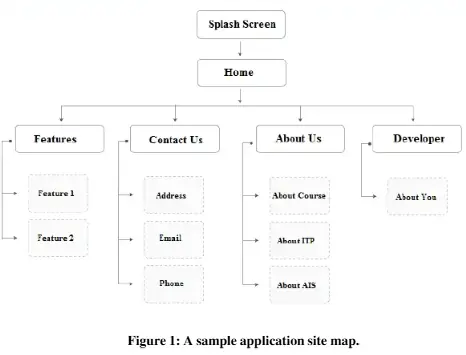
3. Create a site map of your application. A sample of an application site map is illustrated in Figure 1. A sample Application site map and user interfaces.(2 marks)
(site map @ 1 mark, clarity and user-interfaces @ 1 mark)
2. An activity diagram drawn using Visio. (2 marks)
(activity diagram @ 1 mark, clarity and valid@ 1 mark)
4. All documentation must be in Microsoft Word.
Note:
You will create an Android Application User Interface using a declarative and programmatic approach that will provide the needed functionality for the user to do their work. The Android User Interface includes Android Widgets. You can use the traditional UI development (XML file) or the new UI development technology, JetPack Compose. You can use Java or Kotlin if it works for you.
UI requirements (16 marks)
The exact appearance and functionality of your UI are up to you. The only requirements are documented below.
Use at least eight (8) appropriate Android widgets, for example, Buttons, Labels, Radio Buttons, Check Boxes, and Menus. (2 marks)
(0.25 marks for each Android control/widget – maximum of two marks)
Use at least eight (8) Android activities or fragments. (2 marks)
(0.25 marks for each Android activity/fragment – maximum of two marks)
Use at least two different layout managers, for example, Constraint Layout, Linear Layout(Horizontal), Linear Layout (Vertical), Frame Layout, and Table Layout, or any of the legacy layouts. (2 marks)
(1 mark for each different layout – maximum of two marks)
Ensure user-friendly design. A design that is genuinely confusing or hard to use (at the lecturer’s discretion) will not receive full credit. (10 marks)
(Well-organised controls @ 4 marks, professional look and feel – e.g., use of listview, scroll bars, resources etc. @ 3 marks, Correct navigation @ 3 marks)
Event handling requirements: (9 marks)
Incorporate at least three different events, e.g. on Click, on Long Click, on Focus Change, on Key, on Touch, on MenuItem Click(9 marks)
(Three events @ 3 marks each)
Features requirements: (10 marks)
Your application should have the following features: (1) an image gallery and (2) a Google map. (Each feature @ 5 marks)
Other functional requirements: (12 marks)
Include the following functionalities: (1) splash page, (2) dial a phone number, (3) send email or text,(4) browse a website.
(each functionality @ 3 marks)
This includes specific requirements based on your chosen application. These 13 marks will be distributed to the particular/features of your choosing. For example, if your application is a Mortgage calculator, then 13 marks will be awarded based on:
(Requirements are met @ 3 marks, Navigation @ 2 marks, Efficient use of functions@5marks, Display output in a meaningful manner@3 marks)
Make sure that:
You should follow best practices for application development: for finding the best practices for application development, you may consider:
You can further search for the best application development practices. A sample article that discusses best application development practices is given below:
Blair, L. (2018, March 28). 17 Top Mobile Development Practices. Retrieved May 15, 2019, from
https://buildfire.com/top-mobile-development-practices/
(Application development practice is followed @ 5 marks, Application development practices includebut are not limited to - Application is complete (as agreed scope), Application is error-free, Application is secure, Application follows consistent design)
Your application should follow the best coding practices: To find the best coding practices, you may visit various websites, such as those given below, or discuss with your lecturer for guidance.
Guzel, B. (2011, March 30). Top 15 Best Practices for Writing Super Readable Code. Retrieved
May 17, 2019, from https://code.tutsplus.com/tutorials/top-15-best-practices-for-writing-super-readable-code--net-8118
Sun Microsystems. (n.d.). Naming Conventions. Retrieved May 17, 2019, from
https://www.oracle.com/technetwork/java/codeconventions-135099.html
(Application coding practice is followed @ 5 marks, Coding practice may include but is not limited to - Commenting & Documentation, Consistent Indentation, Avoid Obvious Comments, CodeGrouping, Consistent Naming Scheme, Limit Line Length)
Prepare a step-by-step technical manual for installing and configuring the development environment for Android applications. This manual must contain the following:
(Prerequisites @ 2 marks, where to get the development kit@ 1 mark, Installation, and configuration procedure with necessary screen shots@ 4 marks, Simulator configurations@ 2marks, Other necessary packages @ 1 mark)
Technical Manual Formatting Requirement
1. Application demo: A 15 to 20-minute application demonstration is required in the submission week.
In the demo, you need to record a demonstration of your application and briefly explain its functionality.
You may include the following points:
(Using the marking criteria below)
| Category | Criteria | 4 – Excellent | 3 – Good | 2 – Fair | 1 – Poor |
|---|---|---|---|---|---|
| Content structure / ideas | Focus/Scope | Purpose of demonstration is clear from the outset. Supporting ideas maintain clear focus on the topic. | Topic of the demonstration is clear. Content generally supports the purpose | Demonstration lacks clear direction. Big ideas not specifically identified. | No focus at all. Audience cannot determine purpose of demonstration. |
| Content structure / ideas | Organization | Student presents information in logical, interesting sequence that audience follows | Student presents information in logical sequence that audience can follow | Audience has difficulty following because student jumps around. | Audience cannot understand because there is no sequence of information |
| Language and Delivery | Eye Contact | Holds attention of entire audience with the use of direct eye contact, seldom looking at notes | Consistent use of direct eye contact with audience, but often returns to notes | Displays minimal eye contact with audience, while reading mostly from the notes. | No eye contact with audience; entire demonstration is read from notes |
| Language and Delivery | Elocution | Student uses a clear voice so that all audience members can hear demonstration | Student’s voice is clear. Most audience members can hear demonstration. | Student’s voice is low. Audience has difficulty hearing demonstration. | Student mumbles, speaks too quietly for a majority of audience to hear. |
| Language and Delivery | Time Management | Students start and finish demonstration in time, | Students start demonstration in time and could not finish in time, | Students could not start demonstration in time but they finish in time, | Students could not start and could not finish demonstration in time, |
| Technical | Knowledge | Demonstrate clear knowledge and understanding of the OOP concepts | Show clear knowledge and understanding of most of the OOP concepts | Show some knowledge and understanding of the OOP concepts | Show no knowledge and understanding of the OOP concepts |
| Technical | Application features | Demonstrate working of all the required features in applications | Demonstrate working of sufficient features in the application and others not working | Demonstrate working of some features in the application and others not working | Demonstrate features but not working. |
| Technical | Questions | Responded very well to technical questions | Could answer most technical questions related to the demonstration | Could answer some technical questions related to the demonstration | Could not answer any technical questions related to the demonstration |
Buy Answer of SOFT708 Mobile Applications Development Assignment
Order Non Plagiarized AssignmentIf you are preparing for the SOFT708 Mobile Applications Development Assignment at the Auckland Institute of Studies(AIS) and need guidance, our academic experts are here to support you. We provide reliable Programming Assignment Help that follows university guidelines and focuses on clear, well-structured content. Our experienced writers ensure that every solution is easy to understand and properly researched. With our trusted Assignment Help UK, students can complete their assessments with confidence and meet tight deadlines. You can also check our Free List of Assignment Samples Examples to understand the correct format and improve your assignment writing skills.


Hire Assignment Helper Today!
Let's Book Your Work with Our Expert and Get High-Quality Content