| Word Count |
2,000 words (+/-10%) |
| Assessment Title |
Assessment 2 Individual Reflective Report |
| Academic Year |
2026 |
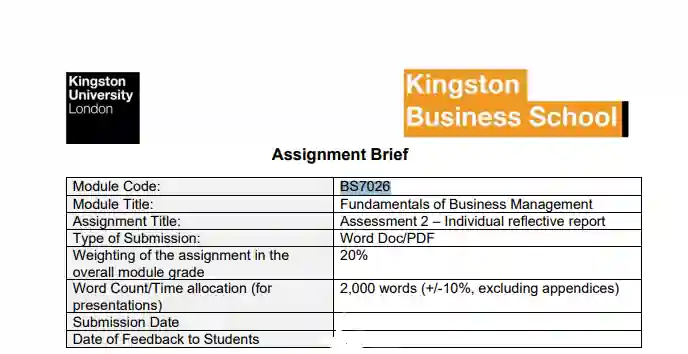
BS7026 Fundamentals of Business Management Assessment 2
Assignment Task\ What is Expected
You are required to write a reflective report to demonstrate your understanding of key marketing concepts and your ability to interpret financial data in a real business context.
Assessment Criteria
- Demonstrates a thorough understanding of marketing concepts and their application.
- Provides accurate interpretation of financial data and links it to business decision- making.
- Uses evidence effectively to support analysis.
- Shows critical reflection and integration of theory with practice.
- Clear structure, professional presentation, and correct referencing.
Part A – Marketing Analysis (Approx. 50% of report)
1. Select an organisation of your choice (this could be a previous employer, a well- known company, or a case study organisation).
2. Analyse the organisation’s marketing orientation and discuss how it contributes to
business performance.
Consider:
Market analysis and research
Marketing planning processes, Implementation of marketing strategies, Control and monitoring mechanisms
3. Critically reflect on how these marketing activities support organisational goals, using relevant marketing theories and frameworks eg. Marketing mix
4. Include examples and evidence from your research or organisational data to support your analysis.
Expected Outcome: You should demonstrate a clear understanding of how marketing decisions and processes impact organisational performance.
Part B – Financial Data Interpretation (Approx. 50% of report)
1. Using publicly available or provided financial data for your chosen organisation, analyse key financial metrics such as:
Revenue, profit margins, and costs
Balance sheet, cashflow or other performance indicators
2. Interpret the significance of these metrics in the context of business decision-making using examples from your chosen business.
3. Discuss how financial data informs strategic and operational decisions, including marketing initiatives.
4. Where possible, link your financial analysis to the marketing decisions discussed in Part A.
Expected Outcome: You should demonstrate your ability to interpret financial information and explain its relevance to organisational strategy and decision-making.
Academic references and/or business study examples must be used where relevant to demonstrate a greater understanding of the subject.
You need to cite sources you are drawing on throughout your submission and have a reference list, both using the Harvard convention. You can use Cite Them Right Online to help. https://www.citethemrightonline.com
Please note that data and words in the Appendices are not included in the word count. The Appendix may include anything else that might be helpful for the reader to know, yet not needed in the main body of the report.
N.B. This is not the place to put irrelevant information or use because you've gone over the word count. Essential information needs to be included in the main body of the report. Whatever you include in the Appendices must be referred to in the main body of the report.
Further Information About This Assessment
1. Further Information
All assignments must be submitted by the date and time specified above.
You are required to submit an electronic Word doc/PDF copy of your completed assignment via the Assignments section of Canvas and follow any specific instructions. Any change to this instruction will be advised via Canvas.
Work that exceeds the word count (inclusive of the 10% buffer) will not be marked.
In line with University Regulations, coursework submitted up to a week late will be capped at 50%. Coursework submitted after this time will receive 0%.
2. Learning Outcomes
The following module learning outcomes are being tested in this assessment:
1. Demonstrate an understanding of the key marketing concepts and how organisational performance can be enhanced by a business’s marketing orientation and the roles of analysis, planning, implementation and control in the marketing process.
2. Demonstrate interpretative skills in relation to key financial data and its use in business.
3. Graduate Attributes
The following graduate attributes will be developed in this module:
| Attribute |
How this attribute is covered |
| Adaptability |
Showing how to match research and analysis with business needs |
| Enterprising |
Choosing an interesting company to discuss and evaluating different outcomes and possibilities |
| Questioning Mindset |
Showing how theory can be related to business decision-making |
4. Marking Criteria and Rubric
Your submission will be marked against the following marking criteria:
| Specific Criteria |
Weighting/Marks Available |
| Marketing Analysis – demonstration of marketing orientation using relevant frameworks |
25% |
| Financial Interpretation – using metrics linked to specific initiatives and outcomes |
25% |
| Integration and reflection – show an understanding of how frameworks and metrics are used in decision-making |
20% |
| Evidence shown with academic frameworks plus links to business outcomes |
20% |
| Clarity of presentation and report writing style: The structure of the content, standard of English expression, use of Harvard business referencing and presentation on the page. |
10% |
| Students are encouraged to check their work in the Academic Success Centre |
|
| |
Total = 100% |
5. Can I use Generative AI (GAI) as part of this Task?
Default use of GAI: You are permitted to use Generative AI for the following purposes:
- Support spelling, punctuation and grammar.
- Support ideation where the ideation is not intrinsic to, or a focus of, the assessment.
- Create a structure or outline for the assignment.
- Support research for the assignment (identifying sources, searching).
- Take the role of a constructive critic.
- Aid understanding.
- Produce media artefacts to support the assignment where the artefacts are not intrinsic to, or a focus of, the assessment.
- Perform basic image/media editing encompassing cropping, noise reduction, sharpening, enlarging, compression, changing format type and adjusting lighting.
- Additional purposes for this assessment only
- Please note: all of the core writing, creativity, arguments, analysis and reasoning must be your own.
For further details on this GAI Assessment category, please see:
Student Guide to GAI at Kingston University 2025/6 in the Digital Learning and Tools module in Canvas (Generative AI section).
6. Academic Integrity and Avoiding Misconduct
Guidance on avoiding academic assessment offences such as plagiarism and collusion can be found in the Digital Learning and Tools module on Canvas – see Academic Integrity.
When you write an essay, report or dissertation, you should always cite the published sources to which you quote, refer to or use as evidence; otherwise, you are likely to be committing plagiarism, which is a form of academic misconduct with potentially very serious consequences. References need to be made both within the text and in a list at the end.
The aim in doing this is to ensure that somebody reading your work can easily find these sources for themselves. This applies to whether you are using a book, a report, a journal article or an Internet site. You will probably know from your own experience how much easier it is to find a reference when a reading list or bibliography is unambiguous. There is help available from the library and online, including a range of videos such as those given below:
https://mykingston.kingston.ac.uk/library/help_and_training/Pages/referencing.aspx.
http://www.citethemrightonline.com/basics
Do remember you can submit your work as many times as you like before the final deadline. It is a good idea to check your Originality Report and ensure that any potential plagiarism is eradicated from your work by rewriting in your own words and referencing correctly. The FBSS ASC (see section will be able to advise on this and on all aspects of academic writing.
7. Groupwork and Misconduct
Work submitted by a group is the responsibility of the group as a whole. In the unfortunate event of the work being judged to have been plagiarised, the only circumstance in which it is possible that the responsibility for the misconduct would only fall on the group member who actually committed it, would be if there were clear evidence that that member had dishonestly misled the rest of the group as to the source of their contribution. This would require clear and contemporaneous evidence of group discussions of the sort which should be available if groups follow the advice given about keeping a log of group proceedings. If the group work is simply allocated amongst the members of the group without any sort of group review of the outcomes, then all the group members are taking on themselves the risk that some element of the work is tainted by academic misconduct. If you are unclear about any of this, you should refer to the University’s guide to Plagiarism for further explanation.
8. Mitigating Circumstances
In case of illness or other issues affecting your studies, please refer to the University Mitigating Circumstances and Extensions Regulations. Please note that once you have submitted your work, you have judged yourself fit to undertake the assessment and cannot usually claim mitigating circumstances retrospectively. Please refer to the Mitigating Circumstances Regulations for more information.
9. Academic Skills Support
For help and advice on this assessment, please contact the assessment setter/s or the module leader. For advice on academic writing and referencing, please contact the FBSS Academic Success Centre (ASC).
To access support, you first need to join the Canvas module: Enrol in the Academic Skills Centre
Trained staff and students will give you guidance and feedback on assessments. FBSS ASC staff can be contacted by email: FBSSasc@kingston.ac.uk.
 Get Expert-crafted assignments