KD6010 Assessment Brief
Instructions on Assessment:
- Using the Simscape®/Matlab® software package, construct the example network shown in Figure 1.Throughout this work, refer to the Simscape® User Guide [1], maintain a logbook to record your progress,and save all simulation results.
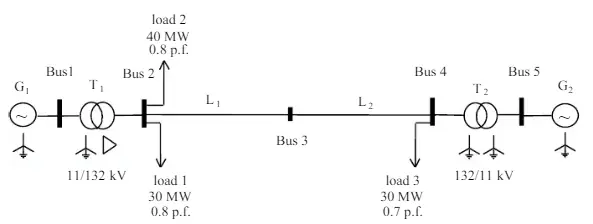
Figure 1. A single-line diagram of the power network.
- This isindividual assignment.Each student must submit a report of no more than 20 pages (includingdiagrams, table of contents, and references). The report should include computer printouts and responsesto the specified tasks. While you may collaborate on developing the network model, the report must beyour own original work. Copying from peers constitutes academic misconduct (see the respective sectionat the end of this document).All sources must be properly acknowledged and cited.
- Submit the report (including the results of the network modelling) via Turnitin on the module E-LearningPortal no later than 23:59 on Friday 23rd January 2026.
- Email all simulation files for the network model to zhiwei.gao@northumbria.ac.uk. Group them in a singlefolder and clearly label it with your name and the module code/title. Note: only the coursework submittedvia the official route will be marked; the e-mailed files are for verification/checking purposes only.
Mapping to Programme Goals and Objectives
The aims of this coursework are to:
- Gain an understanding of how software packages are used for power system modelling, including diagram (dynamic model) development, load flow analysis, balanced and unbalanced fault analysis, power system protection, and state and transient stability studies.
- Design power protection relays, harmonic filters, and load-sharing strategies for cost minimisation, supported by simulation-based validation.
- Enhance learning by linking theory and analytical methods to computer-aided techniques for system analysis and problem solving.
Learning Outcomes (LOs):
- LO1: Critically understand power systems theory and techniques associated with operation, design, simulation, and analysis. (AHEP4: C1)
- LO2: Formulate numerical methods and principles for power system design and analysis, and perform fault-level calculations and/or transient stability studies. (AHEP4: C2, C4)
- LO3: Critically analyse control of power systems with respect to active and reactive power, voltage levels, economic load dispatching, and stability. (AHEP4: C2, C4)
- LO4: Analyse disturbances in power systems and their effects on quality of supply and stability, recommending appropriate design solutions. (AHEP4: C4, C5, M5)
Module Specific Assessment Criteria and Rubric
Tasks
- Build a model of the power network using Simscape. Simulate and record voltages, voltage angles, currents, and current angles. Provide qualitative comments. (10%)
-
Two busbars are interconnected with a reactance XXX.
Given:
Va=Vb∠−δV_a = V_b \angle -\deltaVa=Vb∠−δ
Derive expressions for active power (P) and reactive power (Q). Verify results through simulation. (10%)
- Calculate fault currents for:
- Three-phase-to-ground fault
- Double-phase-to-ground fault
Compare with simulation results. (10%)
- Fault occurs at 0.1 s on Bus 4.
Design:
- Circuit breakers
- Overcurrent relay scheme
Compare system performance with and without protection. (10%)
-
Economic load dispatch using incremental fuel cost functions:
λ1=0.08P1+22\lambda_1 = 0.08P_1 + 22λ1=0.08P1+22 λ2=0.01P2+13+N\lambda_2 = 0.01P_2 + 13 + Nλ2=0.01P2+13+N
Compute optimal dispatch and simulate in Simulink. (10%)
- Design a high-pass harmonic filter supplying 8 MVAr at fundamental frequency. Determine L, C, and R. (8%)
- Industrial estate load demand analysis and transformer selection. (8%)
Daily Load Demand Table
| Time (hours) |
0–8 |
8–10 |
10–11 |
11–13 |
13–17 |
17–24 |
| Demand (MW) |
2.0 |
3.0 |
4.0 |
3.0 |
2.5 |
1.5 |
Determine generator G1G_1G1 operating conditions using equivalent circuit. (10%)
- Calculate load voltage and percentage regulation using short-line theory. (12%)
- Determine critical clearing time for a temporary fault at Bus 2. (12%)
References
- Matlab & Simulink: Simscape User Guide
- Lecture notes (Blackboard), 2025
- Power Systems Lecture Notes – M. Jovanovic, 2025
- Electric Power Systems – Weedy et al., 2012
Appendix: Parameters of Power Network Components
- Generator G1G_1G1: Slack generator, 1∠0° p.u., frequency 50 Hz
- Transformer T1: 11 kV / 132 kV, 200 MVA
- Lines L1 & L2: Positive sequence parameters given
- Transformer T2: 132 kV / 11 kV
- Generator G2G_2G2: PQ type, P=60P=60P=60 MW, Q=50Q=50Q=50 MVAr
Performance Assessment Table
| Task (LOs) |
Technical Objectives |
Weighting |
Bloom’s Level |
| Task 1 (LO1, LO3) |
Model construction (8%), Analysis (2%) |
10% |
6 |
| Task 2 (LO1, LO3) |
Power flow expressions (4%), Factors (3%), Validation (3%) |
10% |
1–3 |
| Task 3 (LO2, LO4) |
Fault calculations (4%), Comparison (4%), Explanation (2%) |
10% |
1–3 |
| Task 4 (LO2, LO4) |
Protection design (4%), Simulation (4%), Analysis (2%) |
10% |
4–5 |
| Task 5 (LO3) |
Load dispatch (3%), Simulation (2%), Analysis (2%) |
10% |
4–5 |
| Task 6 (LO4) |
Filter design (2%), Capacitance (2%), Assumptions (2%) |
8% |
6 |
| Task 7 (LO3) |
Transformer selection (2%), Analysis (3%), Justification (3%) |
8% |
6 |
| Task 8 (LO3) |
Derivations (6%), Calculations (4%) |
10% |
4–5 |
| Task 9 (LO3) |
Voltage calculation (1%), Regulation (1%) |
12% |
6 |
| Task 10 (LO2) |
Pre-fault angle (3%), Equation (3%), CCT (7%), Time (2%) |
12% |
6 |
 Get Expert-crafted assignments