| Category |
Assignment |
Subject |
Computer Science |
| University |
University of South Wales |
Module Title |
CS3S662 Robotics and Autonomous Systems |
| Word Count |
2000 Words |
| Assessment Type |
Asynchronous Assessment |
| Assessment Title |
Morse Reading Robot |
| Academic Year |
2026 |
CS3S662 Robotics and Autonomous Systems Assessment Brief
Assessment Description
Context
In his seminal work “Vehicles”, Braitenberg (1984) discusses a device that stores information in the tracks it leaves on a beach.
To physically implement this vehicle would require:
- The ability to control movement to make the appropriate tracks.
- The ability to read back the information using a suitable suite of sensors. This, in turn, requires that the device show sufficient control to accurately follow the tracks.
Morse code is a well-known digital encoding method for text-based messages. The nature of Morse means it would be a suitable way to store a message: It has a small character set, and the characters are generally easily distinguished.
The assessment task requires you to implement part of this Braitenberg vehicle’s behaviour, reading existing tracks. The messages are encoded as coloured bars on a paper roll, which can be placed on the floor.
Task
You are required to program a LEGO EV3 robot to read a Morse message. To achieve this, you are provided with:
- Preconfigured Lego EV3 robots available in the lab.
- Tracks printed on paper that have Morse encoded messages.
- GEARS EV3 simulator and example simulation worlds. These may be used to develop ideas and help answer the questions below.
The robots in the lab are provided in a suitable configuration. No construction is required. If using GEARS to help develop ideas or for further investigation, use the default configuration or build a more accurate simulation of the lab robots. Avoid the temptation to create simulations that “fix” hardware issues. It may be harder to conclude when comparing devices of arbitrary complexity.
Along with programming the robot and translating the Morse message, you are required to provide an explanation of your programme in a formal report and to demonstrate the robot working within the lab.
Your report should also discuss:
- How do the physical constraints of the robot affect your programme? What physical issues did you experience? Were these overcome? How? Where issues remain, you should discuss how these might be addressed.
- How a simulation differs from reality and what issues you might expect if implementing code developed in simulation on a physical robot. You should identify any issues you have experienced or can anticipate to support this discussion.
- Why simulation might be used in the development of cybernetic systems.
- How simulations can be verified.
Please see Appendix One for further specification of the problem. Additional materials on Morse code are included in the assessment resources section of BB
Deliverables:
You are required to submit:
1. A formal report that records your achievement of the requirements given above. This report will include:
- An explanation of your programme, which covers the design and interesting implementation details
- A discussion of the testing strategy.
- The analysis and discussion as outlined above.
- A clear statement of the message(s) encoded in the final Morse test.
2. A demonstration of the robot operating. Demonstrations will be performed in the timetabled workshop sessions before the submission date.
3. Your code is presented in a suitable format. This may be linked to the text of the report, where tools such as GitHub have been used. Or should be placed in a suitable form in an appendix.
Individual Working
Although you are encouraged to discuss solutions and approaches with your peers as part of the learning process, it must be clear that the work you submit is wholly your own.
Guidance on Format of Assessment
Note: Students are reminded not to include this assignment brief with the assignment submission
Your report should be in a formal style. Video elements must be in a format easily viewed on University computers. References will be in Harvard format. Images should be referenced from the text and provided with titles/captions.
Learning Outcomes Assessed
To demonstrate a deep understanding of the prevailing technologies associated with the development of robotic & autonomous systems and synthesise robotic solutions to specified problems within the ethical and commercial context.
Ensure that you address the grading criteria provided, the level descriptors and the module learning outcome.
Marking Criteria/Rubric
Note: All grades are provisional until they are ratified by the exam board. Please see Appendix Two. For the table of grading criteria.
Submission Details
- Submit Report to Blackboard
- Demonstrate your robot in the lab before the submission date.
- Create a video recording of your demonstration and upload it to the correct “assessment” folder in Panopto. This ensures that all markers and moderators can view the material.
- Provide a link in your report submission to the Panopto video to ensure they are linked.
https://gov.wales/sites/default/files/publications/2018-02/level-descriptors.pdf Note this module is at level six [6]
Available in the module definition document: https://curriculum.southwales.ac.uk/Module/Details?moduleId=MOD008946
There have been issues with Panopto over the last academic year. If you cannot upload to Panopto, submit your video to the report submission link.
- If using, provide a link to the repository, such as GitHub you have used for your code. Please ensure this is public so all assessors and moderators can view the material.
Failure to submit to the correct folders may result in your work being treated as a not being submitted.
What Happens Next?
Your marked assessment should be available 20 working days after submission. However, please be advised that this may be subject to change in the event of Bank Holidays, University Closure or staff sickness. If there is something about the feedback you have been given that you are unclear about, please see your module tutor.
Your Assessment Queries
Any queries about this assessment should be brought to the practical sessions or asked on the module forum. This ensures all student receive the clarification.
Formative Assessment Opportunities
The workshop exercises provide a significant number of formative assessment opportunities to support this work.
Student Checklist
- Does the report address all the required elements as specified?
- Is the video of the demonstration uploaded to the correct folder?
- Is your student number included in the video filename?
- Is a link provided to the video and any repro used for code, on the cover of the report?
Appendix One: Detailed Requirements
You are required to produce a LEGO Mindstorms EV3 solution to decode a Morse Code message.
The program must include the following features and functionality:
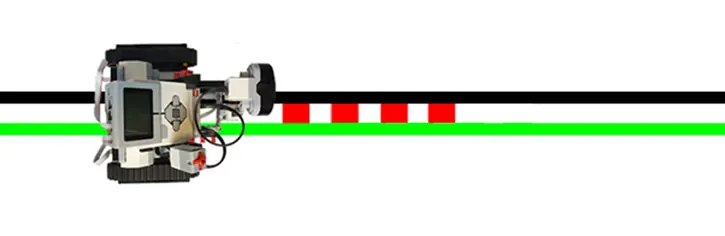
- The decoding robot must follow a white and red pattern, representing a message encoded using Morse Code (International standard) . The message pattern will be bounded by two coloured bars (Figure 1).
- The robot must utilise the light sensor to detect the colours present.
- The robot must only start moving when the button is pressed
- The message pattern may start with either a “dot” or a “dash”. The robot must use this first mark and/or the associated inter mark space to determine the size of one Morse Code time unit and the size of any subsequent encoding metrics. Consider how you might accommodate messages with a different mark width (dot duration).
- Appropriate white spacing will be employed to represent inter-character spacing and the spacing between neighbouring dots and dashes.
- The message pattern will be terminated by: “end of message” marker respecting the Morse Code (International) standards or by the boundary of the environment.
- The message must be displayed on the robot’s screen. Other methods of conveying the message may also be investigated and employed, but these must be in addition to using the screen.
- The implementation may assume that the message pattern is valid and does not contain errors such as invalid spacing. Be aware, however, that some messages include a calibration mark in addition to the message.
- Proximity sensors must be used to control the progress of the robot (such as avoiding an object placed before the robot).
Appendix Two: Marking Scheme
| |
Significant Weakness (<30) |
Fail (30 - 39) |
Satisfactory (40 - 49) |
Good (50 - 59) |
| Design (30%) |
Very poor. The report and implementation demonstrate no significant understanding of the requirements as reflected in the design. There may be no evidence of any design process being followed |
Poor. The report and implementation demonstrate a lack of understanding of the requirements as reflected in the design. Poor application of a design process |
The design demonstrates some understanding of the requirements and that a reasonable approach to addressing these has been followed. There may be some elements of the design that are insufficiently developed or unsuccessful |
The design demonstrates some understanding of the requirements and that a reasonable approach to addressing these has been followed. The design also indicates that an understanding of wider issues of the implementation has been addressed. There may be some unsuccessful elements in the design |
| Functionality (30 %) |
The implementation does not successfully address the functional requirements in any meaningful way. If the robot is demonstrated not to perform any significant element of the task successfully |
The implemDo you need support with your BUS3003NFC Academic Skills Practice Assignment? Our easy and friendly Assignment Help is here to guide you through every topic. You can use our clear ssignment Examples and Samples to understand how to structure your work and improve your learning. With reliable Assignment Help UK, you get simple explanations, helpful tips, and study guidance to boost your confidence. Make your assignment journey stress-free—learn better, understand more, and move forward with success!entation may address some of the functional requirements, but this may be a minority. Alternatively, all functionality may be included but not integrated into an operational whole. The major functional elements can be demonstrated to some extent. Though these may be individual. |
The implementation addresses the majority of the functional requirements, but there may be poor or no integration. There may be shortcomings in the achievement of some of the functions. The implementation can be demonstrated, perhaps with various elements demonstrated independently. Significant elements work successfully. |
The implementation addresses the majority of the functional requirements. However, these elements may not be fully integrated. There may be minor shortcomings in a minority of the functions. The implementation can be seen to operate via demonstration. |
| Review and Analysis (40%) |
The work demonstrates little understanding of the issues of implementing the device in line with the functional requirements. Poor or missing review of the completed work. Little evidence for an understanding of the requirements of robotic solutions. |
Some indication that the requirements are understood and can be discussed, but these may be a minor part. There is a poor review of the work. A broad awareness of issues is provided. |
The report demonstrates an understanding of the assessment task and can place the task into the context of the device. There may be shortcomings in this understanding. A review has been performed. This review will be shown to address some issues experienced. |
The report demonstrates an understanding of the assessment task and can place the task into context. There may be minor shortcomings in this understanding. A review has been performed. This review will be shown to address some issues. There may be some consideration of alternative approaches. |
 Get Expert-crafted assignments